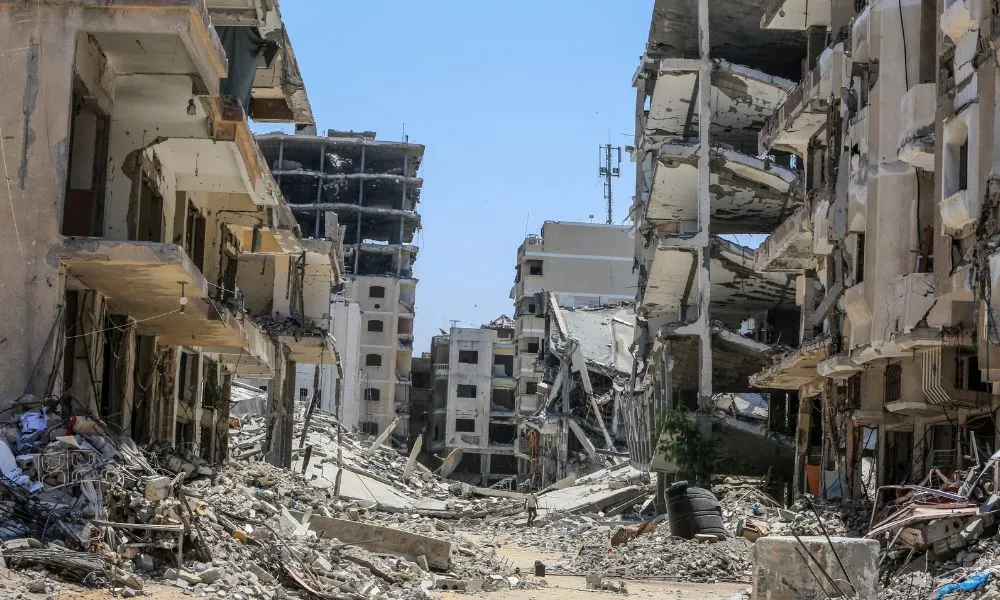



The US negotiator Jared Kushner, son-in-law of President Donald Trump, held a rare meeting with Hamas' chief on Sunday as part of a renewed diplomatic push to revive the stalled Gaza ceasefire, the Associated Press reported. Kushner is due to meet Israeli Prime Minister Benjamin Netanyahu on Monday, days after Netanyahu rejected the 15-point, US-backed road map in what AP described as a rare public act of defiance against Washington. The talks are aimed at salvaging a plan under which Hamas would disarm and Israel would withdraw from Gaza, more than 10 months after the ceasefire ended major fighting in the territory, where around 2 million people remain, according to AP.
The more than two-hour meeting in Egypt with Hamas' Khalil al-Hayya was confirmed by a regional official and a Hamas official, both speaking to AP on condition of anonymity because they were not authorised to talk to reporters. Kushner was joined by fellow envoy Steve Witkoff, with officials from mediating countries Egypt, Qatar and Turkey also present, AP reported. In a statement, Hamas called on mediators and the US-created Board of Peace overseeing the ceasefire to compel Israel to approve the road map. According to the Hamas official cited by AP, the group said it remains committed to the plan and is waiting for mediators to open a 14-day negotiation period to set an implementation timetable, a period that requires approval from all parties before it can begin. The same official said Hamas' leader has demanded that Israel halt its attacks on Gaza and withdraw to the so-called yellow line dividing the territory, a line AP notes was never precisely defined, before implementation starts. Israeli forces have since moved beyond it and now control around 60% of Gaza, with Netanyahu saying in May that the next step would be to reach 70% control.
Kushner is expected to be joined at Monday's meeting with Netanyahu by former British prime minister Tony Blair and the Board of Peace's director, Nickolay Mladenov, according to two sources speaking to AP on condition of anonymity to discuss a closed-door meeting. The White House referred AP's questions about the talks to the Board of Peace, which did not immediately comment, and the Tony Blair Institute also declined to comment.
Regional powers accuse Israel of blocking peace
Several regional powers, including Saudi Arabia and the United Arab Emirates, along with Jordan, Pakistan, Indonesia and the ceasefire's mediators, issued a joint statement condemning Israel's rejection of the road map, saying Israel "now bears responsibility for obstructing the efforts to bring peace in Gaza." The foreign ministers called on the Board of Peace and Washington to take "immediate and concrete measures" to stop any party obstructing the plan, AP reported.
Under the road map, Hamas would hand its weapons to a Palestinian technocratic committee intended to oversee daily operations in Gaza, though that committee has not yet entered the territory. Hamas has linked the surrender of its heaviest weapons to the creation of a Palestinian state, a demand Israel's current government rejects, according to AP. Netanyahu has said Israel will not withdraw from any position in Gaza until Hamas is fully disarmed, leaving other elements of the ceasefire, including reconstruction and the deployment of international forces, on hold.
Netanyahu faces a general election on 27 October while trying to hold together a coalition that includes ministers who favour a harder line on Gaza, and it remains unclear whether he will take decisive steps on the ceasefire before then, AP reported. The anniversary of the 7 October 2023 Hamas-led attack on southern Israel, which triggered the war, also falls before the election. Netanyahu's Likud party responded to the regional powers' statement by accusing Arab states of seeking to remove Netanyahu so that the centrist challenger Gadi Eisenkot and the centre-left leader Yair Golan would "give them everything they want," adding, "That will not happen."
Source: Associated Press