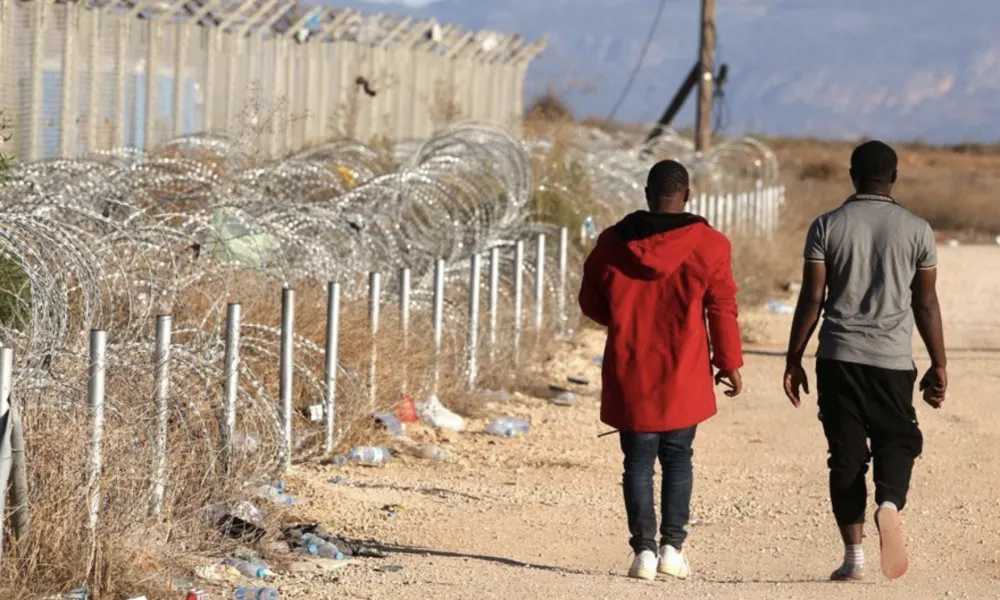

Planning for so-called Return Hubs in third countries is entering its final stretch, with the next steps already mapped out by the "Core Group" of five European countries involved in the initiative.
Return Hubs are facilities intended to operate outside the European Union for transferring and housing people who have no right to remain in the EU and are subject to a return decision. Their operation will depend on agreements with third countries.
According to information obtained by ANA-MPA, the "2nd Munich Migration Meeting" will take place in Munich on 26 September, bringing together 17 European ministers. On the sidelines of that summit, the five Core Group countries, Greece, Denmark, Germany, Austria and the Netherlands, are expected to meet to coordinate the next steps toward setting up the Return Hubs.
The next significant date is 1 October, on the sidelines of the EU's Justice and Home Affairs Council, where Core Group countries are expected to meet representatives of international organisations to further advance the planning and implementation of the Return Centres.
These developments follow a meeting of the migration and asylum ministers of Greece, Denmark, Germany, Austria and the Netherlands in Copenhagen earlier this month. The five countries agreed on a roadmap for the legal requirements and national timelines needed to implement the model, while technical contacts and consultations with potential third countries are already under way.
The key outstanding question is now securing an agreement with a country, or countries, outside the EU willing to host such a centre. To date, however, no specific country has been officially announced as a final partner, nor has any agreement been signed.
What was agreed in Copenhagen
At the ministers' meeting, agreement was confirmed on the core principles of a Framework of Principles for future cooperation with third countries.
According to Greek Migration and Asylum Minister Thanos Plevris, a "specific Roadmap of Legal Requirements and National Timelines" was also agreed, aimed at turning the political agreement into practical planning. "To turn this political will into tangible reality, we agreed today on a specific Roadmap of Legal Requirements and National Timelines," Plevris said after the meeting.
He said technical meetings and consultations with candidate third countries have already begun, expressing the view that an agreement could come soon. "We are particularly optimistic that very soon we will be able to reach a mutually beneficial agreement that will put the model into practice," he said.
Which countries are being considered
The question of host countries remains the biggest open issue. Reports and European sources point mainly to Rwanda and Uganda as the countries at the centre of discussions. The European Parliamentary Research Service has listed Rwanda, Uganda and Uzbekistan as countries that have been mentioned as possible locations for Return Hubs.
The Netherlands had signed a letter of intent with Uganda in September 2025 on cooperation over returns. That planned cooperation was abandoned by the new Dutch government that took office in February 2026, though this does not mean the country has lost interest in the Return Hubs model.
Uzbekistan is a different case. Austria signed an economic cooperation and migration agreement with the country in May 2026, though this did not concern a Return Hub. At the same time, reports have mentioned it as a possible option, although Uzbekistan's Foreign Ministry has said no such negotiations are under way.
Regarding Rwanda, there have previously been discussions involving European countries, including Denmark, over transferring asylum seekers there. Such approaches have in the past drawn criticism over human rights concerns.
What Greece is saying
The Greek government views the Return Hubs model as a tool for strengthening the return of people not entitled to international protection.
Plevris stressed in Copenhagen that Greece ties implementation of the model to strict adherence to legality. "The creation of Return Hubs will be based on absolute legality. This model will operate in full respect of European and international law," he said.
He also linked the initiative to Greece's position at the EU's external border, describing the creation of such mechanisms as a "pressing national need" for Athens. "We cannot allow Greece to become a permanent point of entrapment for those who are not entitled to international protection," he said. Plevris also said the aim is to build a returns system combining legal rigour, strategic planning and cooperation with international organisations.
What the new EU framework provides for
The creation of Return Hubs is no longer just a political discussion. The EU's new returns framework provides for the possibility of setting up such centres in third countries.
The new system concerns people who have no legal right to remain in the EU and are subject to a return decision. The centres could operate either as a final destination or as an intermediate stop before return to a person's country of origin or another third country.
The key condition is that cooperation with the third country must be compatible with EU and international law and must safeguard fundamental rights, including the principle of non-refoulement. At the same time, return decisions remain individual and subject to judicial review.
In any case, critical questions remain open, as the host country or countries have not yet been finalised, nor have the details of how the Return Hubs would operate, their capacity, or their funding. The upcoming meetings in Munich on 26 September and in Brussels on 1 October are expected to mark the next steps, with the aim of reaching agreements.
Source: AMNA