


By Fiona Mullen, Director, Sapienta Economics
The Greek Cypriot and Turkish Cypriot media have been declaring that there will be a new initiative on the Cyprus problem in June or July by the UN Secretary-General, Antonio Guterres. Some have gone as far as to suggest that this will herald the start of new fully fledged negotiations to solve the Cyprus problem, or even an end to the Cyprus problem.
However, if you read statements carefully, it is clear that the aim is to get a “plan” for negotiations by the end of the year. In other words, to agree on wording that can get the negotiations moving again.
So below I am going to concoct an imaginary text that might allow the sides to fudge a way back to the table. For those of you in a hurry, I think it might look something like this. In practice, it might be longer.
The two leaders agreed that the status quo is unacceptable. The objective remains a comprehensive solution in line with political equality as set out in relevant UN Security Council resolutions. The leaders agree to work towards this objective with a sense of urgency in a phased, results-oriented manner, guided by milestones and on the basis of past convergences.
The Cyprob geeks will recognize what has changed or remained the same compared with the landmark Joint Declaration of February 2014, which set out some important convergences (agreements in principle) up to the Crans Montana high-level summit in July 2017; the Berlin statement of November 2019; and the more recent statement of December 2025.
Before I do that, let me lay out the core differences in the current positions of both sides.
Bridging the gap on positions
We start with the challenge that the positions of the two sides (or all sides, if we include certain guarantor powers) on how to get back to the table have been different.
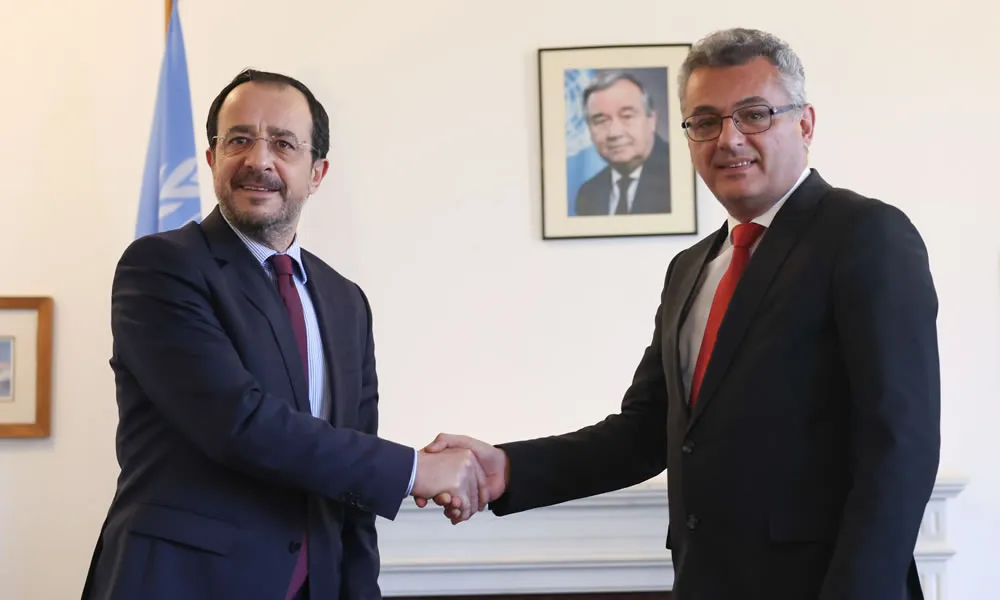
The approach of the president of the Republic of Cyprus and Greek Cypriot leader in the context of UN-facilitated negotiations, Nikos Christodoulides, has been that talks should continue “from where they left off” at the high-level talks in the Swiss resort of Crans Montana in July 2017. Notwithstanding that there is plenty of scope to argue about exactly what had been agreed up to that point, let’s assume that, at the very least, it means the Guterres Framework dated 30 June 2017 and the implementation framework for security. You can find both of those here.
The approach of the president of the unrecognized Turkish Republic of Northern Cyprus and Turkish Cypriot leader in the context of UN-facilitated negotiations, Tufan Erhürman, is not to reject Crans Montana but to insist on four parameters (the Turkish Cypriot insist that these are not “pre-conditions”) for any new round of talks. I have seen the four parameters expressed in various ways, so I am sharing the most succinct I have seen, from fellow Substacker Yusuf Kanlı (numbers added by me):
“…1) political equality, 2) time-bound negotiations, 3) preservation of previous convergences, and 4) protection against returning to the same failed status quo after another collapse.”
Mr Christodoulides’ responded to Mr Erhurman’s four points with five points : 1) reaffirming the basis of a settlement; 2) confirming convergences; 3) a process of the sides confirming those convergences; 4) a formal conference for everyone to confirm the convergences; 5) throwing any talk of crossing points to a five-party meeting.
The Greek Cypriots already de facto got their way on point 5, as it has become clear there will be no more crossing points announced until there is a five-party meeting.
Text for past convergences
How do we get from the 4+5 proposals to a text that everyone can agree on?
Let’s start with convergences. Interestingly, despite the position of Türkiye (Turkey) that two independent sovereign states is the answer to the Cyprus problem, both sides want to preserve previous convergences. This means that a statement agreeing on the preservation of previous convergences should be the easiest for both sides to accept, as long we avoid the rather cumbersome Greek Cypriot proposal for confirming past convergences.
Text for political equality
Acceptable text on political equality is in theory straightforward. Political equality is set out in UN Security Council Resolution 716/1991, which defines political equality with reference to an annex in the Secretary-General’s report of 8 March 1990. Political equality is also written into the 11 February 2014 Joint Declaration, which forms part of the “convergences” (agreements in principle on the basis of “nothing is agreed until everything is agreed”) up to Crans Montana.
It might not be enough for the Turkish Cypriots, who have traditionally wanted to define political equality more closely, specifically: a rotating presidency and at least one positive vote in the Council of Ministers. However, if the Turkish Cypriots and Turkey accept the argument outlined in the abovementioned article by Mr Kanli, that “the current status quo has become strategically unsustainable not only for Turkish Cypriots, but increasingly for Türkiye as well” then they might be willing to be flexible. If we take the wording from the leaders’ meeting in December 2025 then it would be: “The objective remains a comprehensive solution in line with political equality as set out in relevant UN Security Council resolutions.”
Results-oriented and phased process with not return to status quo
Balancing the Turkish Cypriot desire for “time-bound negotiations” with the Greek Cypriot desire to avoid “deadlines” has been done before. In February 2014, the shuttle diplomacy yielded the term “results-oriented”. Let’s assume that this is retained.
Then we get to the trickiest part, namely the Turkish Cypriot request that they do not slip back again, as they did in 2004 and 2017, to their unrecognized status if the process fails, especially if they have negotiated in good faith.
Greek Cypriots fear that any pre-agreed improvements to the Turkish Cypriot status quo regardless of the outcome will incentivize the Turkish Cypriots to mess the process up so that they get a two-state solution, or at the very least, an upgraded status. The proposal by some Turkish Cypriots that might address this fear, namely that an external body (such as the UN) is given the job of deciding who is to blame for any negotiations collapse, seems to me to be a non-starter. The UN did not point the finger explicitly in 2017; this means it never will.
I believe we can get part of the way there with the word “phased”. It was used in November 2019, it implies that there will be stages along the way, and it could, conceivably, mean that each side will get specific, pre-agreed “carrots” if they reach certain milestones.
To meet the Turkish Cypriot desire that they do not return to the status quo, the carrots could come regardless of the outcome. They could be front-loaded (to entice the sides back to the table); back-loaded (to incentivize them to stay at the table); or dependent on milestones (to bake in the “results-oriented” approach). One “carrot-pairing” suggestion doing the rounds is the return of Varosha in exchange for international recognition of the Ercan/Tymbou airport.
However, I have a hunch that “phased” will not be enough for the Turkish Cypriots, not least because it is a phrase that is already seven years old. I have included “sense of urgency”, which also comes from December 2019 but I have also added a new word, namely “milestones”. If the Greek Cypriots reject milestones maybe one could swap “phased” for the slightly stronger “staged”. For the moment, I am keeping milestones.
So there we have it. Taking a bit from the (much longer) 2014 statement on the status quo being unacceptable, we have the following.
The two leaders agreed that the status quo is unacceptable. The objective remains a comprehensive solution in line with political equality as set out in relevant UN Security Council resolutions. The leaders agree to work towards this objective with a sense of urgency in a phased, results-oriented manner, guided by milestones and on the basis of past convergences.
Whether or not such a statement actually leads to anything significant will depend to a large degree on hard-won and probably private commitments on what each of these elements means.
Personally I think a staged approach is also in Greek Cypriots’ interests. There is a desperate need to cut security risks in this region. A phased process makes it more likely that they can get into Schengen, which the Cyprus problem makes difficult; and it makes it less likely that their increasingly close defence relations with Israel, the US and France do not culminate in Turkey drilling in the Republic of Cyprus Exclusive Economic Zone (EEZ) again.
This article first appeared on sapientacyprus.substack.com