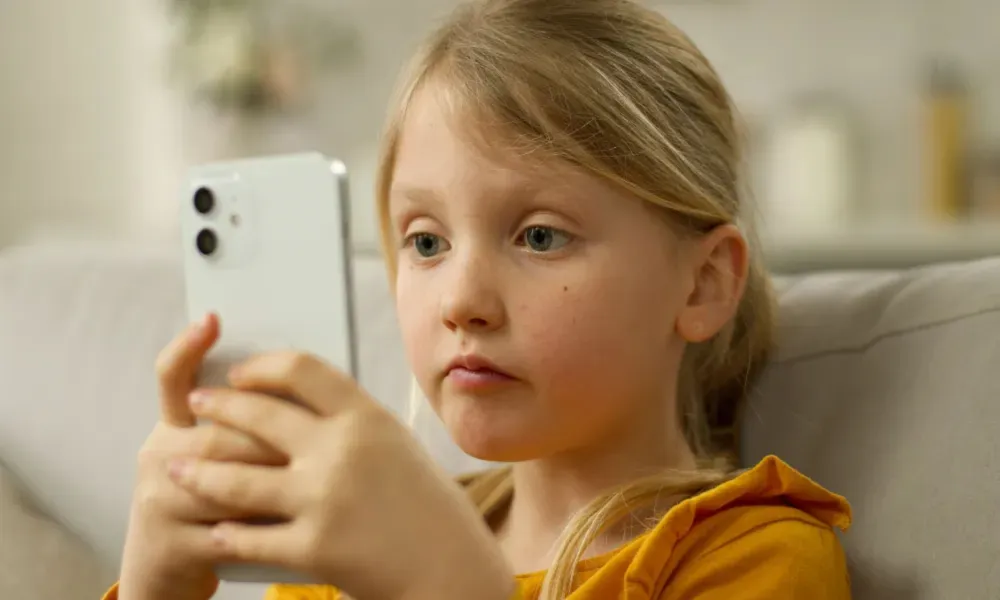

It's Friday night. After a long week at work, a group of friends and I decide to go out for dinner.
At the next table sits a scene that, unfortunately, is all too familiar. A couple in their forties with their young son, no older than six or eight. The father is staring at his phone. The mother is doing the same. The boy is wearing headphones, absorbed in a tablet.
Three people. One table. Three separate worlds.
No conversation.
Until the food arrives.
"Put the tablet away. We're eating now," the mother says.
The boy doesn't react.
"Put it down before I smash it," the father adds.
Still nothing.
The third time, he grabs it from the child's hands.
The result is predictable: shouting, tears and protests.
"I'm not hungry... give it back... I want my tablet... it's mine... you're bad parents," the child screams.
"Be quiet, I can't take any more of this," the father replies.
"If you don't eat, you'll never see it again," says the mother.
The tablet is moved to the other end of the table, and a few minutes later calm returns.
Temporarily.
Then both parents' phones start ringing. One picks up his phone. The other picks up hers. Their eyes return to their screens.
And then comes the most telling line of the evening.
"Why can't I have mine then? Give me my tablet back," says the child, who has already started throwing food on the floor and making a scene.
"Just give it to him and let him be quiet," says the father. Seeing the look from his wife, he adds: "Better that than having everyone listen to this."
The problem was never the tablet.
And it certainly wasn't the child.
The problem was the adults.
Not because these parents were worse than any others, but because scenes like this play out every day, almost everywhere. In restaurants, cafés, playgrounds and living rooms.
We've lost something essential: real connection.
And with it, meaningful communication, with all the consequences that may have for children's wellbeing and their relationship with the world around them, especially with their parents.
Recently, there has been growing debate, including at the European level, about age limits, restrictions and bans on children's screen use.
It is a conversation worth having.
But as long as we focus exclusively on children, we ignore the most important factor of all: ourselves.
Children do not grow up following what we tell them.
They grow up following what they see us do.
You cannot ask your child to put down a tablet when you cannot put down your phone for the duration of a meal.
You cannot tell them screens drive people apart while allowing every notification to interrupt the only hour of the day you might truly spend together.
Technology is not the enemy.
The enemy is the illusion that the problem belongs only to children.
Because if we want them to lift their eyes from the screen, we must first lift our own.