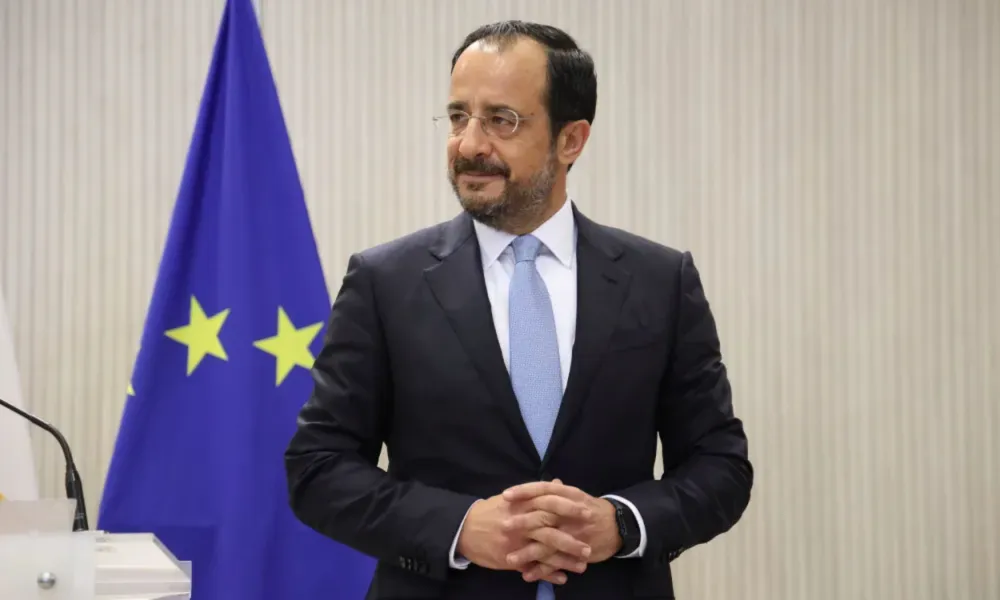

Nikos Christodoulides says he wants the same, but after Crans-Montana, the property prosecutions and repeated nationalist signalling, words are no longer enough. He must show that he is ready for a compromise that will inevitably be uncomfortable for both communities.
The scheduled Aug. 26 meeting between Nikos Christodoulides and Tufan Erhürman should not be judged by whether it produces another carefully worded statement of optimism. Cyprus has accumulated enough declarations of good intent over the decades; what it needs now is evidence that the two leaders are prepared to negotiate toward an outcome rather than merely enter another process.
On that test, the political burden is not equally distributed. Erhürman has already made his choice, while Christodoulides still has to prove that his declared commitment to settlement is stronger than the political instincts and historical baggage that accompanied him through the collapse of Crans-Montana and into the presidency.
Erhürman was elected after rejecting the sterile insistence that sovereign equality and two states must be recognised before negotiations can even begin. He has reopened the possibility of a federal/confederal settlement, insisted that political equality must have substance, called for previous convergences to be preserved and proposed frequent, even weekly, meetings between the two leaders while technical work continues.
That does not mean Erhürman has already made all the concessions that a settlement will require. He will still have to prepare Turkish Cypriots for territorial adjustment, painful property arrangements, compromises over governance and a difficult understanding with Türkiye over security and guarantees, but there is little ambiguity about whether he wants to test the settlement road.
Christodoulides has more to prove.
Crans-Montana cannot be airbrushed away
Christodoulides says negotiations should resume from where they stopped at Crans-Montana in 2017. That is the right starting point, but invoking Crans-Montana also means confronting where and how those negotiations stopped.
He was not a spectator. He was one of Nicos Anastasiades’ closest political advisers and the government spokesman of the administration that walked away from the most advanced Cyprus negotiations in decades, and he was among those who shaped and defended the Greek Cypriot leadership’s political line during the final phase.
I have long regarded him as one of the principal architects of what might be called the Greek Cypriot “helicopter escape” from Crans-Montana. Whether one uses that deliberately provocative shorthand or the more diplomatic description of a failure to take the final political leap, the essential point is the same: when the process reached the stage at which both communities had to swallow genuinely painful compromises, the Greek Cypriot leadership pulled back.
There are competing accounts of who was responsible for the collapse, and history will continue arguing about the final dinner, the guarantees question, rotating leadership, sequencing and who said what. Yet prominent European figures and Greek Cypriot critics have themselves questioned whether the south was politically prepared for the compromises required, especially on power-sharing and effective Turkish Cypriot participation.
Christodoulides therefore cannot simply invoke Crans-Montana as a convenient negotiating starting point while treating his own role in its collapse as irrelevant history. If he wants to persuade Turkish Cypriots that this time is different, he must demonstrate what has changed in his own political approach.
Wanting negotiations is easy
Almost every Cypriot leader says he wants negotiations, peace and reunification. The difficult question is not whether Christodoulides wants another negotiating process, but whether he wants the compromise at the end of it.
If federation means Greek Cypriot majority rule softened by minority protections, there will be no settlement. If effective participation becomes unacceptable whenever Turkish Cypriots can actually influence a federal decision, there will be no political equality; and if rotating leadership remains politically toxic simply because a Turkish Cypriot might periodically head the common state, there will be no genuine partnership.
The same applies to security. If discussions begin from the assumption that every Turkish guarantee, every Turkish military presence and every institutional security link with Türkiye must disappear while Turkish Cypriot fears are dismissed as relics of the past, there will be no agreement.
Compromise is not something the other side does. A viable settlement will contain provisions that Greek Cypriots dislike intensely and provisions that Turkish Cypriots dislike intensely, and if one side returns home declaring complete victory, the agreement will probably already contain the seeds of its next collapse.
Erhürman must prepare Turkish Cypriots for that reality. Christodoulides must do the same in the south, and so far that second part remains unproven.
Nationalist rhetoric carries a price
Christodoulides cannot build a partnership while repeatedly indulging political and historical narratives that deepen Turkish Cypriot mistrust. Greek Cypriots are entitled to their historical memory, including their interpretation of EOKA, but Turkish Cypriots are equally entitled to remember what EOKA and enosis meant to their own community.
A leader preparing society for reconciliation must understand that the same historical reference can sound heroic to one side and threatening to the other. That does not require erasing memory, but it does require a language of leadership capable of recognising the fears and traumas of both communities.
The rise of ELAM makes that task more difficult, but also more necessary. Christodoulides cannot compete with the nationalist right by borrowing its rhetoric while telling the international community that he is preparing a bicommunal federal settlement, because sooner or later those two messages collide.
At some point he must decide whether he wants to reassure maximalists or prepare Greek Cypriot society for compromise. Crans-Montana should have taught everyone what happens when that choice is postponed until the final night.
Property is becoming another battlefield
The property issue is another test of political intent. Greek Cypriot owners retain legal rights, but it is equally unrealistic to imagine that more than half a century of displacement, construction, exchange and demographic change can be undone through criminal prosecutions one property at a time.
Under Christodoulides, the Republic of Cyprus has increasingly pursued developers, estate agents and others connected with Greek Cypriot-owned properties in the north. Whatever the legal basis of individual cases, the cumulative political effect is unmistakable: they create insecurity in the Turkish Cypriot economy and poison the atmosphere in which renewed diplomacy is supposed to take place.
Christodoulides is entitled to say that the judiciary is independent, and of course no democratic leader should interfere with judges or prosecutors. But an increasingly aggressive cross-Green-Line legal campaign cannot plausibly be treated as if it exists in a sterile judicial universe entirely disconnected from the wider political strategy.
Property became one of the central chapters of the negotiations precisely because neither extreme is workable. Not every displaced Greek Cypriot can simply recover every property, and not every present Turkish Cypriot user can simply retain everything unchanged; that is why the negotiating acquis developed criteria for restitution, compensation and exchange, together with an independent mechanism to settle claims.
Property needs a settlement mechanism, not an escalating judicial war. If the two sides genuinely intend to negotiate, they should stop turning the issue into another instrument of political pressure.
Aug. 26 should produce evidence
The Aug. 26 meeting does not need dramatic declarations. It needs evidence that the two sides can move together.
First, the leaders should confirm that previous convergences will be preserved and that settled chapters will not be reopened simply because today’s politicians dislike who negotiated them. Governance, federal competences, EU matters and much of the economic architecture have already been discussed in enormous detail, and there is no reason to rediscover the same formulas for the seventh time.
Second, they should agree on methodology. That means regular leader-level meetings, continuous work by the negotiators, clear sequencing, preservation of convergences and a process that is time-conscious and accountable rather than endlessly renewable.
Third, they should deliver at least one concrete confidence-building measure. Open a crossing, agree on demining or settle another mature practical dispute, because if the two leaders cannot implement something small together there is little reason to believe they can implement a comprehensive federal settlement.
Only then should another 5+1 be convened. The expanded meeting should deal with the genuinely unresolved political core, not repeat every argument conducted since the 1970s.
Cyprus has a balance problem
Cyprus does not primarily suffer from a shortage of constitutional formulas. It suffers from a shortage of sustainable balance.
Greek Cypriots are the numerical majority and cannot be expected to ignore demographic reality, while Turkish Cypriots cannot accept demographic majority being converted into permanent political domination. Internally, therefore, the settlement must combine Greek Cypriot numerical weight with effective Turkish Cypriot participation and safeguards against majoritarian rule.
Externally, the imbalance runs in the opposite direction. Türkiye is the overwhelming regional power and remains indispensable to Turkish Cypriot security, while Greek Cypriots cannot reasonably be expected to live indefinitely under fear of unilateral Turkish intervention.
A settlement has to balance both realities. That means a meaningful Turkish Cypriot role in common decision-making and a security arrangement in which Greek Cypriots no longer fear uncontrolled intervention while Turkish Cypriots do not wake up the morning after a settlement to discover that every tangible security guarantee has disappeared.
The label matters less than the balance underneath it. Federation, decentralised federation, loose federation, confederation or another sui generis arrangement within the UN framework will work only if neither side can dominate the other.
My preference remains a very loose federal-confederal roof bringing together two sovereign and politically equal states, each exercising full authority over its own internal affairs while voluntarily pooling only those limited competences that must be exercised jointly. Rather than a single presidency, the common structure would be headed by a presidential council with rotating leadership, composed on a 2:1 ratio and operating under decision-making rules that require at least one affirmative vote from the other community.
The common roof would possess one international legal personality and provide Cyprus with a single external identity, representing the partnership in the United Nations, the European Union and other international organisations. Beneath that shared international representation, the two states would retain their own political institutions, administrations and extensive sovereign competences, with the common level kept deliberately lean and limited to functions that genuinely require joint authority.
Such an arrangement should not recreate an over-centralised state in which the two communities are condemned to struggle constantly over control of the centre. The common level should be deliberately lean, confined essentially to international representation, EU affairs, agreed aspects of foreign policy, macroeconomic coordination and whatever other functions the two states explicitly decide must be exercised jointly. First cooperation, then constitution should be the guiding philosophy: allow the two sovereign states to build confidence through practical cooperation first, and construct the common federal-confederal architecture around what genuinely needs to be shared rather than forcing both communities into an elaborate central machinery that would simply create hundreds of new issues over which to quarrel.
Compromise is supposed to hurt
This is the truth both leaders need to tell their communities. A settlement will not vindicate either national narrative, restore a vanished past or allow either side to preserve every position it has spent decades calling non-negotiable.
It will not give every displaced Greek Cypriot everything back, nor will it allow every present Turkish Cypriot user to keep everything unchanged. It will not give Turkish Cypriots two sovereign states disguised as federation, and it will not give Greek Cypriots majority rule disguised as federation.
Both communities will have to surrender something important. That is not a weakness of compromise; it is the definition of compromise.
Erhürman appears ready to tell Turkish Cypriots that a settlement requires negotiation, accommodation and Türkiye’s participation in a mutually acceptable security formula. Christodoulides must now tell Greek Cypriots the corresponding truth: political equality will have consequences, power will have to be shared, some cherished positions will have to be abandoned and security must work for Turkish Cypriots too.
That is the real test of Aug. 26. Christodoulides does not need to prove that he wants another round of talks, because Cyprus has had more than enough of those; he needs to prove that he wants the compromise at the end of them.
And if that compromise feels entirely comfortable to either side, it probably will not be a real compromise at all.