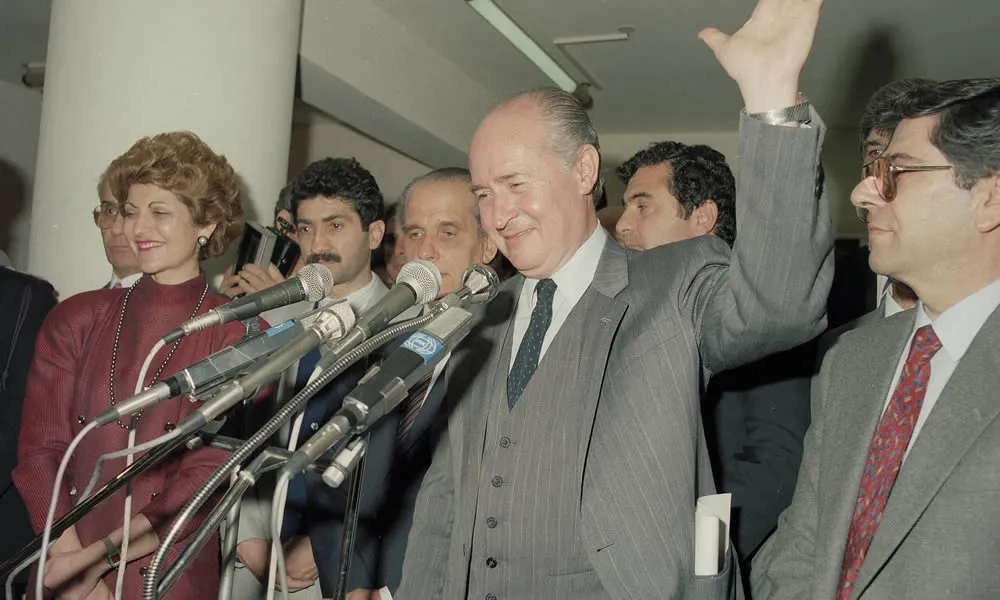

By Michalis Stavrou
Things were not easy when George Vassiliou became President in 1988, nor were any outcomes taken for granted. It was a period when, if you did not read the newspaper Eleftherotypia, you could not expect promotion in the public service. Political monitoring and surveillance were still common practice. If the state broadcaster, then a monopoly, did not begin its news with "The President of the Republic," it was not considered news. It was an era when traffic was halted, ignoring traffic lights, to allow the President to pass in his convoy, which Vassiliou himself described as "fousiekki" in a 2011 interview with CyBC.
It was also a time when establishing a state university was thought to threaten Cyprus's Greek identity, protecting the Akamas peninsula was seen as yielding to foreigners, and computerisation was believed to endanger thousands of jobs. Vassiliou, a technocrat and economist by training, became the first of his kind to assume the Presidency and successfully implement significant reforms, laying the foundations for Cyprus, a state still recovering after 1974, to enter a European trajectory.
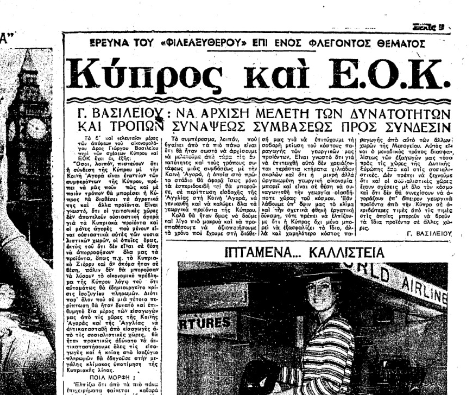
statements by economist George Vassiliou, who argued that Cyprus
should join the “Common Market,” noting that it was the only
way to export the country’s products. (PIO archive)
His passing
George Vassiliou passed away on Tuesday evening at the age of 94. His wife, Androulla Vassiliou, announced his death on social media. She said, "It is difficult to say farewell to this man, who was an exceptional husband and father, a person full of kindness and love for his country and the people of Cyprus. After two years of illness, my beloved George, my life partner of 59 years, quietly passed away in our arms tonight at Nicosia General Hospital."
George Vassiliou had been admitted to Nicosia General Hospital on 6 January 2026 with a respiratory infection. His death prompted an outpouring of condolences from the political community and society at large. In a written statement, President Nikos Christodoulides expressed his deep sorrow, noting that Vassiliou’s name was synonymous with efforts for economic growth, social progress, and the modernisation of the state. He added that Cyprus had lost a statesman who expanded the country’s international presence.
Significant reforms
What characterised George Vassiliou during his five-year term was his decisiveness. "Postponing decisions leads to worse outcomes. I learned this when I was in Hungary, because the longer they delayed making decisions while I was studying there, the more it led to the Hungarian revolution, which ultimately had tragic consequences for the people. That is why I insisted on solving the Cyprus issue, and during my presidency intensive negotiations were held," he said in an interview with the Greek news agency (AMNA) in 2013.
The phrase "solution yesterday" became associated with him during his presidency. On his first visit to Britain, after meeting Margaret Thatcher, a journalist suggested that Greek Cypriots were not interested in a settlement. This led to the famous remark, which Vassiliou explained in 2020 as a way to emphasise Cyprus’ commitment to negotiations and the need for a resolution, regardless of whether the local sentiment fully supported it.
From medicine to economics
Born in Famagusta on 20 May 1931, he was the son of left-wing activist and ophthalmologist Vassos Vassiliou and dentist Fofi Vassiliou. He grew up in Greece until the age of ten, before the family became refugees in 1941 due to the war. He attended schools in Paphos and Limassol, spent a year at the American Academy in Larnaca, and then went to Geneva to study medicine. He interrupted his studies to assist his father, who volunteered as a doctor during the war.
He moved first to Vienna and later to Budapest, where he worked in a factory as a lathe operator. Fascinated by production processes, he earned a scholarship and switched to studying economics, eventually completing a doctorate. He worked as an economist and market researcher for the Reed Paper Group in the United Kingdom. In 1962, he returned to Cyprus and founded the Middle East Research Centre (KEMA), which became a major research and consultancy organisation with offices in eleven countries. He served as president and general director until 1988, when he was elected President of Cyprus.
Presidency and the Ghali Ideas
Vassiliou was actively involved in public life after returning to Cyprus, without formally joining any political party. He served as Vice-President of the Nicosia Chamber of Commerce, was a member of the ATA committee, participated in the Cyprus Employers and Industrialists Federation, and held positions in the State Exhibitions Authority and the Bank of Cyprus. He attended conferences and seminars on economic, social, and political developments.
In 1988, he ran as an independent candidate, supported by AKEL, and was elected the third President of Cyprus. The prolonged deadlock in the Cyprus issue prompted him to lead an active international campaign. Domestically, he restructured the National Council and created a framework for a federal solution supported by political forces, while reviving UN-led negotiations. A turning point came with Boutros-Ghali’s appointment as UN Secretary-General. Vassiliou’s international mobilisation enabled Ghali to present, in 1992, for the first time, a comprehensive set of ideas for a full resolution of the Cyprus issue. In New York that autumn, all aspects of the Cyprus problem, including the return of Morphou, Famagusta, and large villages in Mesaoria, were discussed, but negotiations were blocked by Turkey. Domestically, political forces including DISY, DIKO, EDEK, and the Church opposed the Ghali plan, which influenced the outcome of the 1993 presidential election. In the second round, Vassiliou narrowly lost to Glafkos Clerides, who won with 50.3 per cent against 49.6 per cent.
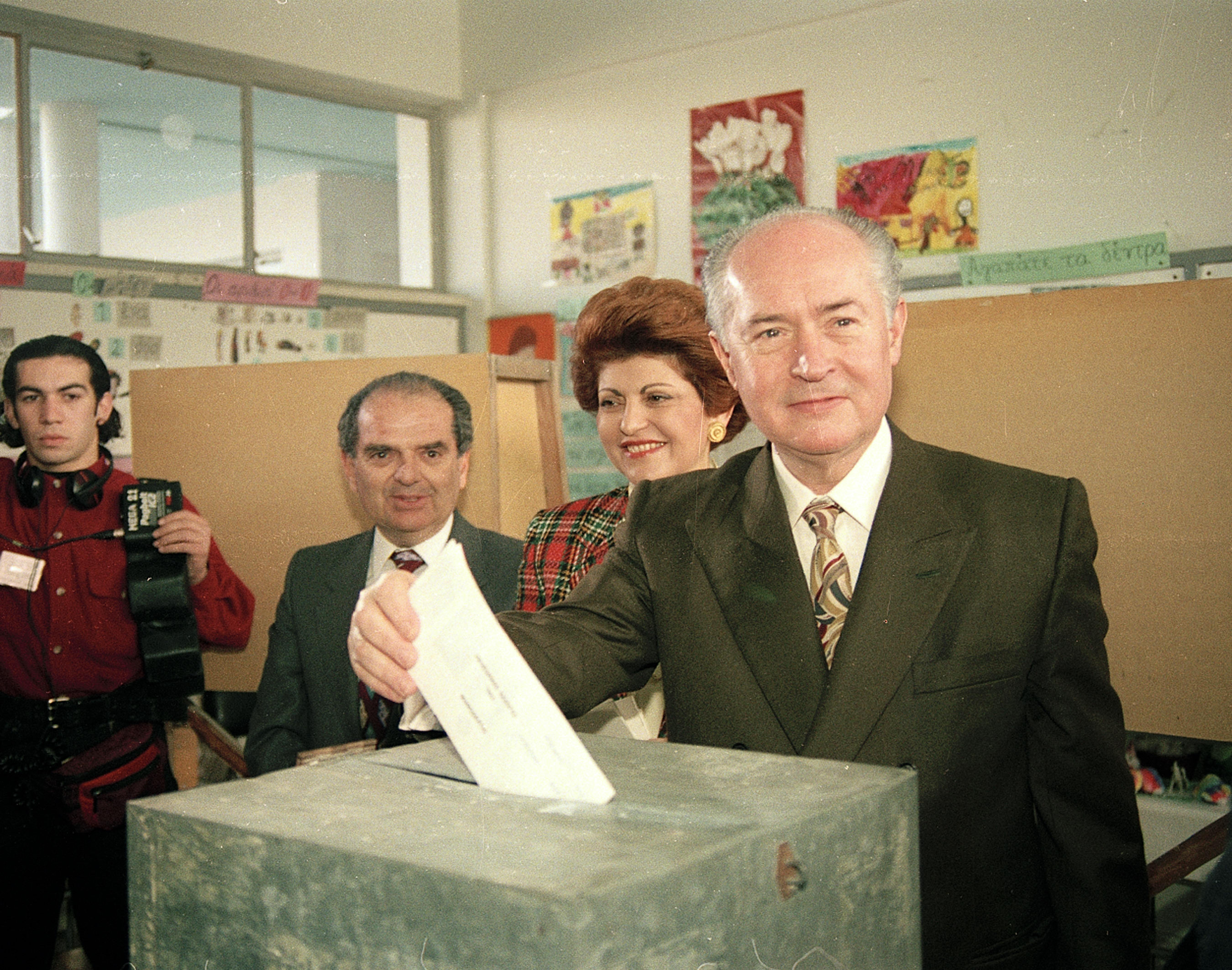
and European Commissioner, and a long-time active figure in Cypriot politics.
Healthy finances
Domestically, Vassiliou implemented major reforms. His new tax reform ensured healthy public finances and economic growth. He championed the end of the state monopoly on radio and television, leading to the launch in 1992 of the first private station, Logos, owned by the Church. The University of Cyprus was established in 1992, despite opposition, and Vassiliou considered this his greatest achievement. He also laid the groundwork for Cyprus’s European Union accession. During his presidency, Cyprus applied to join the EU, and later, under President Clerides, Vassiliou headed the negotiating team for accession, overseeing alignment with EU law. For this work, in October 2002, he received the Grand Cross of the Order of Merit of the Republic of Cyprus, the nation’s highest honour.
CED and MP
After leaving the presidency, Vassiliou remained active in politics. In 1993, he founded the Movement of Free Democrats, which first participated in parliamentary elections in May 1996. The movement later merged with ADISOK to form the United Democrats. Vassiliou served as honorary president and was elected MP for Nicosia from 6 June 1996 to 31 June 1999.
Vassiliou in his own words
-
"I never placed elections or personal ambition above the interests of the country."
-
"Unfortunately, some acted in Cyprus in their own interest rather than for the nation, as was the case with the lost historic opportunity at Crans Montana."
-
"Without a Cyprus-Turkey agreement, there is no solution. Talking about the wrongs the Turks did, which is true, will achieve nothing. A final agreement is necessary."
-
"I achieved a lot during my term. How did we get Resolution 789? I fought continuously, but progress does not happen overnight. If I had been re-elected in 1993, Varosha would have been returned and the Cyprus issue would have been resolved."
-
"A person who says there are no prospects or hope should stop being a politician."
-
"To succeed as President, you must have the courage to challenge the establishment, make decisions, and face political cost. I did not worry about that and lost the elections."
-
"We went through very difficult times with my family, but we never gave up. No matter how hard it gets, you must keep fighting. We cannot say we were defeated or gave up."