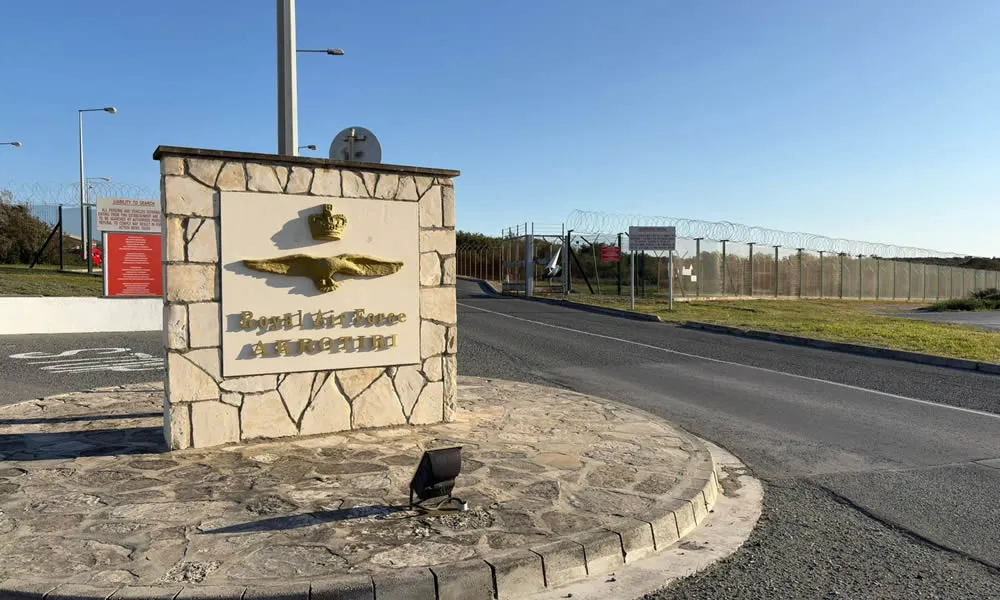

Recent statements by President Nikos Christodoulides and the government spokesperson have brought the issue of the British Sovereign Base Areas back into the public debate. Legal experts warn, however, that any attempt to alter the current framework involves complex legal arrangements, international agreements and political considerations.
A difficult undertaking
Associate Professor of International Law and Human Rights Law at the University of Cyprus Aristotelis Konstantinidis describes the prospect of opening discussions aimed at abolishing the status of the Bases as an extremely difficult undertaking.
Speaking to Politis, Konstantinidis explained that a renegotiation could take several forms. It could involve reducing the territory of the Bases or modifying the terms governing cooperation and coordination between the United Kingdom and the Republic of Cyprus.
According to Konstantinidis, recent security developments may have prompted the renewed discussion. He referred to the drone attack that occurred on the territory of the British Bases and the possibility that the United Kingdom authorised the United States to use the facilities.
In this context, he said, a key issue in any renegotiation could be the conditions under which the Bases are used.
The 1960 agreement
Asked whether the 1960 agreements governing the Bases could be renegotiated, Konstantinidis noted that the Treaty of Establishment involves not only the Republic of Cyprus and the United Kingdom but also Greece and Turkey.
This multi-party structure significantly complicates any legal process. As he explained, this makes renegotiation particularly difficult and introduces a range of legal and political challenges.
For decades, he added, a form of modus vivendi existed regarding the respective rights of the Republic of Cyprus and the Bases. If this balance were to change, particularly in matters affecting the daily lives of citizens, it would raise additional questions.
Changing the terms of use
Konstantinidis said that a possible path forward could be a renegotiation conducted through mutual consent.
Any unilateral attempt to alter the situation would have to follow a legal route that is both highly complex and technically demanding, and therefore unlikely to succeed.
He also referred to a recent advisory opinion of the International Court of Justice regarding the Chagos Archipelago and Mauritius, which described the situation as a colonial remnant incompatible with the principle of self-determination.
However, he stressed that unless a mutually agreed solution is reached with the United Kingdom, any unilateral legal action by the Republic of Cyprus would be complicated and could have political consequences.
For this reason, he said, discussions are more likely to focus on adjusting the terms under which the Bases operate, including their military and potentially non-military use.
The political dimension
Konstantinidis emphasised that the matter remains primarily political.
The key questions, he said, are what changes Cyprus seeks and whether the United Kingdom would accept them. At present, any discussion about potential outcomes remains hypothetical.
He also noted that the United Kingdom has excluded the possibility of unilateral recourse to international courts. One option could be to request an advisory opinion from the International Court of Justice, similar to the approach taken by Mauritius, though important legal differences exist.
Regarding the Treaty of Establishment itself, he said it could only be amended with the agreement of all parties, including Greece and Turkey.
Defining the objectives
Lawyer Achilleas Emilianides also highlighted the importance of clearly defining the objectives of any potential renegotiation.
Speaking to Politis, he said the government must clarify what it aims to achieve so that the results of any negotiations can be properly assessed.
He also cautioned against overstating the significance of the reference included in the conclusions of the European Council in March 2026. According to Emilianides, the European Union simply took note of Cyprus’ intention to open discussions with the United Kingdom and expressed readiness to assist if necessary.
The treaty framework
Emilianides stressed that the status of the Bases cannot be easily altered.
He noted that their current legal framework forms part of the EU treaties, as reflected in the arrangements governing the United Kingdom’s withdrawal from the European Union in 2019.
As a result, any change would require renegotiation. So far, he added, the United Kingdom has not expressed an intention to reopen the agreement.
If negotiations do take place, it remains unclear which specific aspects of the Bases’ operation would be addressed.
The issue of residents
Emilianides explained that renegotiating the overall status of the Bases is very different from discussing specific operational issues.
One possible objective for the government could be improved information for residents in cases where military activity at the Bases may affect the Republic.
Such a demand would be fundamentally different from raising the question of the Bases’ withdrawal from Cyprus.
He noted that past arrangements demonstrate how specific issues can be negotiated without challenging the overall framework.
Non-military development
A notable example is the 2013 memorandum agreed between the Republic of Cyprus and the United Kingdom under President Nicos Anastasiades.
This memorandum allowed for non-military development within areas of the Bases, including economic activity and planning relaxations.
Although it represented a departure from certain original provisions of the 1960 agreements, it was implemented through mutual agreement.
According to Emilianides, negotiations over specific aspects of the Bases’ operation have taken place repeatedly since 1960.
Possibility of confrontation
Another issue, he said, is whether Cyprus would be prepared to pursue a confrontational approach with the United Kingdom.
Such a strategy could involve legal proceedings at the International Court of Justice, similar to the case brought by Mauritius regarding the Chagos Islands, with the aim of pressuring Britain into renegotiation.
However, Emilianides said there is currently no indication that the Republic of Cyprus intends to follow such a path.
Withdrawal scenario
If Cyprus were to request the withdrawal of part of the Bases, Emilianides pointed out that the Treaty of Establishment includes provisions stating that Britain would transfer territory back to the Republic if it were no longer required for military purposes.
So far, however, the United Kingdom has not indicated any intention to relinquish the Bases.
Such a development would not constitute renegotiation of the treaty but rather the implementation of provisions already contained within it.
Financial contribution
Another issue that could potentially be raised concerns the financial contribution Britain provided during the first five years of the Republic of Cyprus.
According to the exchange of letters included in the treaty documents, negotiations were to take place after 1965 regarding the level of this contribution. No agreement has been reached since then.
Emilianides concluded that the government’s recent statements may refer to initiatives similar to those undertaken in the past.
He also noted that a broader political debate is required to determine whether the current moment is the appropriate time to raise the issue.
No new meeting yet with Erhürman
There is currently no confirmation of a new meeting between President Nikos Christodoulides and Turkish Cypriot leader Tufan Erhürman, a United Nations source told the Cyprus News Agency.
The UN Secretary-General’s Special Representative in Cyprus, Colin Stewart’s successor Khassim Diagne, was received by President Christodoulides on Friday and is scheduled to meet the Turkish Cypriot leader on Monday at 11:00.
Regarding María Ángela Holguín, the UN Secretary-General’s Personal Envoy on Cyprus, the same source said there are currently no plans for her return.
During his meeting with Diagne, President Christodoulides reiterated the Greek Cypriot side’s political will to achieve developments that would allow negotiations on the Cyprus issue to resume as soon as possible.
Diagne stated that the United Nations stands ready to facilitate a meeting between the two leaders at any time.
Speaking after participating in the charity event “Run for Autism” in Ayia Napa, the President expressed optimism that the political will of the Greek Cypriot side could soon be translated into a concrete initiative aimed at restarting negotiations.
Asked whether the Turkish Cypriot side had responded to the proposal for a meeting, Christodoulides said he expected a positive response, adding that there was “no reason” for the Turkish Cypriot leader to reject such a meeting.
Disy “the stable answer in difficult times”, says Demetriou
Democratic Rally (Disy) has been and remains the stable answer in difficult times, party president Annita Demetriou said in a speech marking the national anniversaries of 25 March and 1 April at an event organised by the youth organisation NEDISY.
Demetriou said the region is experiencing a period of intense geopolitical instability.
“We live in a neighbourhood that is on fire, in a world that is changing much faster than we can predict,” she said.
At the same time, she added, the geopolitical environment also creates opportunities.
In this fluid environment, Demetriou said Cyprus needs a clear direction that keeps the country on the path of stability and security.
She also stressed the importance of reforms and responsible economic policy, warning against political choices that could undermine national interests.
Demetriou expressed concern about the composition of the next parliament following the elections in May.
She questioned whether decisions would be taken by those who had previously led the country into crisis, by those who confuse patriotism with populism, or by “new self-proclaimed saviours” primarily interested in advancing their political careers.