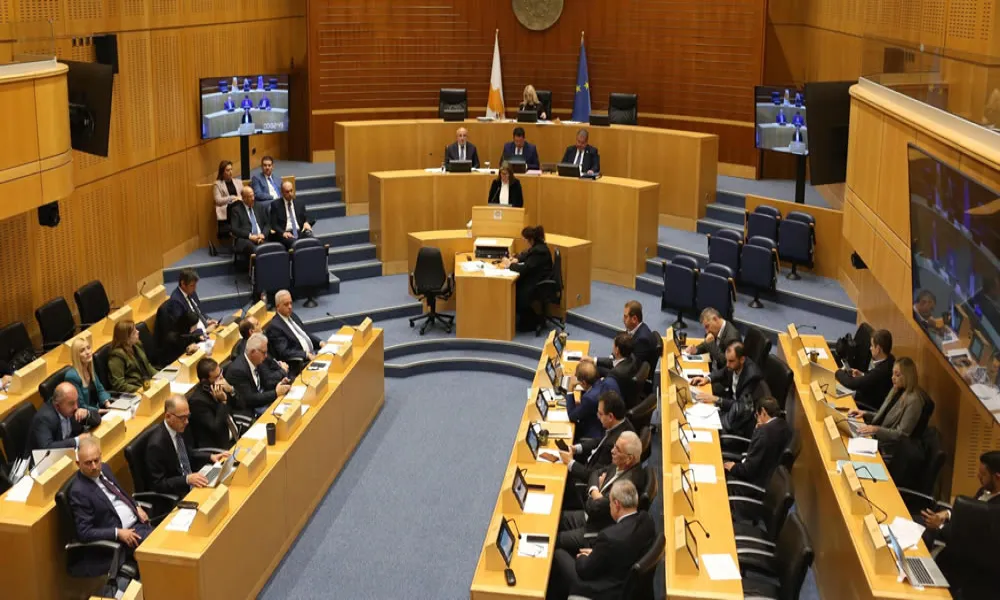

Parliament’s Plenary approved a wide‑ranging package of legislation yesterday that significantly alters the existing framework governing foreclosures and the management of non‑performing loans. With the passage of the AKEL-Greens bill, debtors regain the ability to seek a court order suspending foreclosure proceedings where the outstanding amount is disputed.
The package includes two government bills and 10 party‑sponsored bills, introducing a series of changes that affect borrowers, creditors and guarantors alike. Among other measures, it provides for the suspension of foreclosures on primary residences valued at up to €350,000 until the end of August, limits guarantor liability, and accelerates court proceedings through the appointment of specialist judges.
The complexity of the approved bills presents a challenge in terms of codification and implementation, particularly regarding how the various mechanisms will operate together, such as court‑ordered suspensions of foreclosure in disputes between borrowers and lenders. According to sources, parts of the package are likely to be referred or returned to Parliament by the President of the Republic or reviewed by the Supreme Court.
The parliamentary debate was intense, reviving memories of the 2013 financial crisis, with parties seeking both to defend their positions and to place political pressure on their opponents.
Suspension up to €350,000
A bill submitted by DIPA provides for the suspension of foreclosure proceedings on primary residences valued at no more than €350,000 until the end of August. The measure aims to protect vulnerable borrowers and small family homes by allowing time for the government, Parliament and other stakeholders to address distortions, close legislative gaps and amend related laws to create a fairer and more functional framework.
Access to the courts
A proposal by AKEL and the Green Party allows mortgaged debtors and other interested parties to apply to the competent court for the suspension of foreclosure proceedings in specific cases, including disputes over the amount owed and claims of abusive terms in loan or mortgage contracts. The measure restores provisions that were in force until 2018. An earlier AKEL bill of similar content was not put to a vote at the party’s request.
Special courts
A DIKO proposal empowers the Supreme Court, where deemed necessary, to issue directions enabling the president of a district court to appoint a number of specialist judges to hear financial disputes exclusively. Until such appointments are made, cases may be assigned to district judges with relevant experience.
Under the procedure, a mortgaged debtor may seek the setting aside of a foreclosure notice (Type “IA”) within 75 days of receiving it. The court may issue an order setting the notice aside. After nine months, the mortgage lender may issue a new notice unless the court decides otherwise for special reasons. All such cases must be adjudicated within 12 months.
The Financial Ombudsman
The legislation introduces binding force to decisions of the Financial Ombudsman (Alternative Dispute Resolution Authority for Financial Matters) in consumer complaints against financial institutions where the disputed amount does not exceed €20,000. The Ombudsman’s decisions must be reasoned, and lenders retain the right to appeal to the courts.
Borrowers may also approach the Ombudsman earlier for verification of their mortgage debt upon receipt of a Type “I” notice, instead of waiting for a Type “IA” notice. If no agreement is reached on restructuring or repayment, the borrower may then turn to an insolvency adviser to prepare a Personal Repayment Plan.
Insolvency procedure
A proposal by Greens MP Stavros Papadouris removes distortions that create artificial barriers for insolvent individuals who could otherwise fall within the scope of insolvency procedures, including personal repayment plans and debt discharge.
Cap on additional collateral
An ELAM proposal prohibits banks, credit‑acquiring companies and credit‑facility managers from demanding additional collateral where the loan amount is already fully covered by the value of the mortgaged property.
Write‑off of remaining debt
A bill submitted by AKEL and MPs Zacharias Koulias, Panikos Leonidou, Pavlos Mylonas, Christos Orphanides and Alekos Tryfonides provides that if the proceeds from the sale or auction of a mortgaged property do not cover the outstanding loan and accrued interest, the remaining debt must be written off.
Cap on interest accrual
A second bill by the same group sets a ceiling on interest accumulation. No further interest may be charged once the total amount owed, including interest, reaches twice the original loan principal.
Limiting guarantor liability
A proposal submitted by Averof Neophytou on behalf of DISY MPs, together with MPs Marinos Sizopoulos, Elias Myrianthous, Alekos Tryfonides, Andreas Themistocleous, Costis Efstathiou and Alexandra Attalidou, limits guarantor liability when a mortgaged property used as loan security is sold at auction or repossessed by the lender.
In such cases, the guarantor’s liability may not exceed the original loan amount, minus either the proceeds of the auction or the value at which the property was taken over. The provision does not apply where the guarantor is also the primary debtor.
Further provisions require lenders, where the amount owed is disputed in court, to await a judicial ruling before taking action against guarantors. Another related proposal obliges lenders to exhaust all collateral and obtain a court judgment against the primary debtor before pursuing guarantors.
The legislation also ensures that when a mortgaged property is sold or acquired by the lender, the guarantor’s liability is capped at the guaranteed principal or, where unspecified, the original loan amount, minus sale proceeds or acquisition value and any instalments paid by the primary debtor. This protection also applies where a court judgment exists against the guarantor, provided the lender obtained but did not enforce an order for sale.
Reserve sale price
Finally, a Greens proposal requires that if efforts to sell a mortgaged property continue beyond six months after the first auction, the obligation to apply a reserve sale price remains in force. The reserve price may not fall below 50 per cent of the property’s market value.