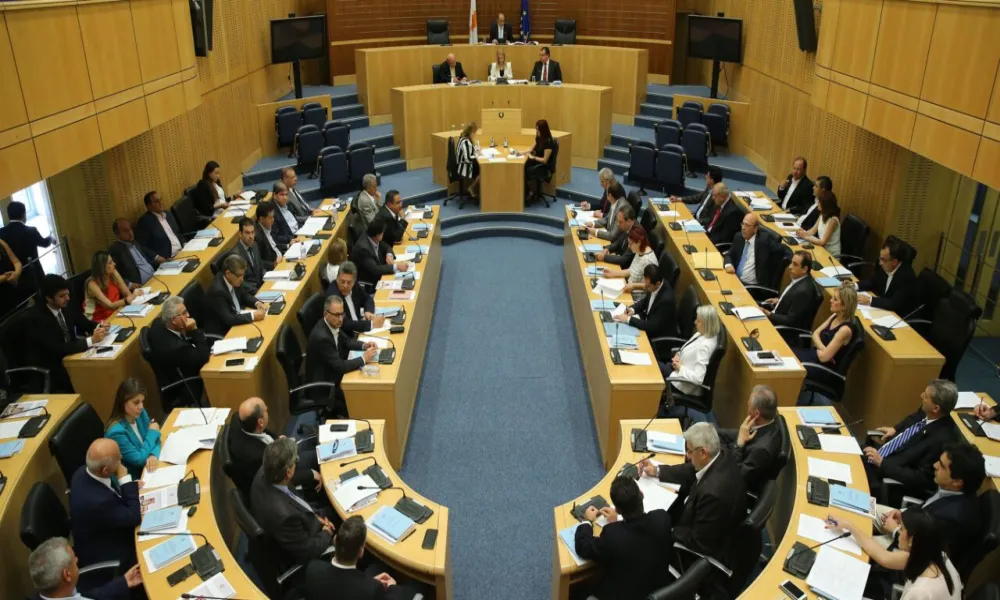
On the agenda of tomorrow’s final plenary session of the House of Representatives before its self-dissolution are three bills concerning parliamentary aides. These are the staff hired by political parties and MPs to assist them in their parliamentary work, with their salaries covered by the state.
Currently, 100 parliamentary aides are employed in the House, with their annual salary cost amounting to €5.6 million for this year. This amount constitutes indirect state funding for political parties and is added to the €7 million distributed annually, based on the percentages they received in the last parliamentary elections.
The three bills provide for an increase in the number of parliamentary aides from 100 today to 115, their salary advancement from scale A8 to the combined scale A8-10-11, as well as further tightening of the provisions of the existing legislation to eliminate cases of nepotism in the House. In the past, when no such legislation existed, there were cases of MPs employing even their own children as parliamentary aides.
Main provisions
The House Institutions Committee, having taken into account all the issues before it, formulated a unified text for the two DISY bills, which address existing gaps and clearly define the number of parliamentary aides that each parliamentary party, independent MP or representative of a religious group is entitled to employ in each parliamentary term.
In particular, the main provisions are as follows:
- Each parliamentary party has the right to employ parliamentary aides in a number equal to twice the number of seats it has secured in the elections. In addition, each MP elected as an independent has the right to employ two parliamentary aides. Given that the election of an independent MP is considered highly unlikely, the parties entering the House next month will employ a total of 112 parliamentary aides (56 seats × two aides).
- Each representative of a religious group has the right to employ one parliamentary aide. These are the representatives of the Armenians, Latins and Maronites. The three representatives are elected every five years, like the other 56 members of the House, and enjoy the same rights (indemnity, immunity, salary), but do not have voting rights. In the new House, they will each be entitled to one aide, as is the case today. Therefore, three more aides are added to the 112, bringing the total to 115, from 100 today.
- In the event that an MP leaves the parliamentary party with which they were elected and joins another parliamentary party, there is an automatic increase by one parliamentary aide for the party they join and a corresponding decrease by one aide for the party they left.
- If an MP becomes independent after leaving the parliamentary party with which they were elected without joining another party, they will be entitled to employ only one parliamentary aide. In this case, there is an automatic reduction by one aide for the party they left.
- The cases in which degrees of kinship constitute a disqualification for employment as a parliamentary aide are expanded. Specifically, the existing provision concerning first-degree kinship with a serving MP or religious representative is replaced with kinship by blood or marriage up to the third degree with the MP or representative who signs the contract, as well as first-degree kinship with any other serving MP or representative.
- A register of such employment contracts will be maintained by the Speaker of the House or an authorised person for monitoring purposes, and key details will be published on the House website, including start and end dates, names, academic qualifications and salaries of parliamentary aides.
Salary increase
A separate vote will be held on the third bill, which provides that the salaries of parliamentary aides will be calculated based on the combined pay scales A8-10-11 instead of the A8 scale that applies today. There are cases of aides who have worked in the House for more than 15 years and remain stuck at the A8 scale.
The bill is co-signed by MPs Charalambos Theopemptou on behalf of the Greens, Christos Orphanides, Zacharias Koulias and Pavlos Mylonas on behalf of DIKO, Alekos Tryfonides on behalf of DIPA, as well as independent MPs Andreas Themistocleous and Alexandra Attalides.
Positions not advertised
Parliamentary aides are hired by MPs and political parties on contract and are paid by the state. The positions are not publicly advertised, as aides must enjoy the trust of MPs and parties.
However, they must meet certain minimum qualifications set by law: they must be citizens of the Republic or another EU member state and reside in the Republic, be at least 21 years old, hold a university degree, have a clean criminal record, have no kinship ties as described above, and must not have been dismissed for disciplinary reasons from the public or wider public sector of the Republic or the EU.
Finally, male candidates must have completed or lawfully been exempted from their military service.