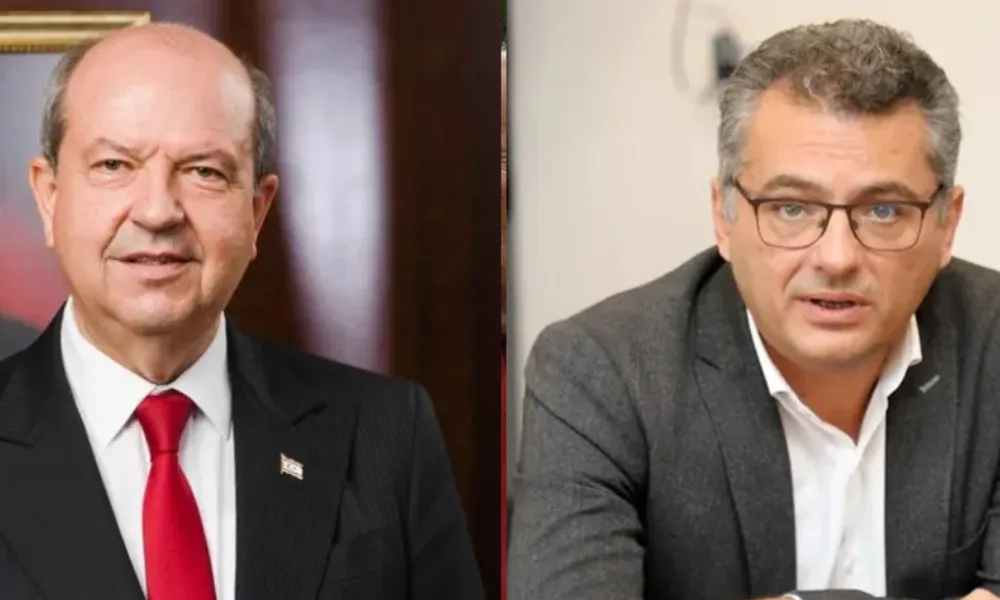

The Turkish Cypriots are going to the polls next Sunday to choose their leader. The two main candidates are incumbent Ersin Tatar and opposition Republican Turkish Party (CTP) leader Tufan Erhurman.
The powers of the Turkish Cypriot leader are mostly limited to handling talks on the division of the island. Like in all electoral races, this does not stop the candidates from promising the world on occasion.
If elected, Tatar will become the first leader since Rauf Denktaş to win a second term in office. His campaign essentially runs on the premise of five more years of the same policy. In other words, no to federation, yes to a two-state solution involving the sovereign equality and equal international status of the Turkish Cypriot people.
Tatar has the backing of Turkey on this. As Turkish President Recep Tayyip Erdogan recently put it: “The matter of federation is now closed for us. […] The only realistic solution is to accept the existence of two states on the island.”
Turkey lends weight to two-state solution
In recent weeks, a host of former ministers, current MPs and mayors from the ruling alliance in Turkey between the Justice and Development Party (AKP) and the Nationalist Movement Party (MHP) have come to the north to campaign for Tatar.
Turkish Vice President Cevdet Yilmaz has come three times in the last three months, including this past week, to support Tatar’s “vision” for a two-state solution.
Tatar also campaigns on a ‘3 Ds’ policy, pushing for direct flights, direct contact and direct trade. He recently attended an Organisation of Turkic States (OTS) meeting in Azerbaijan, saying afterwards he will strengthen trade and cooperation in agriculture, tourism and higher education through the “Sister Markets Network”.
Under his leadership, he ended ‘Imagine’, an intercommunal anti-racism educational programme which brought thousands of students and teachers together from across the divide.
He has set as a precondition to peace talks, recognition of the Turkish Cypriots’ ‘sovereign equality’. Having failed to make any significant headway in the last five years of meetings with President Nikos Christodoulides and in the expanded format with the three guarantor powers, Tatar focuses his narrative on ending the “time-wasting” search for a federal solution and instead bringing the Turkish Cypriots into the fold as equal partners.
Narrative of fear
Regarding the ‘other side’, he adopts a narrative of fear, accusing the Republic of Cyprus (RoC) of escalating tensions through its militarisation and alliances with states like Israel, France and America. He claims the RoC has spent over $3.5 billion on weapons and missiles in the last five years, and rings alarm bells over the rising popularity of the far-right party ELAM.
Tatar’s candidacy is backed by the ruling National Unity Party (UBP), Rebirth Party (YDP) and Democratic Party (DP). The ruling coalition seeks to pass a resolution this week in ‘parliament’ promoting a two-state solution.
According to political and economic analyst Mertkan Hamit, if the resolution passes, it will pave the way for the Turkish Cypriot side to start talking about a ‘Turkish Cyprus State’.
He notes that in January 1983, the ‘Turkish Federated State of Cyprus’ had passed a regulation on self-determination that became the foundation stone of the universal declaration of independence (UDI) of the ‘TRNC’ 10 months later.
While the UDI was condemned by the UN Security Council, Hamit argued that Turkey was a much more isolated actor back then. “The power dynamics are different now.”
If Tatar wins, he will invite international actors to talk about the new realities on the island, with much clearer moves taken towards a permanent division, said Hamit.
Federation talks but no return to status quo
Opposition leader Erhürman’s candidacy is backed by CTP, the Communal Democracy Party (TDP), the Social Justice and Struggle Party (TAM) recently founded by Serdar Denktaş (son of Rauf), and former Turkish Cypriot leader Mustafa Akıncı. If he wins, he will have to negotiate both with Turkey and the Greek Cypriots.
Erhürman is campaigning for a bizonal, bicommunal federation with political equality as defined in UN Security Council Resolution 716 (1991), including a rotating presidency. He wants results-orientated, phased negotiations with a prior commitment to all convergences reached by Crans-Montana. His final, more contentious call is for some kind of assurance that if the new talks fail, Turkish Cypriots won’t be left high and dry, as they were in 2004 and 2017. In other words, if the Greek Cypriots abandon the talks, the Turkish Cypriots should not have to return to the status quo.
Hamit said that if Erhürman wins he will push for peace talks to start. The CTP leader’s position on setting a price to pay if the talks crash is mainly designed to avoid the sides running away from the negotiating table.
“An Erhürman victory will give a new dynamic to the process. Certainly, he is a political leader whose position is internationally acknowledged, making it harder for Turkey to attack him. He holds a more conciliatory position,” said Hamit.
Carrot for Turkey?
However, it remains to be seen how willing Turkey will be to invest in a new peace process, given the host of issues Ankara is currently dealing with – Syria’s transition, tensions with Israel, the Kurdish issue, domestic politics. There is no EU membership or expanded customs union to sweeten the pill. Turkey will likely join the EU’s SAFE financial instrument on defence spending anyway, thanks to key NATO support. So, the question is, what would make Turkey see benefit in a reengagement on Cyprus?
There are those who argue that a two-state solution would weaken Turkey’s position and its maritime claims. CTP representative Ongun Talat (son of former Turkish Cypriot leader Mehmet Ali Talat) argues that a two-state solution would actually undermine Turkey’s guarantee over Cyprus. “Those who claim that the two-state solution secures the guarantee are wrong – on the contrary, it would eliminate Turkey’s guarantee over the entire island.”
Assuming Erhürman convinces Turkey of his positions, substantive negotiations would likely start after Cyprus’ EU Presidency, said Hamit, noting that the timetable could also be affected by early ‘parliamentary’ elections in the north.
A rethink for pro-federalists
If the opposition leader loses, however, Erhürman will have to step down as party leader, and CTP dynamics will also change. The left-wing traditionally pro-federation party will have to consider its political rhetoric and future relationship with voters, argued Hamit.
“If you lose several times while maintaining the same position, what do you do? You need to dilute your positions somewhat. Where will that take you? To a confederation? But that will cause significant chaos among federation supporters, giving UBP more opportunity to stay in power, despite its unpopular track record,” he said.
“These elections are an important turning point,” he added.
According to academic Nikos Moudouros, an expert on Turkish studies, from the 218,313 people registered to vote in the Turkish Cypriot election, around 55%-60% are Turkish Cypriots and the remaining 40%-45% are of Turkish origin. Moudouros noted that this may be the last election where Turkish Cypriots are a majority.
Settlers have deciding vote
Another Turkish Cypriot analyst who did not wish to be named argued that the vote will ultimately be decided by voters of Turkish origin who are a mixed bunch with differing ideologies from across the political spectrum and who include pro and anti-Erdogan supporters.
Hence, Turkey has been sending mayors from Gaziantep and Hatay, from which thousands of settlers originally hail, to campaign for Tatar in the villages where they relocated to.
As a result, Erhürman’s campaign has been shifting the conversation to issues of securing EU citizenship for children of mixed marriages and freedom of movement for settlers across the island.
Erhürman’s team has also tried to dial down the talk of federation in recent weeks, given Turkey’s clear preference against it, said the analyst.
Flexible solution models?
When pressed to defend his position on a federation, the analyst argued that Erhürman gives the impression the concept is flexible, referring both to a loose federation and confederation as if the terms were interchangeable.
The analyst further questioned whether Erhürman was serious about his preconditions, particularly regarding the call for assurances of no return to the status quo. If so, then like Tatar, he could end up failing to achieve any progress towards his goal.
According to the analyst, there is also a section of ruling UBP voters who are very unhappy with the current UBP ‘prime minister’ Ünal Üstel – a figure only in position after the heavy-handed intervention of Ankara. Some want him gone and are willing to make Tatar pay for Üstel’s sins by either not voting at all or voting for Erhürman. The thinking being that if Tatar loses, CTP will apply pressure for early ‘parliamentary’ elections in 2026, instead of the year after, and Üstel will be gone.
The irony here, according to the analyst, is that if Erhürman wins, Ankara will likely resist early elections, and instead keep Üstel in power as a means to lean on Erhürman and convince him of the error of his ways. Since the north runs as a ‘parliamentary’ system, almost all the power is in Üstel’s hands when it comes to domestic issues.
The analyst argued that Turkey is likely to continue supporting a two-state solution, delaying talks, as the north becomes more like Turkey. Another option is that Turkey convinces Erhürman to start an alternative process that won’t be given a name, from which a different type of partnership will emerge. One that everyone can call as they wish, he said.
De-escalation needed
PRIO Cyprus Centre researcher Mete Hatay argued that a federation is in Turkey’s regional interest, as is keeping Turkish Cypriots within the EU.
“A Cyprus solution means peace in the region, including for Turkey. Also, they lose the moral argument by playing for a secessionist entity,” he said.
Hatay noted that the Cyprus issue has never been so convoluted before, with so many regional interests at play at the same time.
If Erhürman wins, Hatay encourages him to adopt positive unilateral steps, such as on Varosha, the return of Maronites to their villages, and others.
“It’s a hard job, but you have to change the atmosphere, lower the tone, and start de-escalation in Cyprus, which can help the region,” he said.
“Erhürman and Turkey will go through a process of influencing each other. He has to negotiate and come to an understanding with Turkey, the patron state, but also with the Republic of Cyprus, the parent state.”
Hatay noted that a win for Erhürman would create some space for manoeuvre for Turkish Cypriots.
“At the moment, the voice of Turkish Cypriots is tuned down. Every small thing is being delegated to Turkey, from the economy to education. A win for Erhürman will gain some confidence for Turkish Cypriots that they can change some things,” he added.