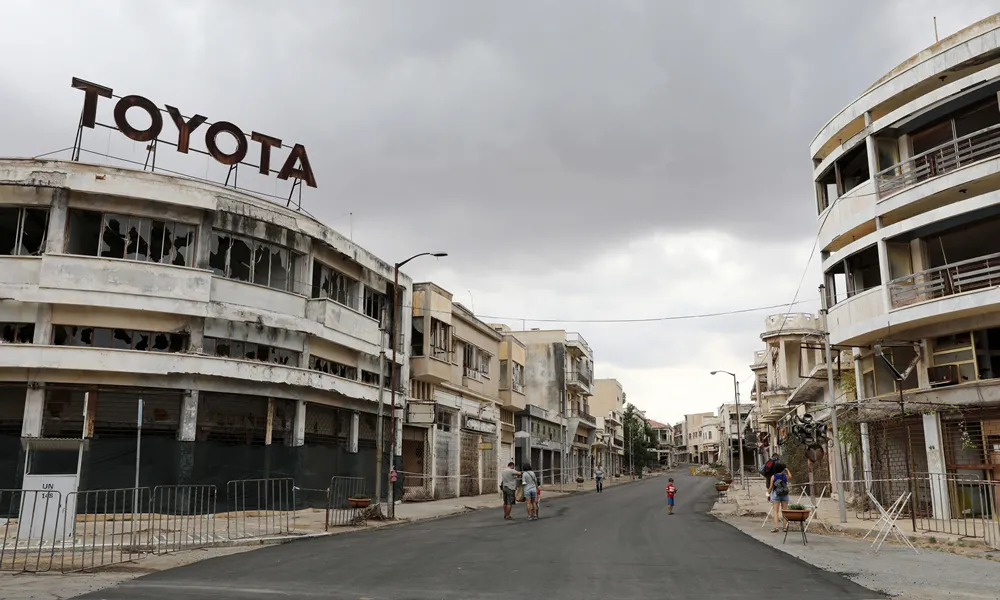
“Let us be patient for two more days. Our roadmap for Varosha will become clearer after December 4,” said Turkish Cypriot leader Tufan Erhürman during his televised interview on Tuesday evening with Turkish Cypriot journalists.
Erhürman’s reference to December 4 relates to the Committee of Ministers of the Council of Europe convening in Strasbourg to assess, among other things, Turkey’s compliance with the 2001 judgment by the European Court of Human Rights (ECtHR), the 4th Interstate Case of ‘Cyprus v. Turkey’.
The Committee met on Wednesday to assess the effectiveness of the north’s Immovable Property Commission (IPC) in relation to the 2001 judgment, along with Turkey’s ongoing refusal to pay the €90 million compensation, plus interest, awarded to relatives of missing persons and enclaved persons under a 2014 ECtHR judgment, issued as a continuation of the 4th Interstate Case.
Varosha on the cards
According to Haber Kıbrıs, when asked during the televised interview about the Varosha issue, the Turkish Cypriot leader said: “If we enter a comprehensive negotiation process, Varosha will form part of that process. However, if the negotiation process does not begin, Varosha could change the dynamics.”
One possible interpretation of his comments is that he implements a game-changer. Varosha could be opened up for a return of its former inhabitants – but it remains to be seen whether such a return would have to go via the IPC, and under which administration the closed-off area would be put under.
Greek Cypriot lawyers have long argued two main points on Varosha:
a) The IPC has little justification to not award ‘restitution’ of properties to their rightful owners in Varosha since, unlike other areas in the north, the properties are not inhabited by displaced Turkish Cypriots or others.
b) Each day Varosha remains withheld from its inhabitants and property owners, the bigger the bill Turkey will ultimately pay in compensation for ‘rent’ and ‘loss of use’.
The Turkish Cypriot leader might be contemplating a left of field move to shake things up, opening up Varosha without peace talks but under UN or Turkish Cypriot administration.
Erhürman recalled in the interview that the opening of Varosha under UN supervision is included in UN Security Council resolutions. “No resolution states that Varosha must be handed over to the Greek Cypriots. It states that it must open under UN supervision,” he said.
High-Level Agreement
The return of Varosha before a comprehensive agreement was also agreed in the High-Level Agreement of May 19, 1979, between then leaders Spyros Kyprianou and Rauf Denktaş.
Provision 5 of the agreement specified:
“Priority will be given to reaching agreement on the resettlement of Varosha under United Nations auspices simultaneously with the beginning of the consideration by the interlocutors of the constitutional and territorial aspects of a comprehensive settlement. After agreement on Varosha has been reached, it will be implemented without awaiting the outcome of the discussion on other aspects of the Cyprus problem.”
Strasbourg outcome ‘decisive’
Referring to the Committee of Ministers which will reconvene on Thursday to hold a vote on the issue of Turkey’s compliance and the IPC’s effectiveness, Erhürman said the results of the vote in Strasbourg will be “decisive.”
Regarding the IPC, he said it has “been a headache” for years, adding that comprehensive work is being carried out to make it more active and functional.
“We have worked hard and will see the results in a few days. It would not be right to give details now, but I will openly share all developments, positive or negative, after December 4.”
According to an informed source, the Turkish side seeks recognition and promotion of the role and work of the IPC at the Committee of Ministers, while the Republic of Cyprus requests that the Committee refer a clarification question on the IPC to the ECtHR. In either case, the Committee requires a two-thirds majority vote. If examination of the issue is completed on Thursday, then a decision will likely be issued.
Erhürman noted that in the past 35-40 days, work has been done on the IPC with initiatives prepared in four-five areas. “We are in consultation with Turkey, since, after all, lawsuits have been filed against the Turkish Republic at the European Court of Human Rights.”
Significant steps have been taken to improve the current situation and strengthen the IPC’s position, he said, noting that a comprehensive study is underway, regarding the IPC fund, while a group of retired judges and public officials has prepared a model for a special fund.
“The money from this fund cannot be used for any other purpose. The study has been communicated to the parties involved, it is not a secret,” he said.
The results of the vote in Strasbourg will be decisive and after December 4, both the initiatives for the IPC and the roadmap regarding Varosha will become clearer, he said.
Source: CNA