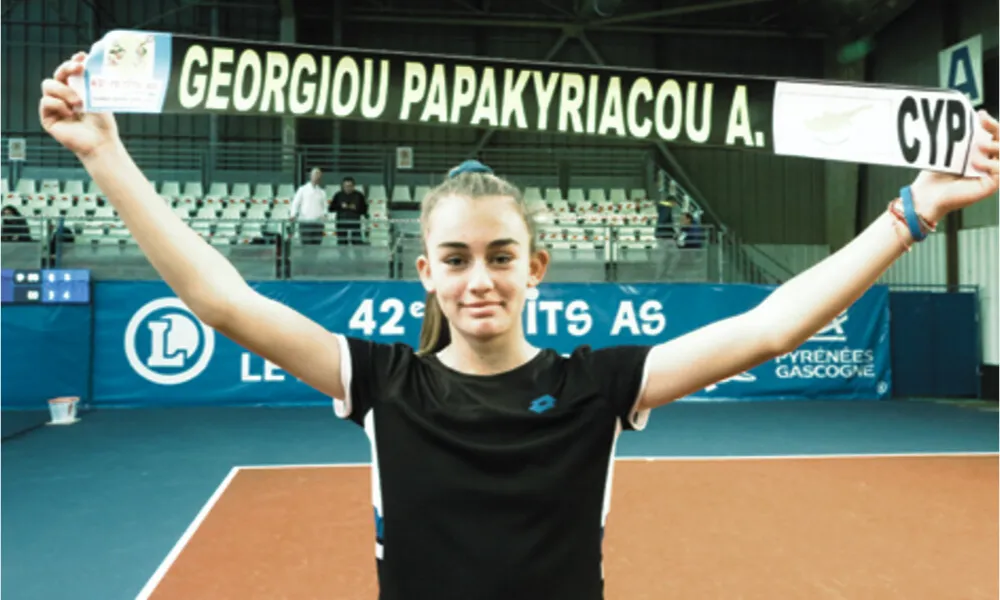

Andrea Georgiou Papakyriakou was four when she first picked up a racket, coached by her mother on public courts in Limassol.
“Back then I was just a little kid,” she recalls. “I did not really understand everything, I just liked it. We started with my mum, then with other kids, and slowly I wanted more training. Around ten I started to understand that I was better than most girls my age. That is when I realised there was talent there.”
By seven she had moved from the family setup to other coaches “for my own good,” as she puts it, in search of something more professional.
Life inside Cyprus’ sports school system
At 15, Andrea attends a sports high school. Three times a week she trains with school coaches in big groups, then goes to her club in Limassol from six to eight in the evening.
“We are many kids on a few courts with one coach,” she says. “It is very difficult to have a really good practice like that. The coaches really do a lot, but when there are so many of us, the coach cannot sit with me and really focus on my mistakes and how I can improve. More private sessions would make a big difference.”
The problem, she says, is systemic. “In Cyprus there just is not that option. The federation does not offer it either.”
Scouted from abroad
Despite these limits, Andrea has already drawn international attention. French coach Geoffroy Dupuis first saw her at Les Petits As in 2024, then again six months later when she won the Small States Championships in Luxembourg, and followed her results and videos for three years.
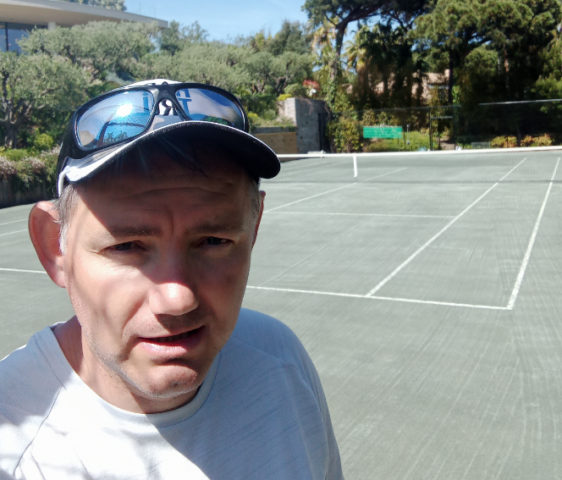
“I saw a complete player, capable of playing well on indoor hard courts and outdoor clay courts,” he tells Politis to the point. “A good player is someone who loves to solve problems all the time. I saw that in Andrea. Of course she loses matches. All players do. But losing them with an impeccable attitude is an essential habit. That is what I appreciated about Andrea. Many young players give up after losing a set. She has a certain emotional stability.”
He notes that she has done this while in a normal school timetable and large training groups, which makes her results stand out even more compared to peers already in tailored programmes.
From Les Petits As to ITF titles
Andrea has already played in Poland, Romania and Italy, plus for the Cyprus national team. Apart from a national team trip to Romania, costs largely fall on the family.
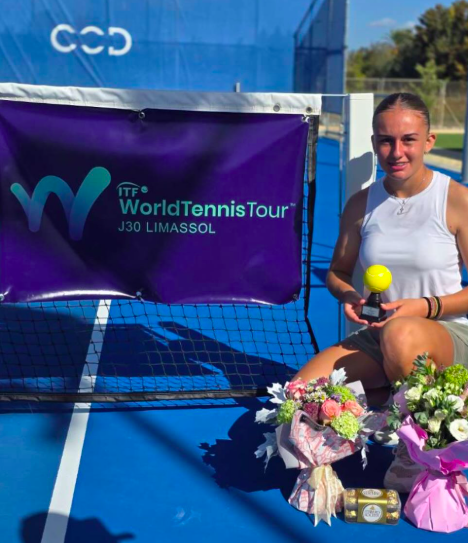
Her favourite moment so far came in Limassol about a month ago, when she won her first ITF junior title. “That was the day I felt ‘yes, this is something’,” she says.
She feels that in her age group in Cyprus there are now very few girls who can really push her. “That is another reason I want to go abroad,” she says. “I need more players at my level or stronger, to challenge me. Because I train a lot on hard courts, it is better for me,” she adds of her preferred surface.
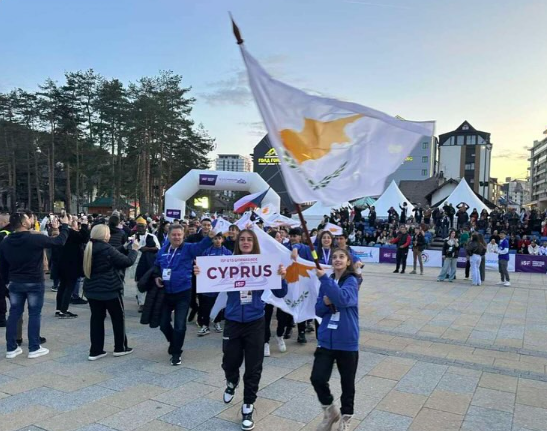
The mental game
Like many young tennis players, Andrea has largely had to manage the mental side alone. “Stress will always be inside you, however much you try to control it,” she says.
“My coaches have not really worked with me on that,” she admits. “It is something I have discovered on my own, learning how to handle it.”
Her motivation comes from goals set very early. “I think back to when I was small and wrote down the goals I had,” she says. “Where I want to reach. I remind myself of that and I keep going.”
The dream: a Grand Slam and the very top
Andrea does not hide what she wants. “I want to win a Grand Slam, especially the US Open,” she says. “And to reach the top like Iga Swiatek.”
She follows players like Aryna Sabalenka and Carlos Alcaraz and studies top level matches on video. The plan at home is to try to move abroad in 2026 if everything comes together, though 2027 feels more realistic.
Would it be difficult to leave school, friends and everyday life behind? “Not really,” she says. “It is my dream, so I will chase it. I know other athletes who made it and spent many years away from their family. It was very hard for them. For me, because I already travel a lot for tournaments, I do not think it will affect me so much.”
A French project built on details
Geoffroy Dupuis says moving to France is about plugging Andrea into a full high performance system while keeping strong links with home, built on “competent and dedicated staff, a very determined player, a supportive family and long term stability and trust”.
“By being based in France, Andrea has access to a training system that is more comprehensive, more personalised and more in line with the reality of top level competition,” he says.
Her recent trip to France has already paid off, he argues, with two ITF junior singles titles and a jump of more than 300 places in the junior rankings. She now has an end of season and pre season plan based on physical testing in France, with rest periods, family time in Cyprus and short training blocks. A provisional 2026 calendar mixes ITF juniors, top Tennis Europe under 16 events, national team commitments and first professional tournaments.
“From now on, every little detail will count more and more in Andrea’s career,” he says. “We have already started putting the tools in place. It is a solid project, with clear objectives, step by step. Training hard is important. But training smart and in the right direction is even more important.”
The price tag of a dream
The problem is money. Andrea’s family already shoulders most travel and competition costs, but a full shift to a European high performance base is on a different scale.
“The level of financial investment required for this type of project is enormous,” Geoffroy says. “No family, with very few exceptions, can make this investment alone.”
He cites Dominic Thiem’s estimate of around 100,000 euros per season at the top end. By optimising travel and expenses, he believes Andrea’s project can operate next season on around 60,000 euros.
Andrea knows help will not appear automatically. “I hope someone will give me support,” she says. “But I know it will not just happen on its own. I will have to go and ask, explain my goals and that I need help.”

So far, she has not seen any structured mechanism in Cyprus to identify a player like her and build a full support package. When Politis to the point asked the Cyprus Tennis Federation how a player like Andrea could be considered for events such as the European Youth Olympic Festival or the Youth Olympic Games, officials cited rankings, results and international federation recommendations passed via the Cyprus Olympic Committee, but gave no clear answer on how these apply in a prodigy’s case.
What both player and coach want now is visibility, in the hope that institutions, private sponsors and individuals with networks in international tennis will step forward.
Andrea wants her country and its organisations to treat her potential as an asset worth investing in, whether through public support, Olympic Committee backing, more international tournaments in Cyprus or private partnerships.
“Even when she comes to France, Andrea will need support from Cyprus. It is her country. She is proud to be Cypriot. So each and every one of you will have a role to play in the emergence of a champion,” coach Geoffroy says.
“Andrea is a young girl with great potential,” he says. “She represents her country all over the world. She conveys images of fair play, success, pushing herself beyond her limits, humility. She needs your support now to win a Grand Slam or an Olympic gold medal.”
“Everyone must be aware of their role,” he adds.
For now, Andrea keeps training on crowded courts in Limassol, going to school, and dreaming of the US Open.