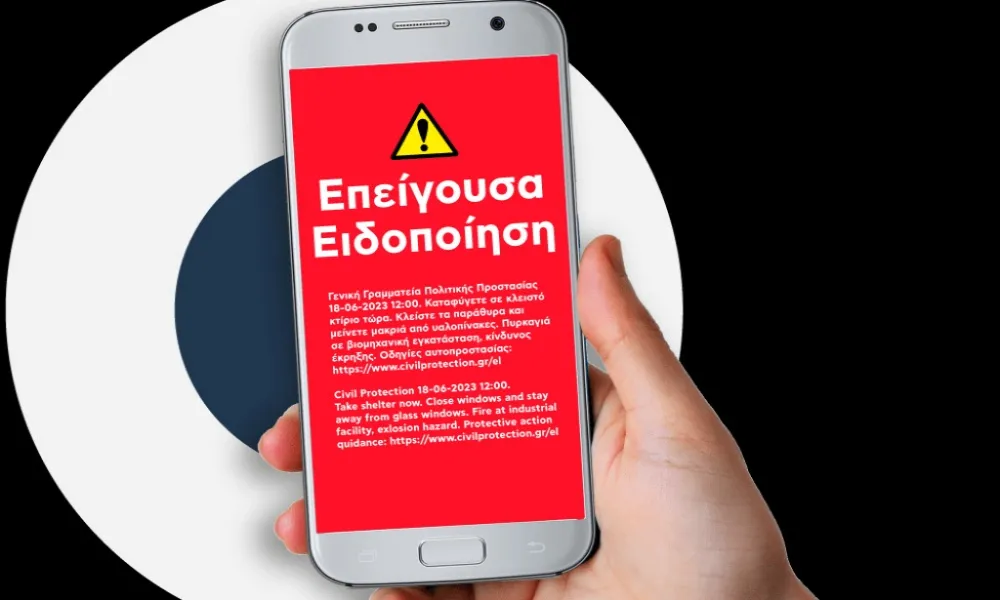

In addition to the shelters described as “holes in the ground”, the first week of the Middle East escalation also turned the European emergency number 112 into something of a bad joke. In an attempt to ease public concern, and at times anger, caused by the absence of this infrastructure, and largely to absorb criticism over its handling of the drone attack in Akrotiri, the government decided to deploy a mobile technology dating back to the 1990s: SMS.
The president repeated himself
For mobile phone companies, the failure of the mass messaging attempt was predictable, for reasons outlined below. For the government, however, it was not.
The first test failed spectacularly, with citizens receiving the messages over a period of four hours. Some did not receive the SMS at all, while others received only the Greek text. In the meantime, Nikos Christodoulides, recalling what critics describe as his worst public appearance during last year’s deadly Limassol wildfire, attempted to convey the message that the government knew what it was doing and to calm the backlash over what many saw as the state’s inability to adequately protect its citizens.
After the predictable failure of the first mass SMS dispatch, a second message was sent on Friday afternoon. The test performed somewhat better, largely because the wording of the SMS messages had been shortened and instead of sending three or four messages to each phone, only one or two were delivered.
By then, however, the damage had already been done. Citizens felt even more exposed to the risk of an emergency incident and increasingly sceptical about the ability and credibility of those governing them.
SMS completely unsuitable
According to a telecommunications expert, the SMS system relies on a “store-and-forward” architecture.
As he explains, “when a message is sent, it does not go directly to the recipient. It is transferred through a message centre (SMSC). The system uses the control channels of the mobile network, the same pathways used to maintain connections and route calls, to deliver the data packet. If the recipient’s phone is switched off or out of network coverage, the SMSC stores the message and attempts to resend it once the device becomes active again.”
“SMS,” he emphasises, “is completely unsuitable for mass emergency alerts, mainly because of the way messages are distributed. Since the network must send a separate, unique message to every subscriber individually (unicast), an area with thousands of users immediately creates a bottleneck. This results in delays that can last from minutes to even hours, something potentially disastrous in situations such as a fire or an earthquake.”
According to his calculations, “if the average messaging server can send 300 to 500 messages per second and a company has around 800,000 subscribers, simple mathematics shows it could take between one and one and a half hours to send all messages. In addition, only the company’s own subscribers will receive the alert. Visitors, such as tourists using roaming services, will not receive the notification.”
112: simultaneous transmission
By contrast, the 112 system operates through Cell Broadcast technology, which is considered ideal for emergencies because it works through simultaneous transmission, known as one-to-all communication.
Unlike SMS, the system does not need to know the user’s phone number or establish an individual connection with each device. The alert is broadcast from mobile phone towers to all devices within their coverage area, in the same way a radio station broadcasts to its listeners.
This means the message reaches thousands of people simultaneously and instantly, without creating network congestion, even when thousands of users are located in the same area.
It should also be noted that when a citizen receives a message from the 112 system, the mobile phone emits a very loud siren-like alert and strong vibration that differs from normal call or message tones. The sound can be heard even if the device is set to silent mode or “do not disturb”.
When will 112 arrive?
As for the introduction of the 112 system in Cyprus, which according to European directives should have been implemented since 2020, the tender process was launched with significant delay in 2022.
In May 2024 the tender was cancelled following legal appeals. The project had to be redesigned and was eventually revised in December 2024.
Officials from Civil Defence estimate that the project, with a budget of €7 million, will become operational in June this year.