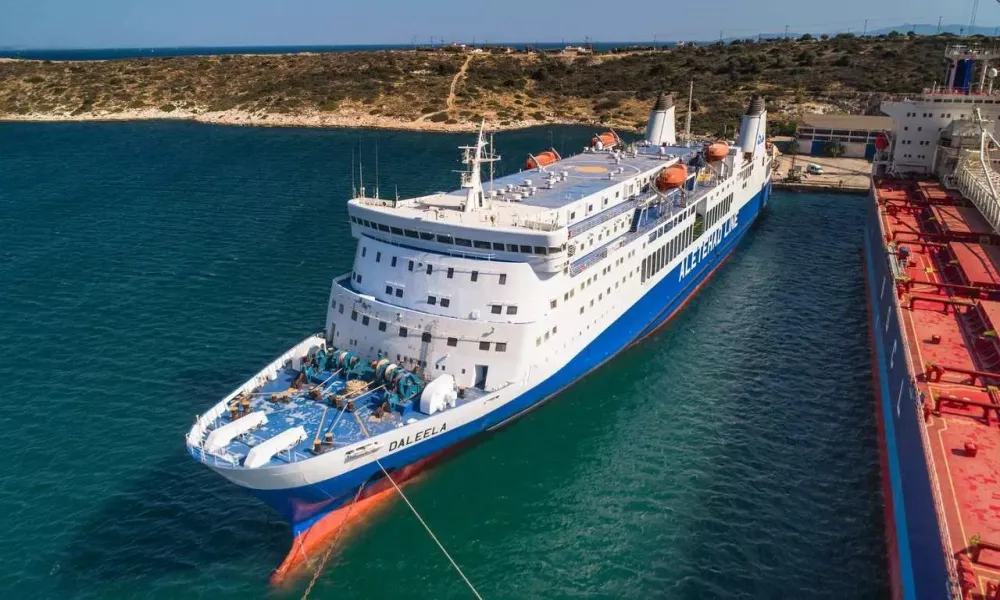
Despite strong public demand, average occupancy on the Cyprus–Greece ferry service stood at just 49% for the period 2022 to 2025, according to a report by the Audit Office of the Republic of Cyprus. The finding comes even as tickets are often sold out shortly after the booking platform opens. The audit was conducted following complaints from citizens regarding ticket availability and occupancy levels. It also examined the calculation of state subsidies by the Deputy Ministry of Shipping, as well as monitoring and implementation of the contract.
Capacity underused
According to the report, the average number of passengers per route between 2022 and 2025 was 173, compared with a maximum capacity of 350. While the service could have accommodated up to 61,600 passengers over the four-year period, only 30,459 actually travelled. In addition, on routes where the booking system showed no available tickets, actual occupancy averaged just 69%, with around 107 seats per journey remaining unused. Similarly, for vehicle transport, routes that appeared fully booked in the system operated at an average occupancy of only 18%.
Booking system distortions
The Audit Office attributes these discrepancies partly to distortions in the booking system. It notes that the system allows practices such as a single passenger booking a four-berth cabin at a lower cost than a single cabin, artificially limiting availability. More broadly, weaknesses in the system may mean it does not always reflect the true availability of seats and vehicle space.
Findings also point to a highly flexible cancellation policy. Bookings can be cancelled at any time before departure without financial consequences, encouraging passengers to reserve multiple seats and cancel unused ones shortly before travel. Although the publicly stated policy предусматривает full refunds only if cancellation is made at least 30 days before departure, with only port taxes refunded thereafter, the practice applied is more lenient. According to the Deputy Ministry of Shipping, full refunds are issued regardless of when cancellations occur.
The Audit Office notes that this practice prevents effective management of bookings and reduces the availability of tickets for other passengers. It also highlights that the ministry does not monitor cancellations or no-shows, nor does it verify whether the operator refunds fares or reissues tickets.
Pricing and subsidy concerns
The Audit Office also describes the pricing policy as overly simplistic. Ticket prices remain the same regardless of season, whether in May or August, despite variations in demand. Given that the service is subsidised at around 93%, and the operator receives a guaranteed annual compensation of €5.47 million plus 6% of ticket revenue, there is limited incentive to maximise occupancy. Lower occupancy may, in fact, reduce operating costs for the company.
Discrepancies in ticket data
For the 32 routes operated in July and August 2025, 154 more tickets were issued than the number of passengers who actually travelled. The Audit Office notes that the Deputy Ministry does not track what happens to the revenue from these additional tickets. Subsidies are calculated based only on the number of passengers who travelled, as reported by the operator.
The report also criticises performance indicators included in the contract for the period 2022 to 2024. Targets for average passengers per route were set at 40, 50 and 60, levels significantly below actual demand. The real average of 173 passengers exceeded the highest target by 288%, effectively guaranteeing contract extensions without meaningful performance improvement. According to the Audit Office, these low benchmarks reduced incentives for the operator to increase passenger numbers or improve service quality.
Call for review and stronger oversight
The Audit Office concludes that there is a clear need to strengthen monitoring and control mechanisms by the Deputy Ministry of Shipping. It calls for a reassessment of the service and measures to ensure both effective public service and protection of the public interest. The ferry connection, it notes, should not function merely as a subsidised service but as a reliable, high-quality service of general interest that delivers real added value to citizens and the state. Such an approach would also support tourism, a sector of strategic importance for the Cypriot economy and international image.
In closing, the Auditor General stresses that the political decision to implement and continue the service does not remove the obligation to ensure prudent use of public funds. An immediate reassessment is required, the report states, so that more citizens can be served with lower cost to public finances.
Source: CNA