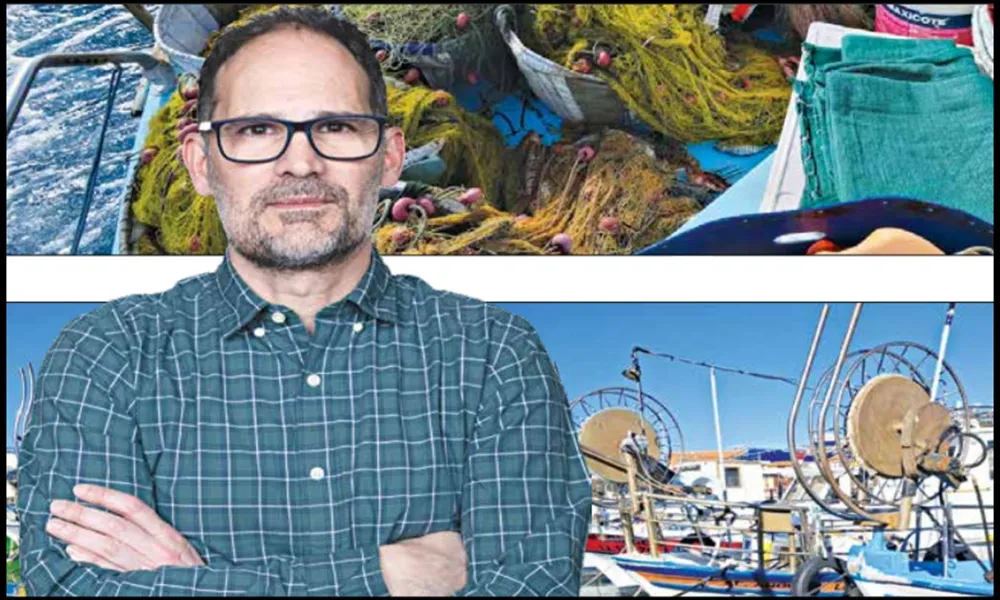
He came to Cyprus, visited fishing harbors, spoke with fishermen who grew up at sea and continue to work in it every day, and heard the same words repeated: fewer fish, higher costs, and a daily income that no longer adds up as it once did. Javier López, Campaign Director for Sustainable Fisheries at Oceana in Europe, visited Cyprus with his team as part of a study aiming to capture the state of the sector. In his interview with “P”, he speaks about the gap between theory and practice, about rules that remain on paper, and about what is needed for fisheries to stand on their feet in the coming years.
Based on your research findings in Cyprus, what concerned you the most?
What stood out most was the gap between what fishers experience daily and what policies are supposed to deliver. In the six fishing shelters we visited, the message was almost identical: reduced catches, increased costs, competition with recreational fishing, and a feeling that rules are not meaningfully enforced. This is not only a Cypriot phenomenon. What we see here reflects a broader picture across the Mediterranean, where stocks remain under pressure, while climate change and invasive species further burden the environment. Ultimately, the success of policy depends on whether it is properly implemented in each country.
The challenges
The Common Fisheries Policy sets objectives, yet fishers do not see results. Where do you identify the problem?
The main problem is the distance between what is foreseen and what is implemented. The principles of the policy are correct—sustainability, fairness, stock recovery. But all of this only has value when applied consistently. What we hear from fishers is that the rules exist, but they do not lead to real change at sea or to improvements in stocks. There is no sense that things are getting better. Therefore, the challenge is not to rewrite the policy, but to make it function as it should.
What are the most serious gaps you identify in fisheries management in Cyprus?
The main issues relate to the implementation of rules, the limited progress in stock recovery, the insufficient protection of sensitive areas, and the lack of meaningful support for fishers. At the same time, there is strong concern about invasive species, climate change, bureaucracy, and the ageing of the sector. The priorities are clear: controls that apply to everyone, protection of spawning areas, compensation during closure periods, more decisive action against invasive species, and a fairer distribution of fishing opportunities, such as for tuna and swordfish. Without these, pressure will continue to grow.
Fair measures
Despite the problems, fishers seem to support protection measures. How do you explain that?
This is one of the most important conclusions. Fishers are not against conservation. On the contrary, they understand that without protection there is no future. What they ask for are measures that are fair and effective. There is support for habitat protection, seasonal bans, and better management of invasive species, especially when these are accompanied by compensation and applied to everyone. When they feel they are part of the process and that their opinion matters, implementation becomes easier.
To what extent have climate change and invasive species affected the situation?
More than it appears at first glance. These changes are not something that will come in the future—they are already affecting their work. Many fishers told us they see differences in the sea, in species, and in quantities. The problem is that responses so far are fragmented or delayed. A more coordinated approach is needed, with better monitoring, organized programs, and meaningful protection of ecosystems, otherwise the situation will worsen.
Cyprus holds the Presidency of the Council of the EU. Can this play a role?
Yes, and it is an opportunity that should not be missed. Cyprus can help focus the discussion on implementation rather than new legislative changes. It can keep fisheries high on the European agenda and push for substantial action in areas such as controls, stock recovery, and support for small-scale fisheries. It is a moment to show that protecting the seas and supporting communities go together.
Uncertainty and youth
The sector is ageing and does not attract young people. What is the reason?
It is a combination of factors, but the economic aspect is perhaps the most immediate. Young people are unlikely to enter a sector where income is uncertain, costs are increasing, and conditions are becoming more difficult. The regulatory framework also plays a role, especially when it is complex or not applied equally to all. Without stability and prospects, there will be no renewal.
If you had to choose one immediate priority?
The need for a comprehensive national strategy for small-scale fisheries, with clear goals and specific actions. Immediate support measures are needed, but also longer-term changes that will allow the sector to stand and develop. What matters is to have a clear plan.
As Campaign Director for Sustainable Fisheries at Oceana Europe, what is your role in shaping policy at EU level, and how can organizations like Oceana make a real impact in practice?
To bridge science, policy, and the experience of fishers themselves. To bring evidence into the discussion and show where problems exist, but also which solutions can work. Through research and public pressure, we can contribute so that policies gain real impact—both for fish stocks and for the communities that depend on the sea.