When historians look back on 2025, they will remember it as the year when the fractures in the global order became impossible to ignore. Tariffs. Export controls. Economic dependencies. They became instruments of pressure and in some cases, weapons. These trends did not start last year, global trade barriers had already tripled in the year before. But 2025 was when they moved from the margins to the mainstream – when fragmentation stopped being a risk and became a reality.
The headlines and news bulletins told a story of conflict and protectionism: of countries turning inward, raising new barriers, and weaponizing interdependence. That story reflects a real shift in the world around us. But it does not tell the whole story and it does not tell Europe’s story.
2026 will be remembered as the year Europe responded to this new world, by proving another path is possible. From energy to security, we are strengthening our strategic independence. Not by retreating behind tariff walls or cutting ourselves off from the world. Europe is pioneering a different route – resilience at home with openness abroad. Because strength today is not built through isolation, but diversification.
And Europe is not alone. From Canada to India, from Latin America to South-East Asia, countries are searching for a model that preserves openness while reducing dependence. Europe stands at the centre of this, not as a spectator but as a driver.
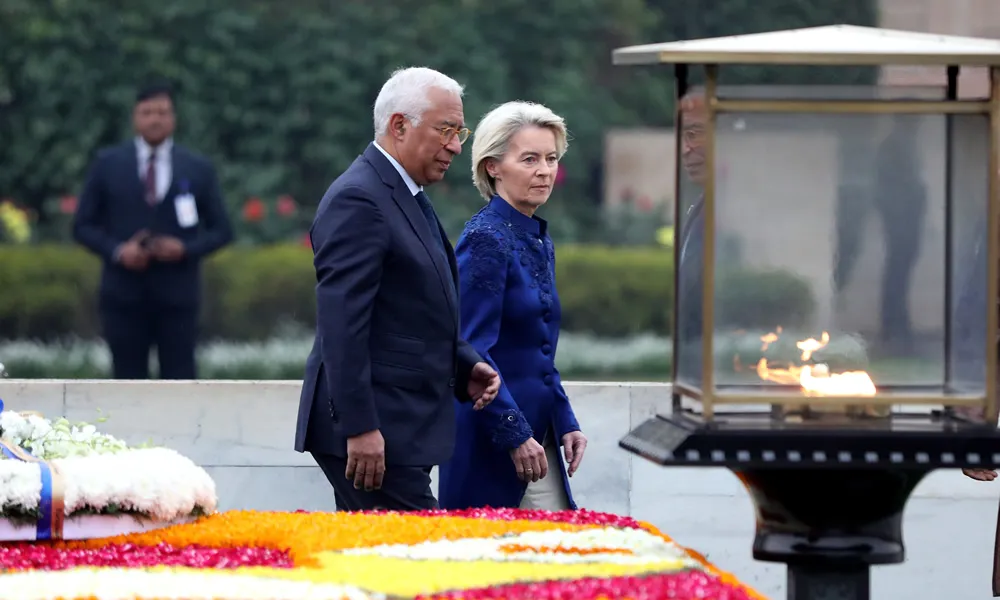
Just ten days ago, I was in Paraguay to sign the EU-Mercosur agreement, creating a market of more than 700 million people and binding Europe and Latin America more closely together at a moment of global realignment. Today, I am in New Delhi to conclude the largest trade agreement ever reached by either the European Union or India.
The EU–India deal will bring immediate benefits for European businesses and citizens. India already accounts for more than €180 billion in annual trade in goods and services with the EU, supporting close to 800,000 European jobs. Under this agreement, tariffs will be eliminated or reduced on 90% of trade. European exporters will save up to €4 billion a year in duties and EU exports are expected to more than double over time.
But this agreement is not just about managing risk in turbulent times, it is about seizing opportunity. It is an investment in the long-term partnership between two of the defining powers of the 21st century. India is the most populous country in the world, and its fastest-growing large economy. Expanding at over 6% a year, it will drive global growth for decades. We are not just trading more; we are investing in each other’s futures. This agreement grants the best conditions India has ever offered to any partner. European firms will enjoy conditions unmatched by global competitors – so they will be in pole position to help shape, and share in, that growth alongside Indian partners. India will gain a trusted, reliable partner to invest in its global rise.
Europe’s farmers will also benefit. Today, Europe exports ten times more agri-food products to China than it does to India. This deal will help close this gap. Indian tariffs on wine will fall from 150% to as low as 20%. Duties on olive oil will drop from 40% to zero. New opportunities will open for Europe’s farmers in a vast and increasingly prosperous consumer market. At the same time, Europe’s sensitivities are fully protected. There are no tariff reductions on beef, poultry or sugar, and all EU health, safety and environmental standards continue to apply to imports from India.
Trade agreements often sound technical. But their effect is simple: when the world feels uncertain, trade agreements create certainty. That matters. It matters to the wine producer deciding whether to invest in a larger harvest, or to the pharmaceutical entrepreneur in Cyprus considering whether to hire new staff to adapt for a distant market.
This agreement is about more than economics. Europe is responsible for its own defence, just as we are responsible for our own prosperity. But in security, as in trade, we know we need to diversify. Today, we are signing the first ever EU-India security and defence partnership. A further sign of how much the world has changed, and how new realities can forge new bonds. We are strengthening the links between our defence industries and our armed forces, including joint naval exercises to tackle piracy and protect vital sea lanes.
Faced with a more fractured global order, Europe and India are showing that another way forward is possible - cooperation over confrontation.
This is not the time for nostalgia politics. The world will not return to old certainties. Standing still will not restore stability; it will only ensure decline. Europe’s answer is to bind itself closer to trusted partners, pursuing diversification, cooperation, and strength - without illusion and without fear.