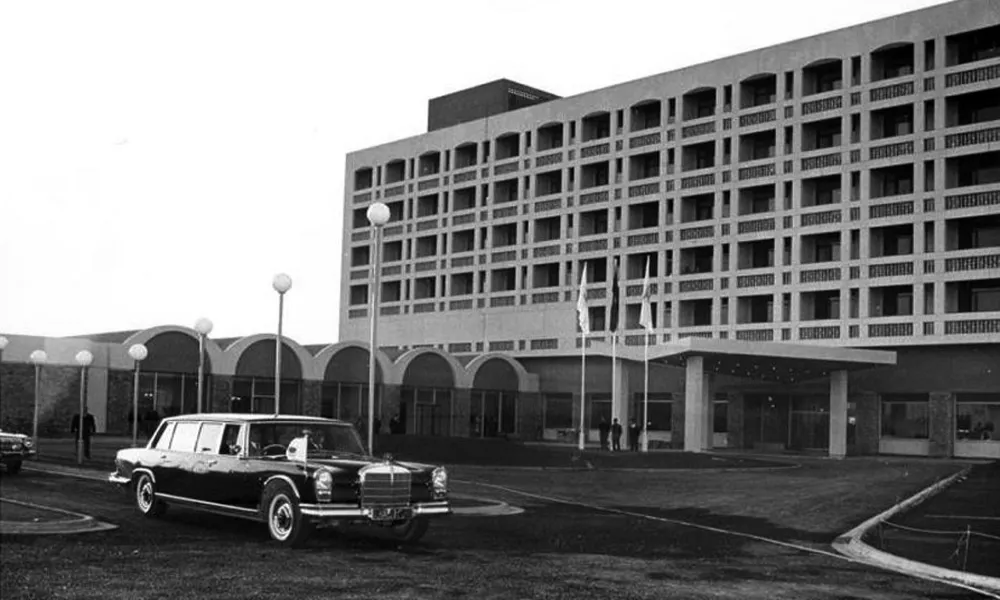
The five-star Hilton Nicosia officially opened on 2 February 1967, marking a milestone in Cyprus’ post-independence tourism development. The hotel operated continuously for 55 years, before being acquired in 2017 by Invel and Pangaea Investments. It was subsequently renamed The Landmark Nicosia, with the change taking effect on 1 June 2019.
In October 2021, the historic hotel closed for extensive renovation. It has now reopened under the name The Landmark Nicosia, Autograph by Marriott, re-entering the city’s hospitality landscape with a renewed identity.
The building had previously undergone major changes in 1982, followed by an expansion and second renovation in 1995, resulting in its current capacity of 588 beds.
A Presidential meeting that set the project in motion
The idea for the hotel was conceived in June 1962, during an official visit by President Makarios III to the United States, following an invitation from President John F. Kennedy.
While in New York, Makarios met Conrad Hilton, founder of the Hilton hotel chain. An agreement was reached swiftly, as the political and economic conditions of the time were considered favourable for tourism investment in Cyprus, then in its second year of independence.
The early 1960s saw the rise of organised tourism in Europe, the expansion of air travel, and the growth of affordable package holidays to warm destinations for travellers from Northern and Central Europe. Cyprus was well positioned to benefit from these trends.
At the time, the island had 4,282 hotel beds across 118 establishments. Only four hotels were classified as “De Luxe”, equivalent to today’s five-star category: Ledra Palace and Regina in Nicosia, Dome in Kyrenia, and Curium Palace in Limassol.
Shareholders and development
The government approved the establishment of the public company Tourism Development Company Ltd, tasked with overseeing the development of Hilton Cyprus.
Private-sector participants included prominent figures from business, shipping, travel and hospitality, nominated through professional associations and industry bodies, reflecting a broad coalition behind the project.
The inauguration
The architectural plans were prepared by Reglan Squire & Partners, in collaboration with I. & A. Philippou Brothers, while construction was undertaken by Ioannou & Paraskevaides.
The hotel was officially inaugurated at midday on 2 February 1967 by President Makarios, in the presence of Conrad Hilton.
In his address, Makarios said Cyprus was proud to be included “in the golden chain of Hilton hotels”, describing the project as a fusion of modern American life set within a Cypriot environment. He highlighted Cyprus’ natural beauty, its mythological association with Aphrodite, and its growing appeal to international visitors, including many from the United States.
The hotel quickly became a point of reference, hosting heads of state, artists, scientists and public figures. It emerged as a social hub not only for Nicosia but for Cyprus more broadly, often compared with the Hilton Athens, which had opened in 1963.
Witness to history
Over the decades, the Hilton Nicosia became a silent witness to key moments in the island’s modern history. Its most significant role came during the 1974 coup and Turkish invasion, when it housed the international press centre, accommodating hundreds of foreign journalists covering the unfolding crisis.
Four years later, on 18 February 1978, the hotel was the site of a terrorist attack during a conference of the Afro-Asian People’s Solidarity Organisation. Two armed assailants assassinated the organisation’s secretary-general, Youssef El Sebai, an Egyptian politician, journalist and close associate of President Anwar Sadat.
Conference delegates were taken hostage in the hotel café. Among them was Vassos Lyssarides, then leader of EDEK and a personal friend of El Sebai.
The hotel’s reopening under a new name brings back into public life a building that has long been intertwined with Cyprus’ political, social and cultural history, carrying with it the weight of events far beyond hospitality alone.
Source: Polignosi