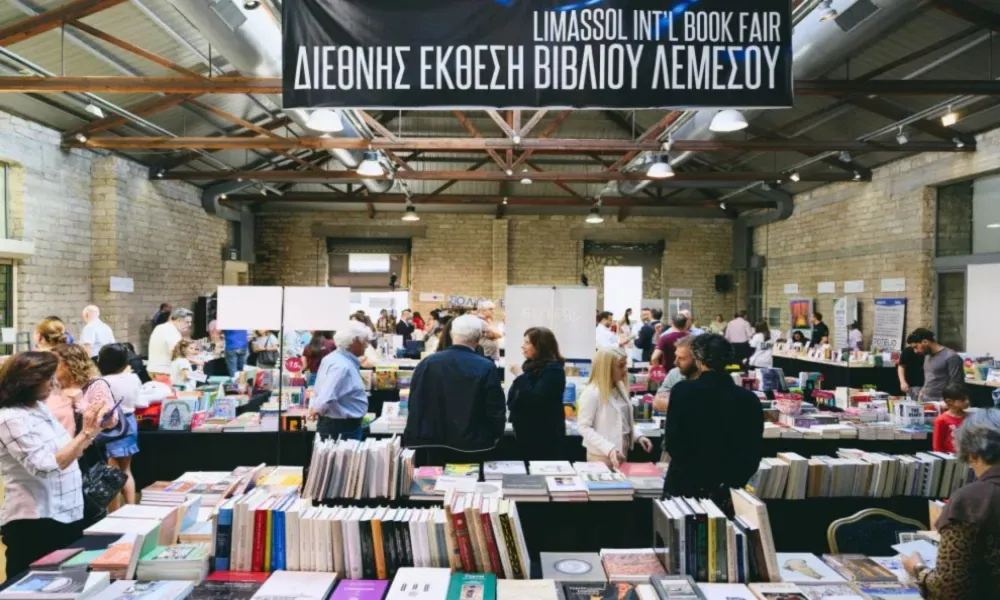

The 5th Limassol International Book Fair will take place from 20 to 22 November at the Carob Mill venues in Limassol, bringing together 46 international guests from 11 countries and introducing a series of new initiatives.
Organisers Haris Ioannides, Anna Ioannidou and Christos Michalaros told the Cyprus News Agency that the fair has become firmly established in Cyprus' cultural calendar and has helped strengthen the place of books in society.
Ioannides said the organisers discuss new ideas after every edition but believe it is more important to build on existing successes than to pursue innovation for its own sake.
"Our aim is to bring more people closer to books, especially those who do not have reading as part of their daily lives," he said, adding that the fair seeks to broaden its themes so that every visitor can find something relevant or inspiring.
New initiatives
For the first time, all exhibition stands and event stages will be operating from Friday.
Through the Stories on Wheels initiative, books will be collected for seven libraries in remote communities, while the fair is also participating in the creation of the international BookTech Collective, an initiative linking the publishing sector with technology.
The organisers stressed that the goal is not simply to bring international guests to Cyprus for a series of talks.
"We want relationships that last, collaborations that continue, and people who remain friends of Cyprus and of Cypriot literature," Ioannides said.
Promoting books and publishing
The fair also aims to encourage visitors to explore exhibition stands, meet authors and publishers, and purchase books.
According to the organisers, a healthy publishing market is essential for a strong publishing ecosystem.
Other objectives include promoting Cypriot books both locally and internationally, while maintaining discussion about the future of the sector and the need for a long-term strategy for books and reading.
They hope that partnerships formed during the fair will continue beyond the event, leading to more translations of Cypriot books into other languages and the development of new initiatives.
Books and technology
Anna Ioannidou said books, in all their forms, remain an important tool for knowledge, reflection, entertainment and meaningful communication.
While new technologies can expand opportunities for creating, distributing and accessing knowledge, she said they should not come at the expense of critical thinking, human connection or the value of reading.
She described the fair as a hub bringing together authors, publishers, academics, industry professionals and readers, creating space for discussion about developments in literature and publishing.
"The challenge is not to choose between books and technology, but to ensure that technological progress continues to strengthen people, knowledge and culture," she said.
Changing perceptions
Christos Michalaros said the fair has helped reshape perceptions about reading in Cyprus.
When the event was launched five years ago, he recalled, organisers frequently heard that Cypriots did not read and that the local publishing sector had limited prospects.
According to Michalaros, those assumptions have been challenged year after year.
Beyond growing visitor numbers, he said people from different towns now arrange to meet at the fair, discover new authors and books, bring their children to buy books and actively seek to broaden their reading horizons.
"It is extremely rewarding to hear visitors say they now make time in their lives for reading and not only for scrolling," he said.
"It is a great source of satisfaction, but also motivation to continue."
Source: CNA