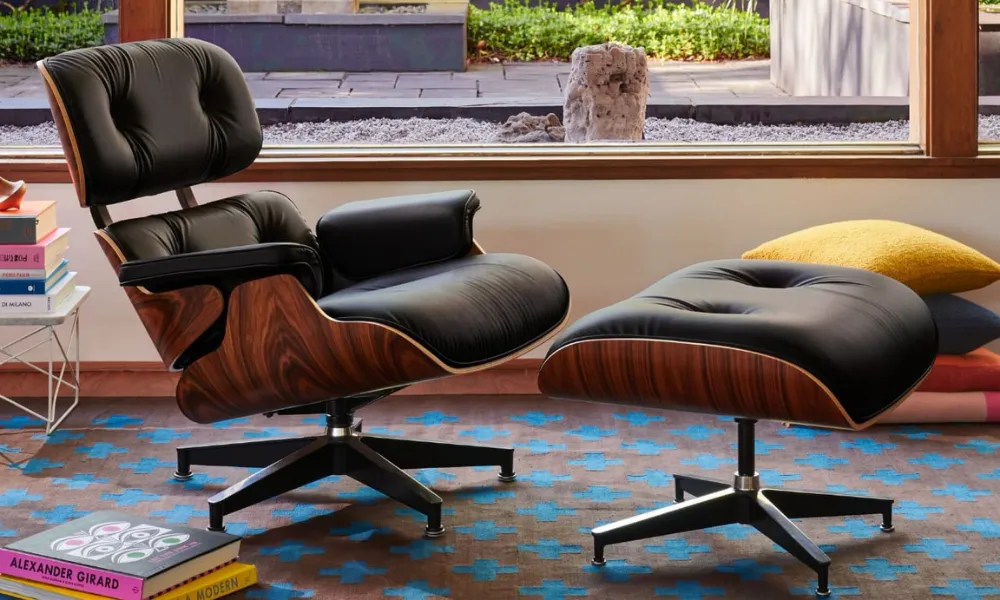

The Eames Lounge Chair and Ottoman was designed by Charles and Ray Eames and introduced by American furniture company Herman Miller in 1956. It was the first chair the Eameses designed for the high-end market, and it has remained in continuous production ever since, a rarity among their designs, most of which moved in and out of production over the decades.
The designers
Charles Eames was born in St Louis, Missouri, in 1907, and Ray Kaiser Eames was born in Sacramento, California, in 1912, according to the Metropolitan Museum of Art. The two met at the Cranbrook Academy of Art in Bloomfield Hills, Michigan, where Charles had become head of the experimental design department. According to the Eames Foundation, their partnership began when Ray assisted Charles and fellow designer Eero Saarinen on a winning entry to the Museum of Modern Art's 1940 Organic Design in Home Furnishings competition. Charles and Ray married in 1941 and moved to Los Angeles, where they began experimenting with moulded plywood in their apartment.
During the Second World War, the couple adapted their plywood techniques for the United States Navy, producing leg splints, stretchers and experimental glider shells, work that led directly to the founding of the Eames Office, according to the Eames Foundation. Over four decades, the Office went on to shape American furniture, architecture, film and exhibition design, according to Encyclopaedia Britannica.
From wartime plywood to a design icon
The Eames Lounge Chair emerged from this earlier plywood work. According to Herman Miller, Charles and Ray wanted to create a chair with "the warm, receptive look of a well-used first baseman's mitt," a deliberate departure from the bulky, upholstered club chairs of the 19th century that the design was intended to modernise.
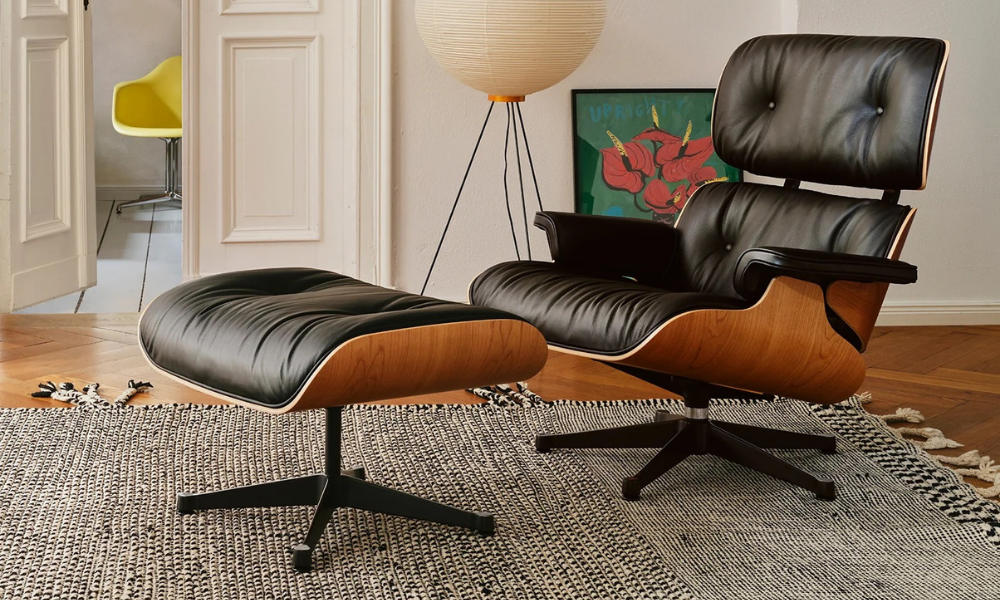
The finished chair is built from three curved, seven-ply moulded plywood shells, forming the headrest, backrest and seat, connected by rubber and metal joints known as shock mounts that let each shell flex independently, according to Herman Miller. The shells are topped with button-tufted, leather-upholstered cushions and set on a die-cast aluminium base that swivels 360 degrees. A matching ottoman completed the design.
Debut and recognition
The chair made its public debut in 1956 on the NBC television programme Home, hosted by Arlene Francis, according to Herman Miller. Herman Miller began marketing and selling the chair immediately afterwards, and licensed production began in Europe through Vitra in 1957. According to Vitra, the chair was awarded the Triennale Prize in Milan shortly after its European licence began, and by 1960 it had entered the permanent design collection of the Museum of Modern Art in New York.
The chair and ottoman, originally produced in rosewood and leather, are held today in major design collections, including MoMA, the Smithsonian's Cooper Hewitt, National Design Museum, and the Art Institute of Chicago, according to Herman Miller and Cooper Hewitt's collection records. Cooper Hewitt's holdings include an original 1956 chair and ottoman, catalogued as No. 670 (chair) and No. 671 (ottoman).
A design still in production
Herman Miller remains the chair's sole authorised manufacturer in the United States, assembling each example by hand. The design has been adapted only in small ways over the decades, most recently through sustainable upholstery options, including bamboo-based vegan leather and a fabric made from post-consumer recycled wool, according to Herman Miller's own product history. Vitra continues to produce the chair for the European and Asian markets under licence, and has more recently introduced European-sourced wood to its version of the design.
Nearly seventy years after its debut, the Eames Lounge Chair and Ottoman remains, according to Britannica, one of the clearest expressions of Charles and Ray Eames's design philosophy: mass-producible furniture defined by beauty, comfort and elegance.
Sources: Herman Miller, Museum of Modern Art (MoMA), Encyclopaedia Britannica, Eames Foundation, Metropolitan Museum of Art, Cooper Hewitt, Smithsonian Design Museum, Vitra