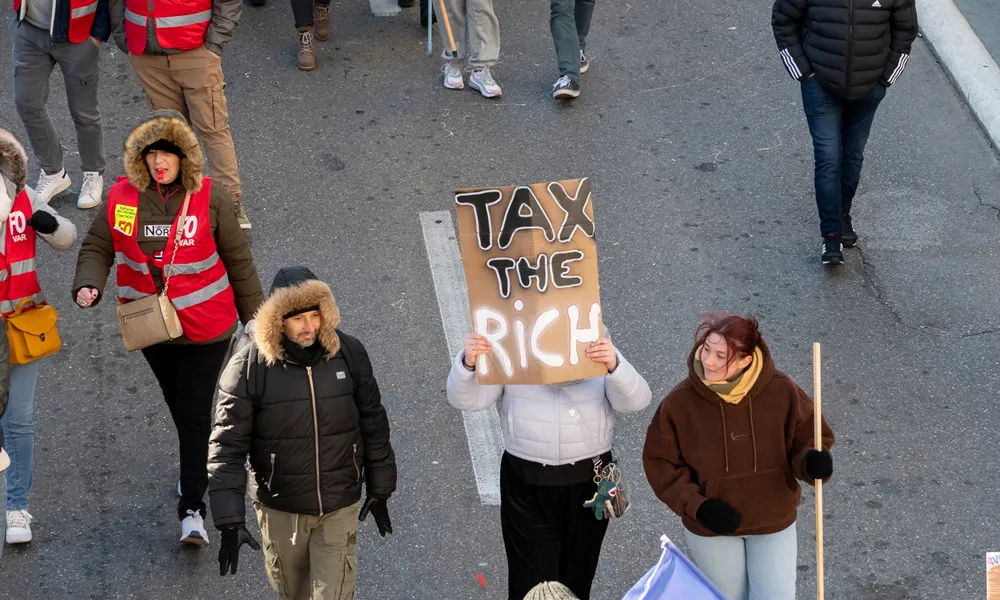

Across Europe, the debate over how to tax wealth has returned with force. In France, lawmakers and economists have openly questioned whether the very richest should be subject to a minimum wealth tax, arguing that traditional tax systems are failing to capture extreme concentrations of capital. At EU level, however, the most concrete movement has not been toward personal wealth taxes, but toward minimum corporate standards and tighter anti-avoidance rules.
Cyprus’s recent tax reform sits squarely at this intersection. It does not attempt to tax wealth directly, nor does it mirror the French debate. Instead, it recalibrates the country’s existing model to fit a new European tax environment shaped by the 15% minimum corporate tax, while preserving the role of taxation as a tool of competitiveness rather than redistribution.

That framing has been echoed by Finance Minister Makis Keravnos, who has repeatedly stressed that the reform is not designed as a “tax the rich” exercise, but as a structural adjustment required by a changing European and international tax landscape. Presenting the package, Keravnos said the government’s objective was to modernise the tax system, strengthen compliance and safeguard Cyprus’s competitiveness, while aligning with the EU and OECD minimum corporate tax framework. According to the Finance Minister, the shift to a 15% corporate tax rate and the redesign of dividend taxation were intended to create a more balanced and transparent system, one that supports economic activity and investment without undermining public finances, a point he had underlined during the reform debate.
That distinction is central to how the reform should be read, according to Anastasis Yiasemides - Cypriot economist and tax policy specialist, who argues that the changes move Cyprus in a more coherent, if not more progressive, direction.

“The tax reform is moving in the right direction,” Yiasemides says, “insofar as it reduces the tax burden for certain taxpayers and narrows the differences between companies with Cypriot shareholders and those with foreign shareholders.”
At the core of the reform is a redesign of how business profits are taxed. Cyprus raised its corporate income tax rate from 12.5% to 15%, aligning with the EU and OECD minimum-tax environment. At the same time, it abolished deemed dividend distribution and cut the Special Defence Contribution on actual dividend distributions from 17% to 5%.
The combined effect is significant. “The effective tax rate for Cypriot businesses falls from around 23% to a structure of 15% corporate tax and 5% SDC on actual dividend distributions,” Yiasemides explains. In practice, this lowers the total tax friction for owner-managed companies and shareholders extracting profits, even as the headline corporate rate increases.
This design choice reflects a broader philosophy about what taxation can and cannot do. “Taxation should not be seen as a tool of social policy, but as something that complements such policies,” Yiasemides says. In his view, issues such as pensions, the cost-of-living crisis and housing affordability should be addressed through targeted state interventions, not through the tax system alone.

Competitiveness under European constraints
One of the key questions raised by the reform is whether Cyprus is losing ground as a low-tax jurisdiction within the EU. Yiasemides believes the increase in corporate tax is manageable, provided the broader framework remains attractive.
“The 2.5 percentage point increase in corporate tax is manageable,” he says, stressing that competitiveness depends on the overall package rather than a single rate. Predictability, clarity and the treatment of investment income all play a role in how Cyprus is perceived by businesses and high earners.
While France’s debate focuses on taxing extreme personal wealth, EU policy has concentrated on setting minimum corporate floors and limiting aggressive tax planning. Personal taxation, including how wealth is treated, remains largely a national choice.
Cyprus, in that sense, has opted for alignment rather than experimentation.

Wealth taxation and Cyprus’s limits
As discussions around taxing wealth intensify across Europe, driven by fiscal pressures in large economies, Cyprus faces structural limits. “In Cyprus, it would be very difficult to implement a global wealth tax,” Yiasemides says, warning that such a move would significantly undermine competitiveness in a small, service-oriented economy.
That does not mean all forms of wealth-related taxation are off the table. Yiasemides suggests that targeted approaches could return to the agenda. “Property taxation could re-emerge in some form, particularly on inactive or underutilised property,” he notes, drawing a line between broad wealth taxes and more focused instruments.
Sustainability and administration
Whether the reform strengthens the long-term sustainability of public finances remains an open question. Critics have argued that the reduction in dividend taxation could cost the state more than the additional revenue generated by the higher corporate rate.
“This is something we will have to see in practice,” Yiasemides says. At the same time, he points to administrative reforms as an often-overlooked pillar of sustainability. “Significant steps have been taken in the digitalisation of the Tax Department through the Tax For All system,” he says, arguing that improved compliance and easier interaction for taxpayers could have long-term benefits.
A service-based model, reaffirmed
Looking ahead, Yiasemides is clear-eyed about Cyprus’s economic reality. “Cyprus does not have, and will not develop, heavy industry,” he says. As a result, the economy will continue to rely on services, and taxation will remain a key instrument for maintaining competitiveness as a financial and business centre.
Seen in this light, Cyprus’s tax reform is less a response to calls to “tax the rich” and more an adjustment to a Europe where minimum standards are rising and room for divergence is narrowing. France may be testing the political limits of wealth taxation. The EU is building enforcement and minimum floors. Cyprus, by contrast, is refining a model built on balance: compliance where required, competitiveness where possible.
The unresolved question, now shifting to Brussels, is how long that balance can hold as European tax debates continue to evolve.