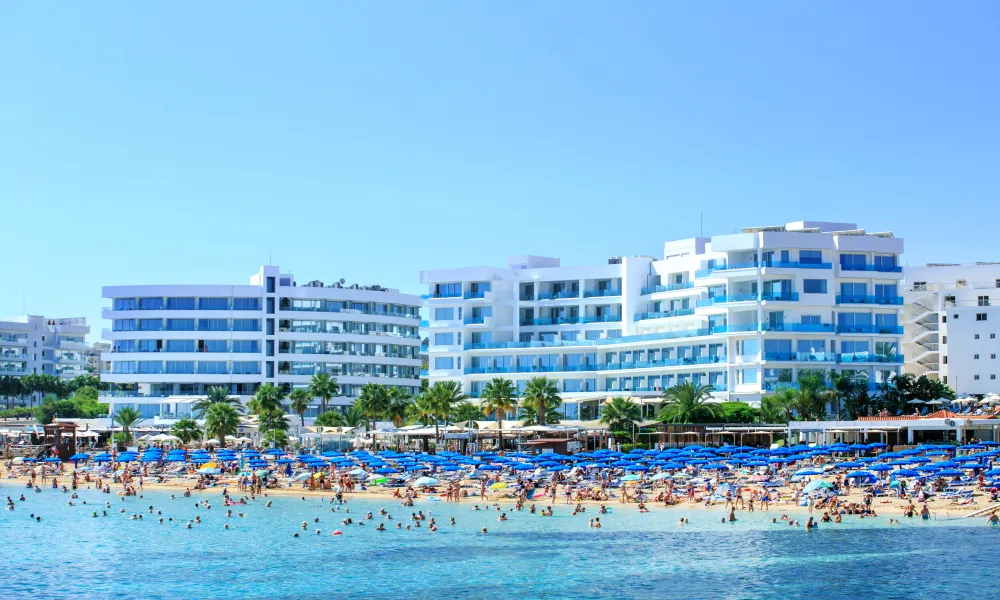
Hotel sector calls for more support
Hotelier associations STEK and PASYXE asked the government for additional support in light of reduced bookings caused by the ongoing crisis in the Middle East.
During the meeting at the Deputy Ministry of Tourism – attended by the Ministers of Labour and Finance, Government Spokesperson Konstantinos Letymbiotis, and Deputy Minister to the President Irini Piki – officials reviewed the support measures announced for the hotel industry.
Among the economic support measures announced last Thursday by President Nikos Christodoulides is a subsidy for hotel sector wages for April. Specifically, the government announced a 30% subsidy of employee wages in hotel units and tourist accommodation that remain in operation from 1 to 30 April 2026.
At Monday’s meeting, Politis understands that the hotel associations requested the subsidy be increased to 50%, but the government declined to adjust the scheme.
A government source told Politis that the meeting reviewed the measures already announced for the hotel industry, adding that the government is monitoring the impact of the war and developments in fuel prices, expressing hope for improvement. Should the crisis continue, the source said, the government is examining various scenarios – always within the state’s fiscal capabilities.
Hoteliers alarmed
Ongoing cancellations and slow booking rates are raising fears that some businesses may choose not to open in April, increasing the risk of layoffs and redundancies. Even for active bookings, hotel executives told Politis they fear they will be cancelled if the war in the Middle East continues.
One hotel executive noted that each business owner must assess whether it is economically viable to open or remain closed, adding that with the additional support requested (from 30% to 50%), the overall savings for the state would be greater compared with the cost of covering unemployment benefits if layoffs occur.
As of late Monday afternoon, PASYXE and STEK were still in joint deliberations to assess the situation.
Unions to meet Labour Minister
According to Politis sources, the hotel workers’ unions are scheduled to meet the Labour Minister today at 8.30am to discuss the measures adopted for the sector. The unions believe the criteria must be clearly defined to avoid problems in implementation.
Wave of cancellations
According to the Financial Times, the war in the Middle East has triggered a wave of holiday cancellations across the Eastern Mediterranean, extending far beyond the immediate conflict zone and affecting countries including Cyprus and Turkey, while driving up prices in busy destinations in Western Europe.
In Cyprus, accommodation prices for April and May fell by more than 12% last week compared with the week before the outbreak of the conflict, according to Lighthouse Intelligence, which monitors hotel and short‑term rental demand and pricing.
Nick Aristou, commercial director at Muskita, told the FT that Cyprus’s tourism sector can withstand “some turbulence,” but only if travellers return soon. “The war needs to end soon,” he said. “If it continues for another two or three weeks, then the summer will be affected – and that is when things will become really serious for us.”
Travellers express “a general anxiety about the wider Middle East,” said Natasha Michaelidou, director of Thanos Hotels and Resorts, noting that the company did register a slight uptick in bookings late last week.
The main challenge for Cyprus as a destination since the outbreak of the war with Iran is the perception of insecurity abroad. “Public opinion is being bombarded with travel advisories from various countries, signalling a difficult tourist season ahead,” the president of the Association of Cyprus Travel & Tourism Agents (ACTTA), Haris Papacharalambous, told CNA.
According to Papacharalambous, developments in the war will be decisive for Cyprus tourism. Travel agents are also awaiting government measures to address the crisis – measures currently limited to support for airlines and hotels.
Cyprus, Greece exposed
A report by Canadian rating agency Morningstar DBRS also highlights the effects of the crisis on tourism. The agency notes that Greece and Cyprus are particularly exposed to geopolitical shocks from the Middle East due to the disproportionately large role of tourism and shipping in their economies, despite their resilient growth.
Cyprus, it said, is more vulnerable due to its proximity to the conflict zones.
The DBRS report adds that the tourism and shipping sectors are significantly more important to the economies of Greece and Cyprus than to most other EU member states.
Informal meeting of Energy Ministers
Meanwhile, an extraordinary informal meeting of EU Energy Ministers will take place today under the Cypriot Presidency of the Council of the European Union 2026. The meeting will be held via videoconference, and ministers will discuss the EU’s coordinated approach to the energy situation in light of developments in the Middle East.