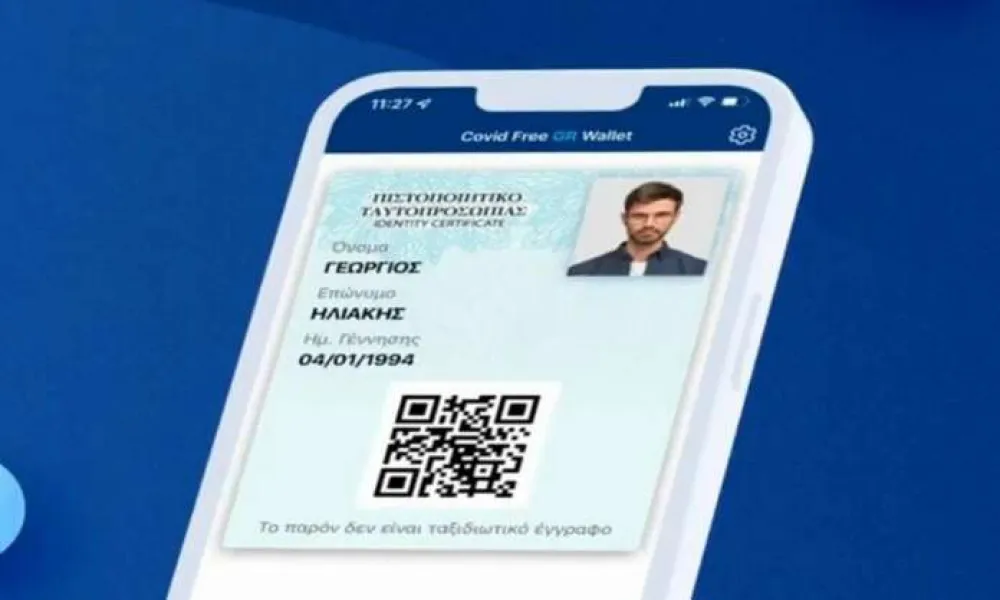

The European Commission has announced that its new European age verification application is technically ready, with Cyprus listed among the member states preparing to integrate the tool into national digital wallets. The initiative is designed to help protect minors from harmful online content while maintaining strict privacy safeguards.
European Commission President Ursula von der Leyen presented the initiative alongside Executive Vice-President Henna Virkkunen, describing the application as a free and user-friendly solution for verifying age when accessing online services.
Cyprus among early adopters
Von der Leyen said several EU member states are already moving ahead with implementation, identifying Cyprus among the countries at the forefront of integrating the application into their digital systems.
“We see member states such as France, Denmark, Greece, Italy, Spain, Cyprus and Ireland at the forefront, planning to integrate this element into their national digital wallets,” she said.
The application allows users to prove their age when accessing online services in the same way age is verified in the physical world. According to the Commission, it is designed to operate without revealing additional personal information or enabling user tracking.
Technical features and open-source framework
The Commission said the application has been developed with strong privacy protections and will work across devices including mobile phones, tablets and computers.
Von der Leyen emphasised that the tool is fully open source, meaning its code can be publicly reviewed. She also noted that the system could be used beyond the European Union.
“It works on mobile, tablet or computer, on any device,” she said. “It is open source so anyone can check the code, and this means it can also be used by international partners.”
Model based on COVID-19 digital certificates
Von der Leyen linked the project to the experience gained during the COVID-19 pandemic, when the EU introduced digital vaccination certificates.
“During COVID-19 we developed the certificate application in record time, in just three months. It was used by 78 countries across four continents. It was a great success,” she said, adding that the same model and principles are now being applied to age verification.
Enforcement under the Digital Services Act
Executive Vice-President Henna Virkkunen said protecting minors online remains a key priority for the European Union, highlighting the role of the Digital Services Act (DSA) in regulating online platforms.
“The enforcement of the rules is critical. We will not tolerate platforms that make money at the expense of children,” she said.
Virkkunen referred to recent EU actions against platforms over addictive design practices, including infinite scrolling, autoplay functions, continuous notifications and highly personalised algorithms.
Privacy protection and EU coordination
Virkkunen said the Commission developed the application after identifying the lack of reliable age verification tools from online platforms themselves.
“As platforms do not have the appropriate tools, we moved forward with our own solution. The European application is technically ready as of today,” she said.
She added that the system is designed to keep users in full control of their personal data and will avoid practices such as scanning passports or using facial recognition.
The Commission is also working on a European coordination mechanism to ensure age credentials function seamlessly across all member states.
“We need one common solution, not 27 different ones,” Virkkunen said, adding that the EU remains committed to ensuring the internet becomes a safer environment for children.