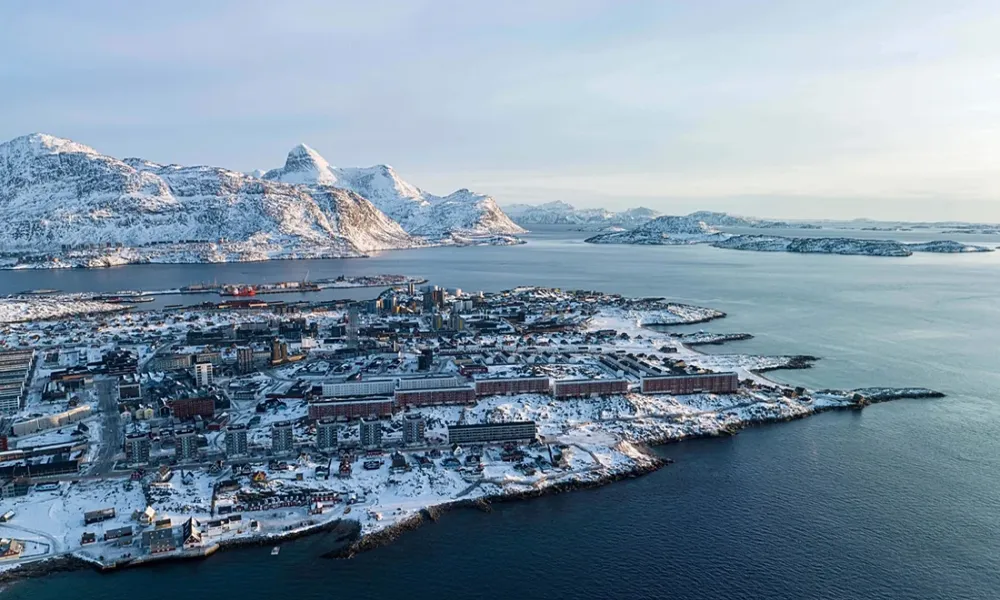
While rising global temperatures are causing sea levels to rise worldwide, Greenland presents a surprising anomaly: its sea levels are projected to drop, posing unique challenges for coastal communities and infrastructure.
According to Euronews researchers at the Lamont-Doherty Earth Observatory, part of the Columbia Climate School, have found that despite record ice melt driven by climate change, sea levels around Greenland are likely to fall in the coming decades. The study, published in Science Communications, predicts that by 2100, sea levels could drop by approximately 0.9 metres in a low-emissions scenario and up to 2.5 metres under high-emissions conditions.
Greenland’s seas are falling
The phenomenon is linked to the mass of Greenland’s ice sheet. As the ice melts, the land beneath it rebounds, rising once freed from the immense weight, in a process known as glacial isostatic adjustment. Lead author Lauren Lewright explains: “The sea surface is pulled toward the ice sheet because of that gravitational pull. As the ice sheet loses mass, its gravitational pull on the sea surface decreases, translating into sea level fall.”
Co-author Jacqueline Austermann likens the effect to a memory-foam mattress decompressing after the weight on it is removed. Both the land rebound and the change in gravitational pull are expected to account for up to 30 per cent of Greenland’s future sea level decline.
Implications for communities and industry
Falling sea levels may seem like a reprieve from the flooding threatening millions worldwide. However, for Greenland’s coastal communities, infrastructure and industries like shipping and fishing, the impacts could be significant. “The biggest impact is on local communities and the effects on shipping routes, fishing and infrastructure,” Austermann warns. Buildings and ports designed for current sea levels could be left “high and dry.”
There is also potential for stabilising certain glaciers as they enter the ocean, which could slow their retreat. However, researchers caution that it is unclear whether the predicted sea level drop will be sufficient to trigger this effect.
As climate change continues to reshape coastlines globally, Greenland’s unique situation underscores the complexity of the planet’s response to warming, and the unexpected consequences that may arise.
Source: Lamont-Doherty Earth Observatory / Science Communications, via Euronews.