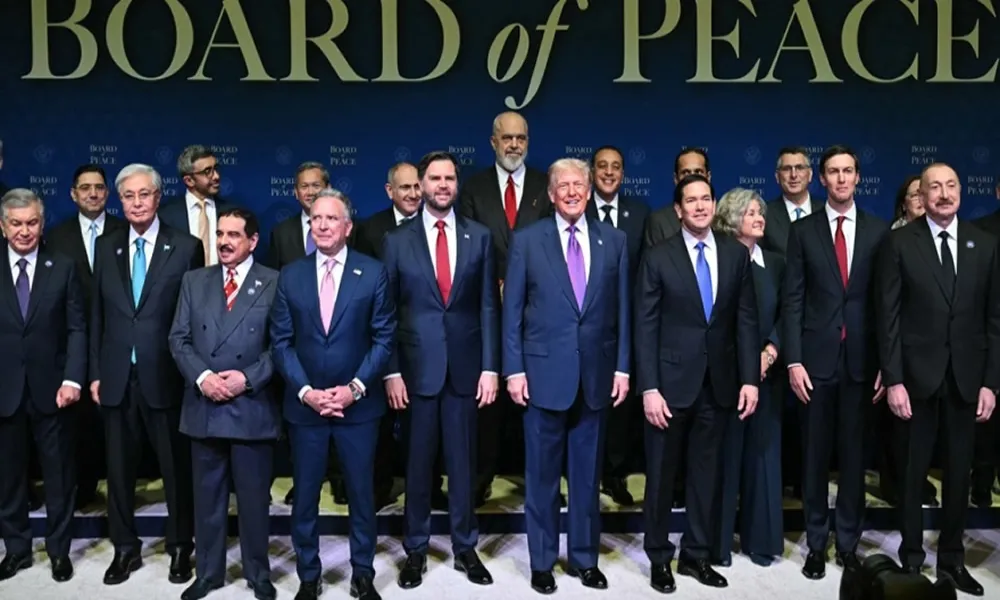
President Donald Trump convened the first-ever meeting of the Board of Peace at the United States Institute of Peace in Washington, D.C.—a building now bearing his name. Addressing a room full of heads of state and top diplomats, Trump welcomed dignitaries from countries including Argentina, Hungary, India, Pakistan, and Vietnam. Meanwhile, France and the United Kingdom, which have not joined the board over concerns about possible Russian involvement, sent observers.
Israel and Arab states also have representatives at the board, but notably, there is no Palestinian representative.
Trump opened with high praise for his creation:
"This is the most prestigious board ever put together. You know, I've seen some great corporate boards. I've seen some great boards, period. It's peanuts compared to this board," he said.
Some observers worry the new organization could be used to undermine the United Nations. Indeed, a U.N. Security Council meeting on Gaza was moved up on Wednesday to allow diplomats to attend both gatherings.
Trump also signaled a broader vision for the panel:
"Someday I won't be here, the United Nations will be, I think, is going to be much stronger. The Board of Peace is going to almost be looking over the United Nations and making sure it runs properly," he said, adding that the board would work "very closely" with the U.N.
$7 Billion Pledged for Gaza
Nine countries—Kazakhstan, Azerbaijan, UAE, Morocco, Bahrain, Qatar, Saudi Arabia, Uzbekistan, and Kuwait—pledged a total of $7 billion to support reconstruction in Gaza, according to Trump. While substantial, this is only a fraction of the estimated $70 billion needed to fully rebuild the territory.
The United States separately pledged $10 billion to the Board of Peace, though Trump did not clarify how the funds would be allocated.
Additionally, countries including Indonesia, Morocco, Kazakhstan, Kosovo, and Albania committed to sending troops to a Gaza stabilization force, while Egypt and Jordan pledged to train police personnel.
A key component of the Trump plan hinges on Hamas disarming. Israel, the U.S., and several Arab states insist that financial and military support should be conditional on assurances that Hamas no longer rules Gaza, to avoid a resumption of hostilities.
Israeli Prime Minister Benjamin Netanyahu stated that Hamas must surrender not only heavy weapons such as rockets and mortars but also small arms like Kalashnikov rifles, even as Israel supports rival Palestinian militias fighting Hamas on the ground.
Trump Sends Message to Iran
While emphasizing the need for peace, Trump also issued pointed remarks toward Iran, signaling U.S. resolve in the region.
“We have to make a meaningful deal. Otherwise bad things happen,” Trump said, standing before regional allies who had recently urged restraint. His comments underscored the broader strategic stakes, even as he sought to promote the Board’s image as a neutral conflict-solving body.
Turkiye Offers Troops Amid Ceasefire Concerns
Turkiye’s Foreign Minister Hakan Fidan announced yesterday that Ankara is prepared to deploy troops to Gaza and contribute to rehabilitation of health and education sectors, as well as police training.
However, ongoing ceasefire violations have complicated foreign force deployment. “The humanitarian situation remains fragile, and ceasefire violations continue to occur. A prompt, coordinated, and effective response is essential,” Fidan said.
Israeli Prime Minister Benjamin Netanyahu has openly opposed Turkiye’s troop involvement, reflecting tensions in regional cooperation.
European Allies Sit Out
While several European nations sent observers to the Board of Peace meeting, key allies like the UK, Italy, Germany, and France declined full membership.
- The UK cited legal concerns over joining a treaty-like body.
- Italy and Germany referenced constitutional restrictions.
- France raised objections that the Board might undermine United Nations authority, giving Trump excessive power over Gaza reconstruction.
Analysts suggest these decisions reflect broader skepticism about the Board’s legitimacy and Trump’s ambitions for it to rival the UN in conflict resolution.
Critics Cite Authoritarian Membership
Observers noted that many founding member countries are governed by authoritarian regimes or military-led governments. According to The Guardian, several members joined largely to appease Trump, sparking criticism that the Board of Peace may prioritize strategic interests over democratic norms and human rights.
“The US-led body is seen as an attempt to sidestep the UN and establish a fee-paying members’ club run by one individual,” reported Oliver Holmes of The Guardian.
Protests Highlight Palestinian Voices
Outside the United States Institute of Peace, dozens gathered yesterday to protest Israel’s involvement and the exclusion of Palestinian representation. Chants of “Gaza is not for sale” and “Free Palestine” echoed as police mobilized around the scene.
Al Jazeera’s Manuel Rapolo reported, “Without discussing the right to self-determination of the Palestinian people, there is no concrete plan that could be put in place.” Protesters argue that peace and reconstruction efforts cannot succeed without Palestinian participation.
Looking Ahead
As the Board of Peace moves forward, it faces complex challenges: balancing pledges and troop contributions, ensuring compliance with ceasefire agreements, requiring Hamas disarmament, and gaining international legitimacy. While yesterday marked a historic start, the road ahead for Gaza reconstruction and broader Middle East stabilization remains uncertain.