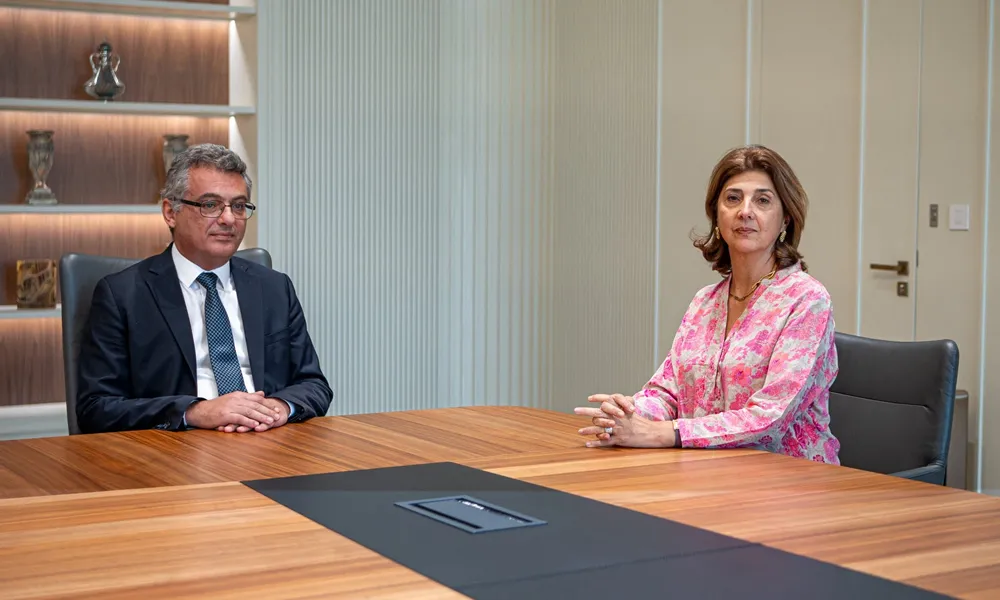
Polish Ambassador to Cyprus Marek Szczepanowski gave a candid account of his country’s six-month turn at the helm of the EU Council on Wednesday, noting that achieving unity was the greatest challenge. He singled out Hungary, and to a lesser extent Slovakia, for holding out on unanimity in the Council while seeking trade-offs on the big issues, rather than pursuing Union goals.
He also advised Cyprus, before its EU Presidency begins in January 2026, to prepare well for highly developed disinformation campaigns, such as the “problematic” ones Poland experienced during its Presidency. The ambassador noted that Cyprus had elections coming up next year and needed to be alert. An embassy official noted in a presentation that disinformation campaigns are already in play in Cyprus, adding that Russian and Turkish sources appear to be the primary attackers.
The EU Presidency ‘Trio’ of Poland-Denmark-Cyprus, started with Poland in January 2025 and ends with Cyprus in June 2026. The Polish Presidency’s key focus during the six-month period was European security.
Milestones with difficulties
Speaking at a press event, Szczepanowski hailed the Polish EU Presidency’s achievements, referring to milestones such as the:
· Launch of the SAFE Instrument (Security Action for Europe), making €150 billion available in preferential loans for joint defence investments;
· Three new sanctions packages against Russia;
· European Migration Act, tightening rules on migration and asylum;
· OMNIBUS programme to reduce bureaucracy and simplify EU legislation;
· RePowerEU Roadmap to end dependency on Russian gas by 2027;
· Reform of the pharmaceutical sector for the first time in 20 years;
· EU Cyber Blueprint on shared cybersecurity crisis management;
· EU rapid response teams to strengthen resilience against hybrid threats (first mission sent to Moldova);
· Launch of European Democracy Shield to combat foreign information manipulation, protect democratic processes, and strengthen civil society.
On ending dependency on Russian gas, the Polish diplomat highlighted that Cyprus’ energy policy to deliver offshore Cypriot deposits to continental Europe via Egypt worked towards achieving this goal.
International order at stake
Regarding implementation of tougher sanctions against Russia’s war of aggression on Ukraine, the ambassador noted that Hungary, and to a lesser extent Slovakia, created the biggest obstacles, seeking trade-offs on national goals before aligning with EU efforts.
“We are very glad that President Christodoulides has shown from the very beginning strong support to Ukraine,” said Szczepanowski.
“If we allow Russia to prevail and subjugate Ukraine the situation for Cyprus would become difficult because it would mean that you can change the international order through an invasion.”
If we accept such a scenario all the other countries which have similar situations would also be in jeopardy, he added.
Beware of disinformation campaigns
Economic Officer at the Polish Embassy Agata Ratuszek-Parmakkis shared Poland’s recent experiences with disinformation campaigns mainly from Russian and Chinese sources, and the means with which they were countered.
Ratuszek-Parmakkis noted that FIMI (Foreign Information Manipulation and Interference) campaigns, including disinformation, have become a threat to democracy and to the rule of law. She argued that strengthening democratic resilience was the cornerstone of protecting Europe’s security. At the same time, democracy cannot thrive without freedom of expression, requiring a balanced approach in tackling such campaigns.
The embassy official noted that Poland is one of the most targeted NATO states in the EU in terms of FIMI campaigns. She highlighted four main categories of campaigns, adding that the EU needed to share expertise and resources to detect and respond to threats and build democratic resilience.
The categories are:
Misinformation – defined as incorrect or misleading information spread with no intention to cause harm.
Malinformation – information based on reality but used with intention to inflict harm on a person, organisation or country.
Disinformation – distributing false content that is shared with the intent to harm or achieve another specific purpose.
FIMI – A mostly non-illegal pattern of behaviour that threatens values, procedures and political processes. Manipulative, intentional, coordinated. Performed by state or non-state actors.
Poland has launched a systemic fight against disinformation in Poland, involving 10 government bodies and other state-affiliated institutions, as well as eight civil society organisations.
Ratuszek-Parmakkis pointed to two main types of disinformation operational models:
a) Russia: characterised as chaotic, aggressive, based on multiplying contradictory narratives;
b) China: methodical, systematic, long-term, focused on control and image-shaping.
The two use a combination of state media, internet and social media, she said. On the internet, Russia adopts rapid, large-scale campaigns using bots and trolls while mixing fiction with facts. China’s approach is to use large comment farms, and pursue content harmonisation through the removal or curation of content, said the economic officer.
In terms of their respective strategic goals, according to the Polish experience, Russia’s goal is destabilisation and the weakening of opponents, while China’s is building a positive image and achieving structural influence.
They are both highly developed, long-term campaigns with a global reach, said Ratuszek-Parmakkis.
Disinformation campaigns in Poland
She gave two examples of disinformation campaigns Poland faced in recent months:
1) Russian drone attacks in September: over 64,000 posts reached more than eight million users immediately after the attack, adopting narratives such as Poland “exaggerated” the threat, and that the drones were Ukrainian provocations. The goal was to cause confusion, undermine trust in the government’s security measures, weaken public support for Ukraine.
2) Attack on Polish railways in November: over 10,000 posts reaching over four million users on X, claiming it was a false flag operation to drag Poland into the war, or that the Ukrainians blew up the tracks.
Online campaigns in Cyprus
Regarding Cyprus, the Polish presentation noted several “spectacular examples of disinformation activities” where Russian and Turkish sources appeared to be the primary attackers, though Russia appears to adopt a more Chinese operational model for the island.
According to the presentation, disinformation campaigns in Cyprus focused on migration, Ukraine war, Covid, external politics and defence.
The goals were to: sow fear, distrust, and social polarisation; weaken Cyprus’ position in the region, undermine trust within Cypriot society, influence international relations, legitimise Turkery’s presence in the north.
For example, there are narratives circulating that Cyprus is a ‘pawn’ of third countries, with the aim of generating tensions with Arab or Islamic countries, and attempting to normalise the division of the island.
On social media, there are reports of the Cyprus Republic’s heavy militarisation, with Israel, India, Greece, the US, Serbia, France, and the UK involved. Reports are also shared of a “Greek Cypriot secret army” receiving military training abroad. And narratives that the Mari naval base will become a foreign warship hub for France, Israel, India, Greece and the US.
The effort is to portray Cyprus as dependent on external powers, said Ratuszek-Parmakkis, noting that recent surveys show over 70% of Cypriots take information from social media, compared to around 50% in Poland.
‘Prepare for election interference’
Speaking after the presentation, Ambassador Szczepanowski said Poland pays a lot of attention to such activities and called on Cyprus to also take measures, particularly ahead of next year’s parliamentary elections. He reminded of the problems faced in Romania last year when the Constitutional Court annulled the first round of presidential elections, citing evidence of foreign-backed disinformation and interference.
He highlighted that Poland set up a unit to deal with such threats in 2018, originally allocating 5 people. The same unit now has 70 people and needs more.
It is likely Cyprus will have to face these challenges, he added.