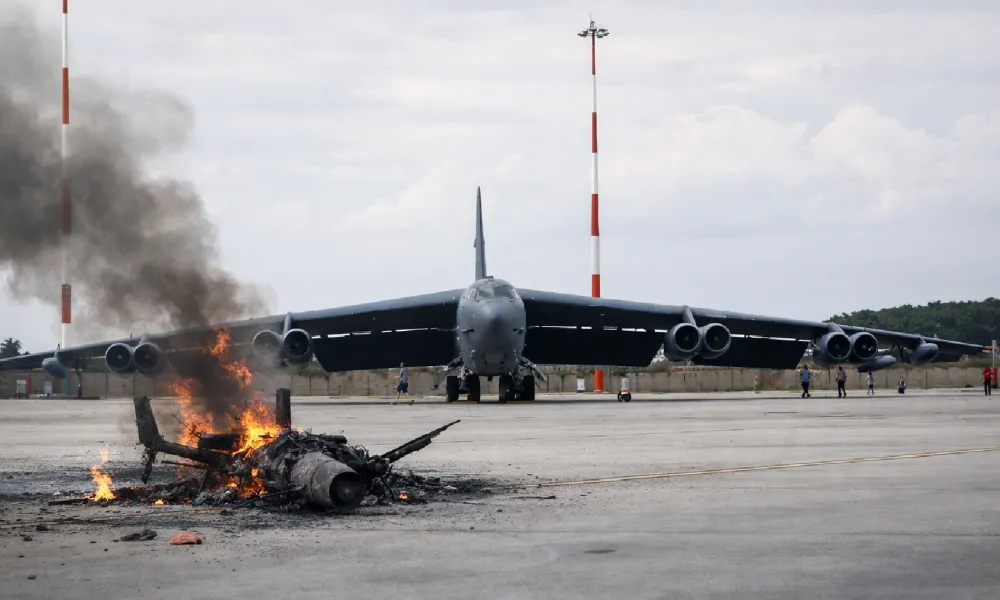

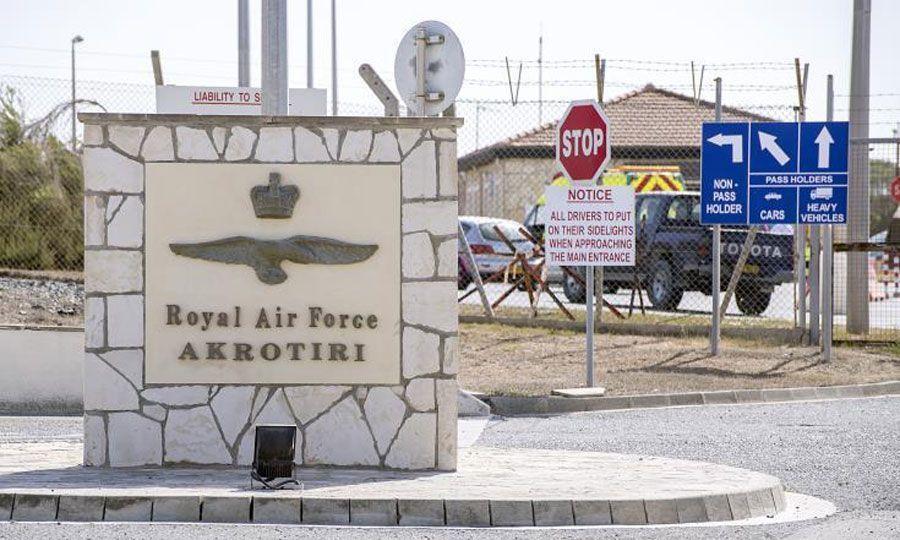
In the last 24 hours one Shahed drone struck a hangar at the Akrotiri British air base causing minimal damage while two more were intercepted en route. Fighter jets were seen coming and going throughout the day. Family members of bases personnel were moved to alternative accommodation nearby. In fear of more attacks, some Akrotiri village residents also left their homes to go stay in hotels. Nearby schools were closed and Paphos airport was briefly evacuated.
The drone attacks came just a few hours after British Prime Minister Keir Starmer announced on Sunday evening that the UK would permit American use of British bases to destroy Iranian missiles at storage depots and launch sites.
With or without US bombers – Cyprus now in the crosshairs
Speaking to the UK Parliament on Monday evening, Starmer said it was important to state that “our bases in Cyprus are not being used by US bombers”.
He added: “I want to be clear. The strike on RAF Akrotiri in Cyprus was not in response to any decision that we have taken. In our assessment, the drone was launched prior to our announcement.”
If that’s the case, then Iran or its proxies likely targeted the bases for their historic role in facilitating US military activities in the region, or for some other reason not yet publicly available.
In any case, it raises the question, how has Cyprus now joined a long list of countries – including Bahrain, Iraq, Jordan, Kuwait, Oman, Qatar, Saudi Arabia, and the United Arab Emirates – that have come under Iranian missile or drone attack. And is it ready for what’s next?
Target by association or geography
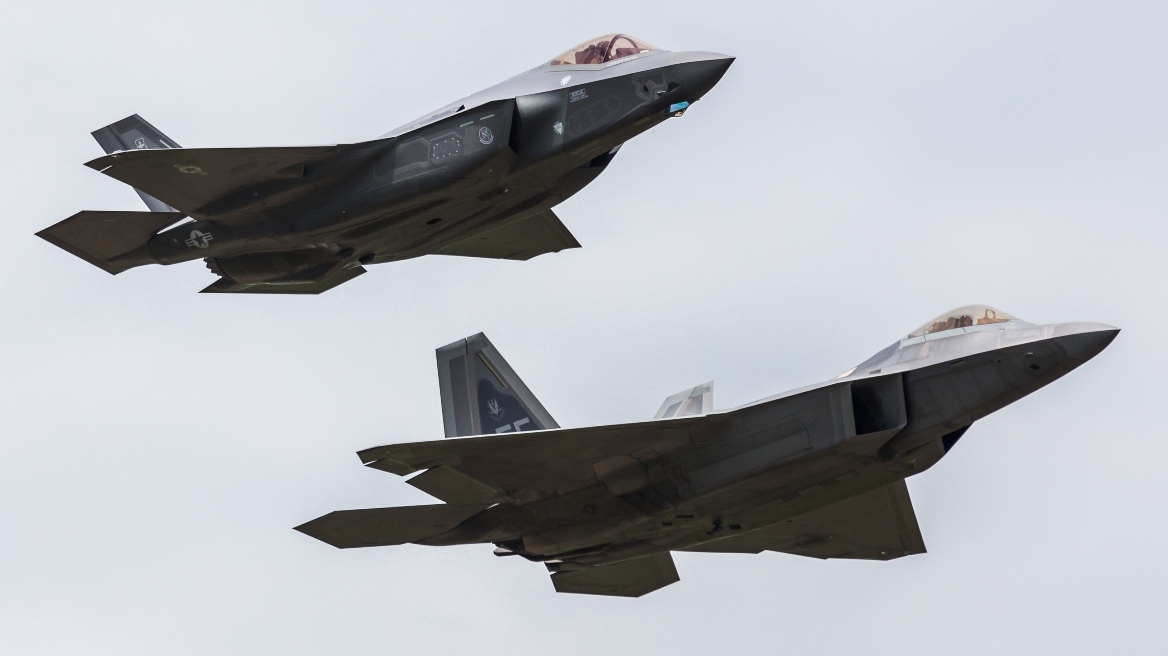
The bases have clearly become a target, and while they have sophisticated radars, air defence systems and F-35 jets at their disposal, the missile and drone attacks launched elsewhere in the region show that impact cannot be ruled out.
On the prospect of more strikes on Akrotiri, the UK Ministry of Defence said: “We are clearly seeing increasingly indiscriminate and disproportionate attacks from the Iranian regime. It is difficult to predict what they will do next, so as a result it is right that we take sensible and calm precautionary measures.”
To be clear, the Cyprus Republic does not control over what goes on in the British bases and cannot be considered responsible for US-UK activities on the strips of land considered a colonial remnant of Cyprus’ troubled road to independence. But if the past 24 hours have shown anything, it’s that Cyprus is now in the crosshairs simply by geography and will be impacted by the expansion of the regional war launched by the US and Israel on Saturday. The most obvious way is in terms of the physical safety of residents, whether living within the bases or not, but also economically, as flights get cancelled, along with holidays, EU Presidency-related conferences and more.
And this despite the fact Cyprus enjoyed generally acceptable relations with Tehran over the years, with Nicosia even working to restrain calls within the EU to designate the Islamic Revolutionary Guard Corps (IRGC) as a terrorist organisation – until the brutal suppression of public protestors made any counterarguments moot.
Then there’s the question of whether the Cyprus Republic is or will become a direct target. Having pivoted clearly to the West in recent years, developing possibly the closest relations in its history with both the US and Israel, as well as a seemingly good working relationship with the UK, France, and others – have the years of non-alignment ended for Cyprus in the most “kinetic” manner?
Cyprus was explicitly threatened before, in June 2024, by then Hezbollah leader Hassan Nasrallah who warned that if Cyprus opens its airports and bases to Israel to help target Lebanon, Hezbollah will consider Cyprus “part of the war” and treat it as a combatant. The Cypriot government was quick to suggest the threat was targeted at the British bases, but the lines may be blurring a little.
What’s done is done, but are we ready?
Politis to the point spoke to two analysts to see what Cyprus can expect moving forward and what options it has.
Anna Koukkides-Procopiou, Yale Peace Fellow and president of Politeia think tank, argues it’s not a question of whether we should be part of the West or not. It’s not even about whether we should have British bases or not – perhaps that can be discussed later – but for now, it is a fact.
“We have made choices, perhaps in the right direction, and these choices have led to this outcome… Are we ready to face the music?” she asked.
“What troubles me a lot right now is can we handle the collateral damage that could reach us through this confrontation in the region?
“No matter how much emphasis we place on EU membership, geographically, we are part of a very volatile region, and we need to be prepared.
“If Dubai and Abu Dhabi and Bahrain were attacked, why wouldn’t Cyprus be attacked. If we haven’t built this into our calculations about the future, it means we haven’t done the thinking properly… this is where the emphasis should be,” she said.
World is fracturing
Koukkides-Procopiou explained that “the world is fracturing, it's not as we knew it” and Cyprus needs to be prepared for these shifts.
Countries are responding in deep and drastic ways to the changes. Finland and Sweden joined NATO, Ireland is re-examining its neutrality, Iceland is considering EU membership.
As for Cyprus, you do not have to be in government to know that the Americans have been using the British bases for years. What steps has Cyprus taken to prepare for possible reactions to that?
Cyprus’ closer ties to powerful western countries might offer it some, informal provision of security, but it also brings risk.
What precautions have we taken?
Bearing that in mind, the analyst questioned whether Cyprus has taken all the necessary steps to prepare for that? Why is the ‘112’ Public Warning System – which allows authorities to send emergency alerts in select languages to specific locations while also geolocating users – not up and running yet? How prepared and effective is the Civil Defence for the range of possible outcomes in an increasingly volatile region?
It is not a question of whether Cyprus is vulnerable, but what steps are being taken to improve on that vulnerability, she argued.
If you are taking a riskier approach to foreign policy – rightly or wrongly – what precautions are you taking? Koukkides-Procopiou likened it to the notion of pursuing an energy policy – despite vocal objections by Ankara – and then not factoring into your planning the question of energy security.
In other words, all policies, but especially more assertive ones require strategic preparation and contingency planning.
“We made a choice (in terms of foreign policy orientation). What do we do now? What have we got back in return in terms of tangible benefits? And how did we prepare for the possible reactions our choices may cause?”
What’s next?
In an interview with ABC News correspondent Jonathan Karl, US President Donald Trump said he expected combat operations against Iran to last four to five weeks, though it could be shorter or longer.
In other words, the regional instability Cyprus is caught up in is not about to disappear any time soon.
There is also the question of what follows. Trump initially appeared to aim for regime change, which could provide some respite for the people protesting against the regime but also unleash untold chaos in Iran and the region, depending on how it plays out.
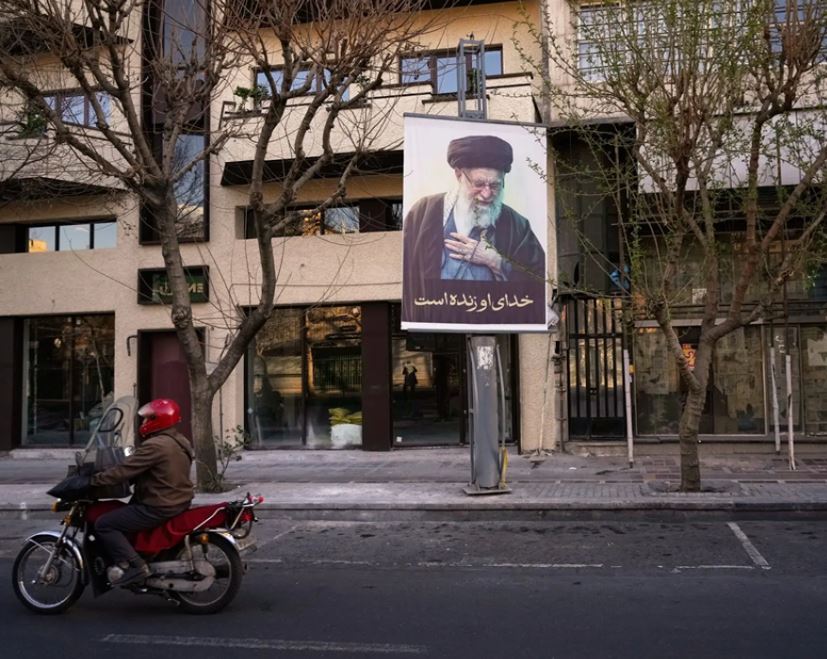
Asked who is going to take over Iran now that Ayatollah Khamenei is dead, Trump said the US had identified possible candidates to take over Iran, but they were killed in the initial attack.
According to the ABC correspondent, Trump said: "The attack was so successful it knocked out most of the candidates. […] It's not going to be anybody that we were thinking of because they are all dead. Second or third place is dead.”
What is Trump’s end goal?
International relations analyst James Ker-Lindsay said there was no doubt whatsoever that American/Israeli actions were in complete violation of international law. But what he fears now is that Trump will have shaken up the repressive and “murderous Iranian regime” just to ultimately replace its leadership with a more compliant one that continues cracking down on dissent but curbs its nuclear ambitions and opens the door to commercial contracts with US companies.
“One thing that really worries me about all this is what is the end goal? What does Trump think he’s going to do?”
Ker-Lindsay notes that first Trump encouraged the overthrow of the Iranian regime, telling the public that the country was there for the taking.
“Now he’s saying we can do the same as we did in Venezuela… but you just told people to go out on the streets, and then you’ll go cut a deal with the regime.”
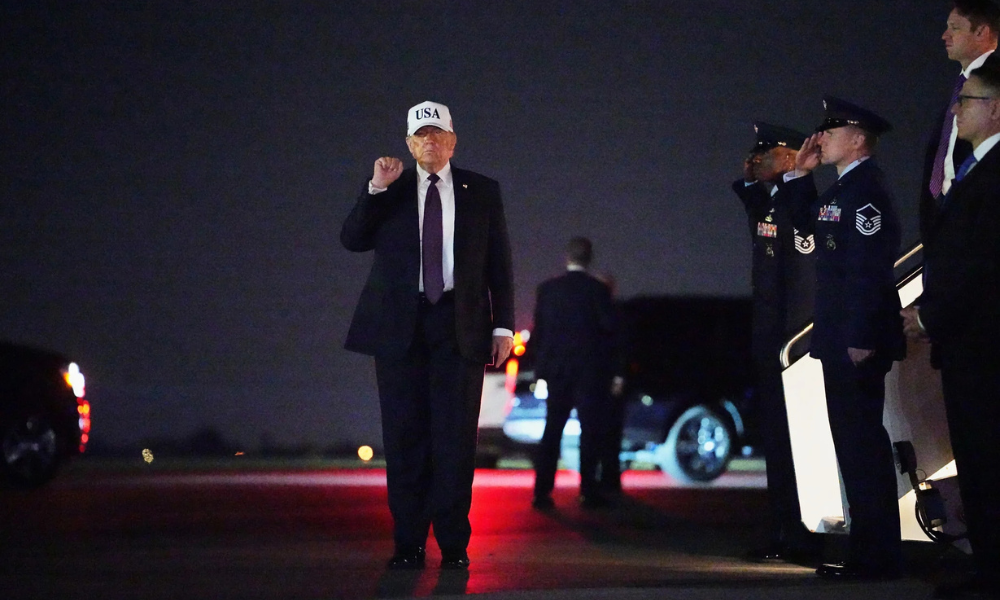
The analyst said he could imagine a scenario where the US accepts new regime leaders who agree to a nuclear deal, in exchange for an easing of sanctions, while a blind eye is turned to the repression of the people.
“And guess who will get the (commercial) contracts?”
Ker-Lindsay said it may sound cynical, but it is also well documented how much Trump has enriched himself while in the presidency.
He argued that even Israeli Prime Minister Benjamin Netanyahu might not find it in his interest for the Iranian regime to fall. “On the one hand, it may be good for Israel, but is it good for Netanyahu who faces allegations and thrives on having a constant threat? It sounds very conspiratorial, but that is the world we are in right now.”
Canadians adapt to new reality
Driving the point home, the analyst noted that in the first two months of 2026, Trump has overthrown and arrested the leader of one country and assassinated the leader of another.
He added: “When you have Canadian defence planners now modelling for a US invasion, just considering it as a possibility, even if remote, then you know we are living in a very different world altogether.”
On Iran, it remains to be seen how long hostilities will last. While he expects an escalation, Ker-Lindsay said the option of land warfare seems remote while at some point, Iran will run out of missiles and drones.
“It’s the proxies that matter and what they do, the Houthis and Hezbollah.”