
By Elena Apostolidou
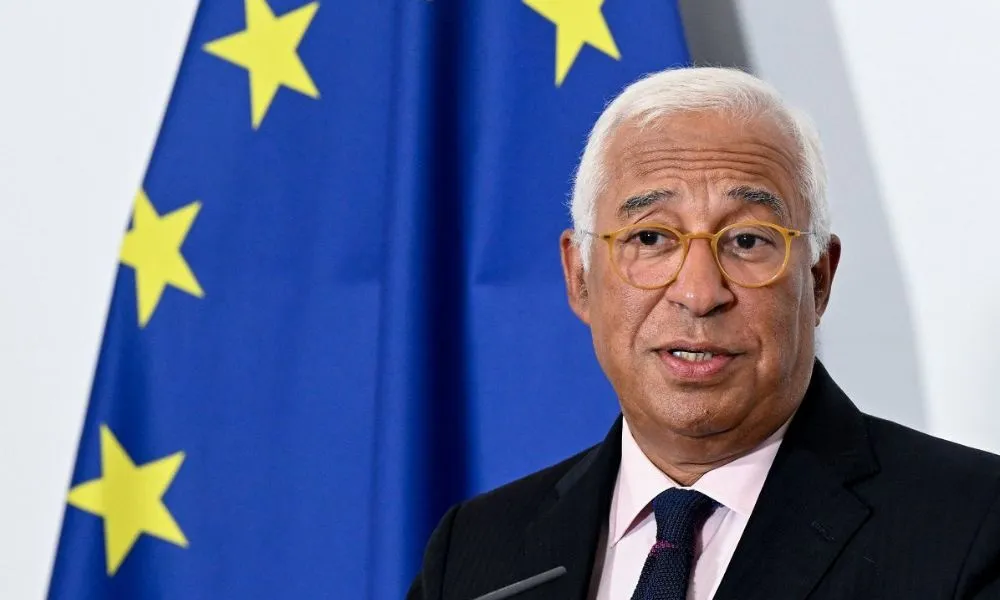
European Council President António Costa, speaking in an interview with the European Newsroom (ENR) ahead of the 19-20 March European Council in Brussels, addressed the crisis in the Middle East and the broader consequences for security and energy markets. He stressed that the duration of the conflict cannot be forecast, as the strategic objective driving it remains undefined. He also touched on the impact on energy prices, noting the need to distinguish short‑term stabilisation measures from the EU’s longer‑term energy strategy. On Ukraine, he rejected suggestions that the EU is preparing any plan to normalise relations with Russia.
Middle East
Commenting on the rapid response by several EU member states to events in Cyprus, Costa said that countries “such as Greece, France, Italy, Spain and the Netherlands reacted immediately to defend Cyprus, demonstrating our capacity to act autonomously.” He underlined that solidarity within the EU is founded on a clear legal basis, adding: “The Treaty is absolutely clear. Article 42(7) stipulates that all member states must provide mutual assistance to one another.”
Turning to the Middle East crisis and its uncertain trajectory, he stated: “It is difficult to predict how long the conflict will last. It depends on the final objective of the mission, and that is not clear.” He warned of the European Union’s deep concern about escalation and its potential impact on global security and the international economy.
Costa noted that “the initiative was taken by the United States and Israel without prior notification of the European allies,” expressing “deep concern about the consequences of this war for the rules‑based international order, for the humanitarian situation, and for the impact on energy costs across the global economy.”
Asked about the situation in the Strait of Hormuz, he replied: “The situation in the Strait of Hormuz is the result of a war in which we are not involved, between the United States, Israel and Iran, with consequences for the region. What we ask of all parties is to show restraint, to stop the conflict and turn to diplomacy, which is the only way to guarantee freedom of navigation in the Strait of Hormuz.”
On the legality of the conflict, he stressed that the United States and Israel “launched this initiative without informing their allies,” and warned of the “significant risk of rising international tension and threats to Europe’s security, economic stability, the humanitarian situation and terrorism.”
He added: “We ask all sides to show restraint, to fully respect international law – particularly the principles of the United Nations Charter – and to give space to diplomacy. We condemn Iran’s attacks on neighbouring countries, in the Middle East and in the Gulf region.”
Energy impact
Costa also highlighted the effect of the conflict on energy costs, calling it “a dramatic and demanding moment for the rules‑based international order, which naturally has a huge impact on the cost of energy.”
Asked about forthcoming measures, he said he expects the Commission to propose a “toolbox” of temporary actions. However, he emphasised that the crisis reinforces the importance of the EU’s long‑term strategy: “This situation reminds us that we are on the right path by investing in the energy transition. We cannot rely on imported energy. We must develop domestic sources, whether renewable or nuclear. We need to be independent and strengthen our strategic autonomy.”
He added that temporary measures must be clearly separated from broader structural policies: “We need short‑term measures to address the spike in prices due to the Middle East conflict. That is one issue. But even before this crisis, we had already identified the need to reduce energy costs. The best way to achieve this is to invest more and more in domestic energy.”
Ukraine-Russia
Responding to comments by Belgian Prime Minister Bart De Wever regarding the possibility of easing relations with Russia, Costa clarified that the EU’s strategy remains centred on reducing energy dependence on Russia, not negotiating energy prices. He said dialogue on security and peace in Ukraine will eventually be necessary, “but not at this moment.”
On the EU loan package for Ukraine and Hungary’s position, he reminded that Hungary’s prime minister “already committed to this on 18 December,” adding that “it is unacceptable for a member state to retreat from agreed decisions.” He also noted that the EU is working with Ukraine to restore and protect the Druzhba oil pipeline, which suffered damage from Russian attacks.
Costa stressed that the EU’s support for Ukraine remains unwavering – militarily, diplomatically, politically and economically – and described relations with President Volodymyr Zelenskyy as “very good.”
Sources: European Newsroom / AMNA