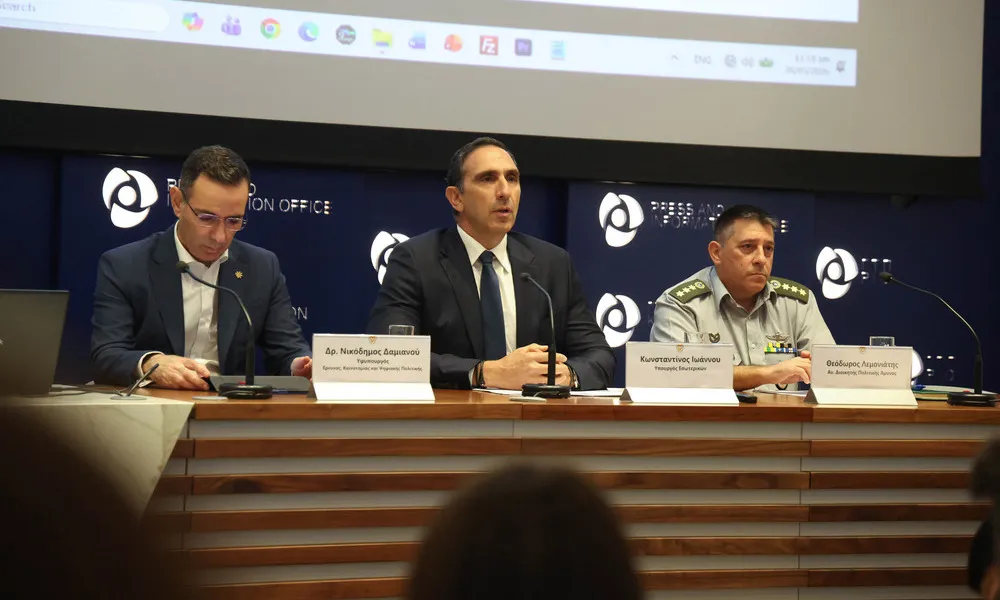

Cyprus has finally acquired its own national population early‑warning system for emergency situations. The system, known as CY‑Alert, will go live on Tuesday, 2 June.
Within Civil Defence, there is a clear sense that the system fills a critical gap – a gap made painfully evident during the major Limassol wildfire exactly one year ago, and more recently amid regional instability linked to the war in Iran – and complements the existing protective measures in the service’s operational ‘toolbox’.
On the occasion of CY‑Alert’s launch, Politis spoke with the deputy commander of Civil Defence, Colonel Theodoros Lemoniatis.
A system Cyprus lacked
This is a system that Cyprus clearly lacked, as demonstrated in the worst possible way during the Limassol fires. What are its main features and how will it work?
CY‑Alert is the national population early‑warning system. It operates through mobile phone masts using Cell Broadcast technology. When an alert is issued, it is broadcast directly from the masts covering the affected area and reaches all mobile phones present there automatically, within seconds.
There are three key things citizens need to know. First, no registration is required, no application is needed and no personal data are collected. Second, the system works regardless of mobile provider or the country of origin of the SIM card, meaning it also covers visitors to Cyprus. Third, critical alerts are always active and cannot be disabled.
CY‑Alert aligns with the European EU‑Alert standard and with similar systems already operating in other EU countries, such as NL‑Alert in the Netherlands, FR‑Alert in France and RO‑Alert in Romania. It is, genuinely, one of the most important technological leaps in public safety for the Republic of Cyprus.
Citizens without mobile phones
Was any assessment carried out – either by Civil Defence or the Deputy Ministry of Research and Innovation – on whether the choice of Cell Broadcast technology might ‘exclude’ people who do not have mobile phones from receiving timely warnings?
That is a valid question, and my answer is clear: CY‑Alert does not replace any existing means of information. It adds to them. Public information remains multi‑channel.
We continue to use television, radio, social media, in‑person announcements by the authorities in local communities, and cooperation with local government. CY‑Alert fills precisely what was missing: immediate, targeted and mass notification within seconds.
For fellow citizens without mobile phones – mainly elderly people in rural areas – Civil Defence responsibility remains in place through traditional channels. In addition, we encourage citizens, and this message will be reinforced in the coming period, to proactively check on elderly neighbours and relatives when an alert is issued.
The community remains the first line of defence. CY‑Alert strengthens it. It does not replace it.
Speed of notification
Once CY‑Alert is fully operational, how quickly can all citizens be informed simultaneously?
Within seconds. That is the essence of Cell Broadcast technology. The alert is not sent as an individual message from device to device; it is broadcast from mobile phone masts to all phones within range at the same time.
There is no network congestion, no sending queue, and no dependence on whether thousands of people are trying to make calls simultaneously. This was precisely one of the key weaknesses of previous notification methods: in moments of crisis, networks collapsed. CY‑Alert addresses that problem at its root.
When it will be used
In what situations will the early warning system be activated?
It is intended for situations involving serious and immediate risk to life, health or property, as well as for general public information. Typical use cases include:
- Forest fires and the need to evacuate populations.
- Floods and extreme weather events.
- Seismic events and potential tsunamis.
- Large‑scale industrial or chemical accidents.
- Public‑safety situations requiring immediate citizen action.
- Road closures following serious incidents.
Each alert includes a clear instruction to the public. We do not issue alerts without a specific action step – evacuation, staying indoors, avoiding a particular area. That is a core principle of the system.
Geographic targeting
Will CY‑Alert allow alerts by district or radius, or will notifications be nationwide?
The system offers full geographic targeting. We can broadcast alerts at district level, municipality or community level, or within a specific radius around an incident – from a few kilometres to nationwide coverage, depending on the nature and scale of the risk.
This is critical, as it allows us to inform only those citizens who are actually affected, without causing unnecessary alarm elsewhere. In the case of a forest fire, for example, the alert will reach those in the danger zone – not the entire country.
Upgrading 112
Beyond CY‑Alert, are additional measures being promoted to strengthen civil protection?
Yes, and this is something I want to emphasise. CY‑Alert is an important tool, but it is not the only one.
Civil Defence is simultaneously advancing specific projects to strengthen overall population protection. Two are priorities for the coming period.
First, the transition to 112 Next Generation. This is the next generation of the European emergency number, which will modernise how citizens communicate with the authorities in moments of immediate danger – including precise geolocation and the ability to transmit video and data from the caller. Work on this is already under way.
Second, the upgrade of the ‘Polyvios’ plan, the national Civil Defence plan for organised population evacuation. This plan is currently being systematically updated, based on lessons learned from recent incidents and modern operational requirements. The aim is a plan that is faster, more flexible and more realistic for today’s conditions.
Beyond these, we continue to strengthen our operational forces, train volunteers, conduct regular exercises with other authorities, and deepen cooperation with local government.
Readiness for building collapses
In recent months, there have been incidents involving building collapses. How prepared is Civil Defence to respond?
Civil Defence has trained urban search and rescue teams, which have repeatedly supported operations in building‑collapse incidents in recent years, responding promptly and effectively when required.
That said, it should be clarified that the primary operational authority for managing building collapses is the Fire Service. Civil Defence operates in a supporting role within the overall state response and civil‑protection coordination framework.
Our role becomes particularly critical in large‑scale disasters, such as a major earthquake or incidents involving multiple, simultaneous collapses, where mass mobilisation of forces, personnel and specialised search‑and‑rescue teams is required.
Readiness is not static. We continuously train our teams in specialised USAR (Urban Search and Rescue) techniques, in cooperation with European and international partners. Our procedures and operational training are based on INSARAG (International Search and Rescue Advisory Group) standards of the United Nations, which are internationally recognised benchmarks for locating and rescuing people trapped in collapsed structures.
It is important to stress that rescue techniques and procedures are essentially the same regardless of the cause of collapse – whether earthquake, structural failure, lack of maintenance or other factors.
At the same time, we continuously invest in modern equipment, including trapped‑person detection tools, hydraulic cutting and rescue equipment, drones for assessing building stability and condition, and gear for operations in hazardous environments.
Our cooperation with the Fire Service, Police, Ambulance Service and other involved agencies is ongoing and critical for effective incident management.
I will be candid: these incidents also highlight broader issues related to building control, ageing structures and infrastructure maintenance – matters beyond Civil Defence’s remit. Our role is to respond when an incident occurs and, together with other competent services, to protect human life and manage the crisis.