
In a rapidly changing global environment, European citizens are increasingly calling for a more united and assertive European Union. The Autumn 2025 Eurobarometer survey captures this shift clearly, with strong majorities backing deeper cooperation, greater global influence and a more protective role for the EU in the face of mounting challenges.
Across the bloc, 89% of respondents say EU Member States should be more united to face global pressures, while 86% support a stronger EU voice internationally. This reflects a growing recognition that geopolitical instability, economic competition and security threats require coordinated action at the European level.
Demand for protection amid rising insecurity
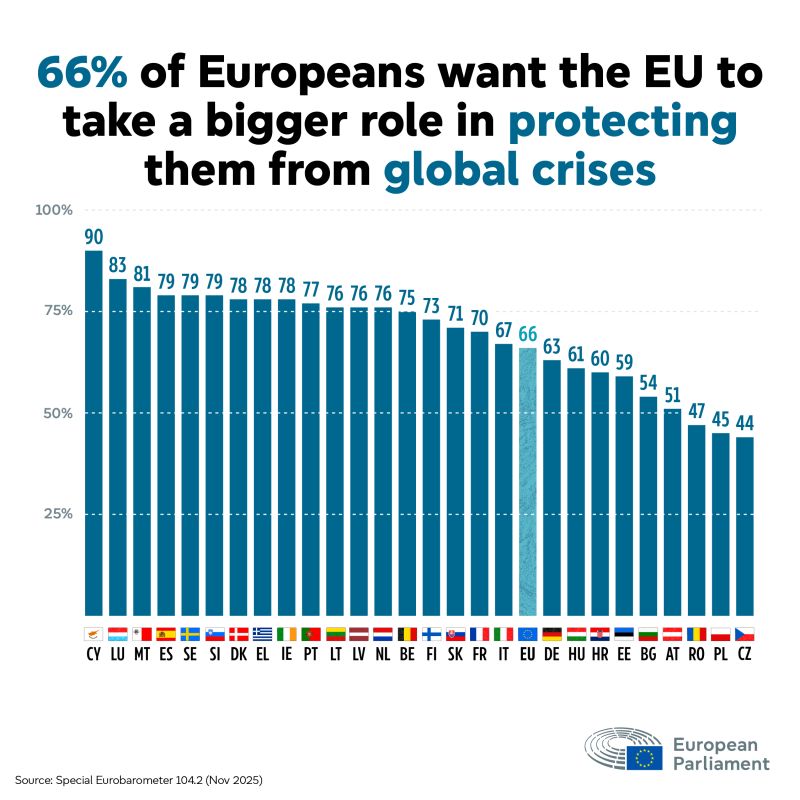
The demand for protection is equally pronounced. 66% of Europeans want the EU to play a greater role in safeguarding them against global crises and security risks, identifying defence and security (40%), economic competitiveness (32%) and energy independence (29%) as priority areas.
This aligns with broader public anxiety, with 72% expressing concern about conflicts and wars near the EU, 67% about terrorism, and 66% about both climate-related disasters and cyber-attacks.
Digital threats move to the forefront
At the same time, the digital sphere has emerged as a major source of unease. Large majorities report concern over disinformation (69%), hate speech (68%), AI-generated misleading content (68%), and online data protection (68%), highlighting how technological change is reshaping perceptions of security.
Cost of living remains the top priority
Economic pressures continue to dominate public concerns. Europeans want the European Parliament to prioritise inflation and the cost of living (41%), followed by the economy and job creation (35%) and defence and security (34%).
Despite these pressures, 62% of respondents consider EU membership a good thing, a figure that has increased compared to previous measurements. However, the EU’s image has slightly declined, with 49% holding a positive view of the Union and 38% of the European Parliament.
A divided outlook on the future
The survey reveals a complex outlook on the future. While 52% are pessimistic about the future of the world, fewer express pessimism about the EU (39%) or their own country (41%).
Personal optimism remains strong, with 76% feeling positive about their own future and that of their families. Among young people aged 15 to 30, optimism is even higher, with 65% optimistic about the EU and 80% about their personal future, reinforcing their position as some of the strongest supporters of European integration.
Cyprus: sharper concerns and stronger expectations
Within this broader European picture, Cyprus stands out for both the intensity of its concerns and the strength of its expectations. Cypriots are more likely than the EU average to call for a stronger and more protective Union, with around 90% supporting a greater EU role in protection and 94% backing a stronger EU voice globally.
At the same time, concerns over security and economic pressures are significantly elevated. Migration emerges as a dominant issue, cited by 35% of respondents at national level and 45% at EU level, well above the European averages. Cost of living pressures are also more acute, with 37% identifying it as a key concern, compared to 31% across the EU.
A persistent trust deficit
However, this heightened expectation of the EU is accompanied by a notable deficit in trust. Only 30% of Cypriots report a positive image of the EU, while a majority express distrust towards both European and national institutions. Large shares of respondents say they feel their voice does not count, pointing to a broader sense of political disengagement and dissatisfaction with democratic representation.
A sharper version of the European trend
This combination of high expectations, elevated insecurity and low institutional trust places Cyprus in a distinct position within the EU. Citizens appear to rely on the Union as a source of protection and stability, while simultaneously questioning its effectiveness. There is clear support for a stronger, more united EU, but also growing pressure for tangible results in security, economic stability and democratic representation. In Cyprus, these dynamics are more pronounced, reflecting both the island’s geopolitical context and deeper challenges in public trust.