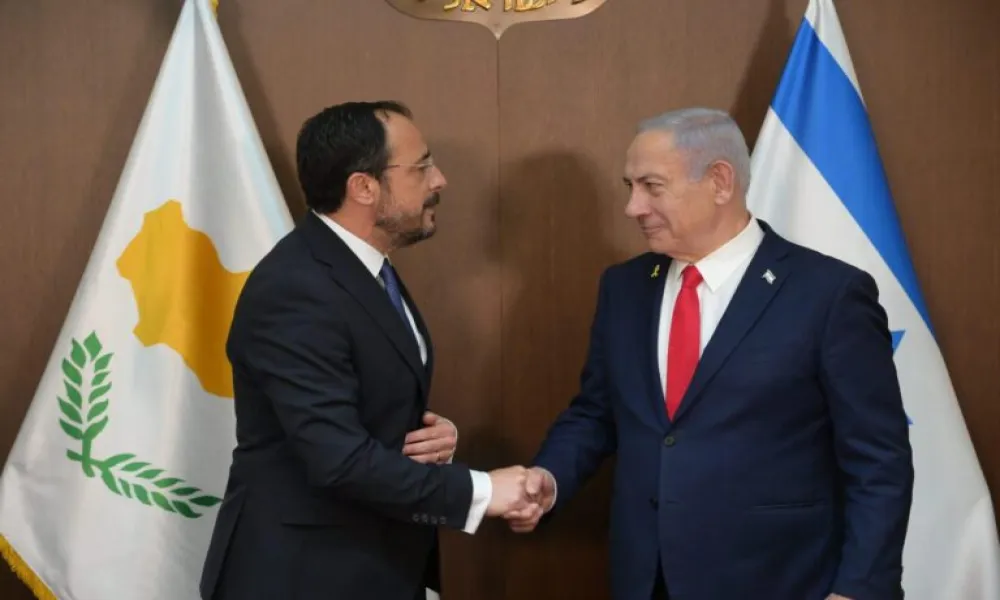
Cyprus considers the bilateral meeting between President Nikos Christodoulides and Israeli Prime Minister Benjamin Netanyahu, held in Jerusalem on Monday ahead of the Cyprus–Greece–Israel Trilateral Summit, as highly significant, according to information from CNA.
Discussions focused on resolving outstanding issues regarding the Aphrodite–Ishai gas field, the possibility of launching the Cyprus–Israel segment of the Great Sea Interconnector (GSI), and Turkish activities in the region. The two leaders also examined the purchase of military equipment from Israel and potential partnerships between Israeli and Cypriot companies for accessing EU funding under the SAFE programme.
Aphrodite–Ishai negotiations
During the meeting, both sides reiterated the need to close pending matters on the joint gas field and expressed the intention to resolve the issue by the end of January. Cyprus submitted its final comments last week.
There was extensive discussion on the GSI project. Sources did not rule out the possibility of construction beginning with the shorter Cyprus–Israel segment. This phase would require less time and lower investment.
Netanyahu is expected to raise the project with US President Donald Trump during his visit to the White House on 29 December, including its connection to the India–Middle East–Europe Economic Corridor (IMEC) through a proposed Cyprus–Israel–Jordan–Saudi Arabia–India network. President Christodoulides also suggested the inclusion of Lebanon in the grid.
Regional concerns and Turkey
The leaders discussed developments in Lebanon, Syria and Iran. According to the same sources, Netanyahu expressed strong concern and dissatisfaction over Turkey’s actions in the region, including support for groups such as the Muslim Brotherhood. These activities are viewed negatively by several regional states, including Egypt, Jordan and Lebanon.
Netanyahu’s public reference during the post summit press conference to actors who imagine they can restore their empire and assert control over the region was interpreted as a direct reference to Turkey. This reading is shared by Cyprus and Egypt, which have taken note of Turkey’s attempts to obstruct Cyprus’ agreement with Lebanon through Hezbollah and to exert influence in Syria.
Defence and joint exercises
The meeting also included discussion on possible Cypriot purchases of three defence systems deemed important for the National Guard. The two sides examined further joint exercises and potential ventures between Cypriot and Israeli companies to pursue EU funding under the SAFE framework.
Netanyahu reportedly asked for Cyprus’ support during the country’s upcoming EU Council Presidency in order to improve Israel’s image in Europe. He also expressed interest in Israel participating in the new EU wildfire resilience centre to be based in Cyprus.
Significance of the trilateral timing
According to CNA sources, the timing of the Cyprus–Greece–Israel Trilateral Summit is critical for Nicosia, taking place just days before Cyprus assumes the rotating Presidency of the Council of the EU. It also coincides with an intense period in regional diplomacy across the Eastern Mediterranean and the Gulf.
For Cyprus, the summit reaffirms its role as a reliable partner, a pillar of regional security and an EU member state capable of linking Eastern Mediterranean dynamics with European priorities in energy, connectivity, security and resilience.
This is the first leaders level meeting since the ninth trilateral held in Nicosia weeks before the 7 October attacks and the subsequent regional escalation. The intervening period underscored the need for more stable security and connectivity frameworks in the Eastern Mediterranean, with Cyprus acting as a dependable gateway for Europe.
Strategic priorities
The main political aim of the summit was to reaffirm the strategic architecture of the trilateral format. Cooperation spans energy, economy, defence, cyber security, maritime security, civil protection and crisis management.
Sources noted growing momentum for reviving and upgrading the 3+1 format with the United States, alongside increased interest from the US Congress in institutional support for regional cooperation.
The summit provided political impetus to energy and infrastructure projects, including electric interconnections such as the GSI and new subsea telecommunications cables. These initiatives dovetail with IMEC priorities.
The recent Cyprus–Lebanon EEZ delimitation agreement signed on 26 November 2025 is seen as reinforcing regional energy security, supporting stability and opening the door to further cross border arrangements.
Role in Gaza humanitarian operations
Cyprus’ comparative advantage as a secure European logistics hub was also highlighted, including port services, medical evacuation, storage and specialised training facilities such as CYCLOPS. The Amalthea humanitarian corridor was cited as an example of effective operational planning, with more than 30,000 tonnes of aid delivered since its activation.
Strengthening resilience
Decisions expected to be implemented in 2026 include the creation of a Maritime Cybersecurity Centre of Excellence in Cyprus, new working groups on emergency preparedness and health, and a joint exercise on marine environmental incidents. These initiatives aim to build common operational culture and enhance regional resilience.
Source: CNA