By Stefanos Messios*
Iran is in disarray once again, as millions of protesters had taken to the streets of Tehran and every major city in the nation to voice their opposition to the Islamic Republic (Nezam) once again.
However, unlike many of the previous protests, these protests are undeniably the biggest since the 1979 Islamic Revolution which had brought the Nezam to power and have unfortunately become the deadliest with how violent the government has cracked down on the people.
Protests and protestors
The initial spark which caused these protests seem to be the record high inflation, a cost-of-living crisis and economic mismanagement and corruption which had been plaguing the country since 2024, in addition to factors such as the Iran-Israel War in 2025, which only exasperated the economic woes of the 90 million Iranians who had finally reached a breaking point.
Similarly to the Islamic Revolution, it was the bazaari (shopkeepers and merchants) in Tehran's Grand Bazaar who were the first people to begin protesting on December 28th of 2025 by shutting up their stalls and marching in the streets demanding the government fix the economy, especially the much-depreciated Iranian rial which has gone into free fall since the Iran-Israel hostilities.
By December 30th, university students and other members of Iranian society joined these protests, quickly adding other grievances, such as the human rights violations, the mandatory use of the hijab/the abuse and mistreatment of women, religious prosecution, Iran’s involvement in proxy wars, Internet censorship and blackouts, water shortages, food prices, and many more issues.
Additionally, ethnic separatist groups from Kurds, Azerbaijanis, Khuzestani Arabs, and Balochs have alder to Iran’s wows, seeking independence and rights, limited under the Nezam’s leadership.
21st of January
The 31st of December is when the first confirmed acts of violence against protesters, as well as deaths, were reported. Tragically, from then onwards more deaths followed, with protestors from the many different factions taking part being shot, beaten, or tortured to death by the police and army across the country.
On January 8th, the Iranian government issued a telephone and Internet blackout, which had made reporting on these deaths accurately next to impossible, with multiple different sources announcing drastically different numbers, which only added more to the confusion.
By the time the blackout ended, many have reported that the protests had quieted down from the 19th, due to these violent crackdowns
As of the 21st of January, Human Rights Activists in Iran, (HRANA), an NGO dedicated to supporting democracy and Human Rights, have reported 4,902, with other news outlets and observers claiming that number is closer to 20,000, with 26,541arrests and the Sunday Times claiming that 330,000 to 360,000 people have been injured.
The factions
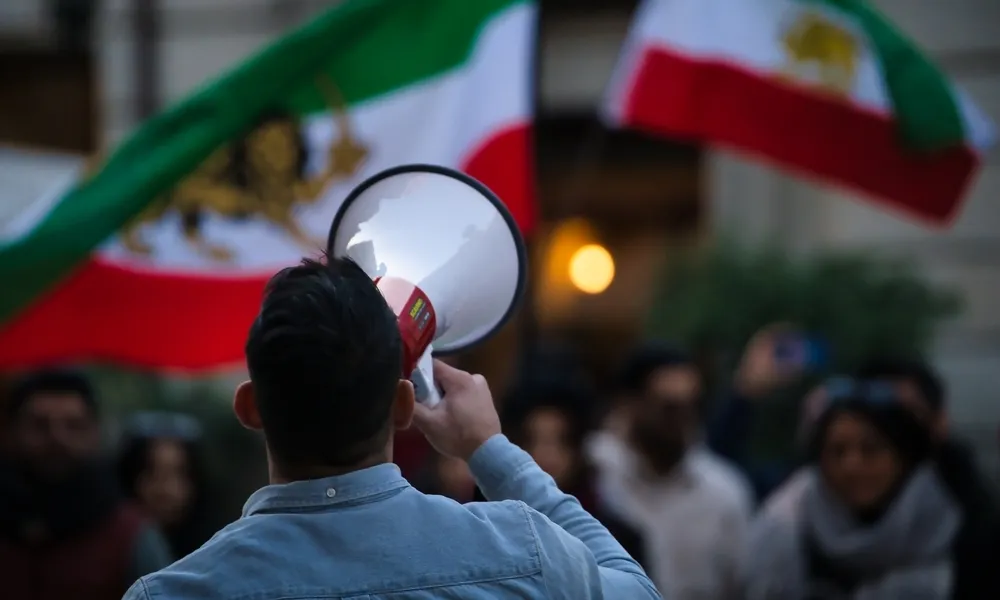
As stated before, while the initial protests were leaderless and focused on the economic strife within the nation, it has become clear that the protesters, while mostly united, have different solutions to who should replace the Nezam, with some of the loudest and most focused on factions by the Western Media being the ‘Pro-Shah’ factions, who seek to reinstall Reza Pahlavi, the eldest son of Mohammad Reza Pahlavi, the last Shah of Iran, to his throne and bringing back the Pahlavi dynasty under his group the Iran National Council (INC). They have been heard chanting slogans like "Reza Shah, may your soul be blessed", "Long live the Shah", and "The Shah is coming home, Zahhak is overthrown" as they protest, seeking American and even Israeli intervention to overthrow the Nazem.
On 8th of January, Pahlavi has voiced his support for the protestors and made a call to action. Many observers have stated that this has had a noticeable influence on these factions, as the protesters were clearly made up of many different groups of people and were ‘mostly leaderless.’
There have also been many anti-regime dissidents who also disagree with the Shah being reinstated, with figures like the Nobel Peace laureate Narges Mohammadi, actress Taraneh Alidoosti, and rapper Toumaj Salehi coming under fire by the ‘Pro-Shah’ factions. Groups like the People's Mojahedin Organization of Iran (PMOI) and the National Council of Resistance of Iran (NCRI), while anti-monarchist, have aligned themselves with the ‘Pro-Shah’ factions for the sake of unity against the regime.
On social media, diaspora Iranians and those in exile have also used their platforms to highlight what is going on within Iran, while expressing their support for Pahlavi and the return of the Shah.
As might be expected they have sought to encourage US President Donald Trump and Israeli Prime Minister Benjamin Netenytahu to intervene and overthrow Ali Khamenei, the Supreme Leader of Iran, with many of the Iranian diaspora, especially in the US as well as online agreeing with a great deal of Trump’s statements, including “Make Iran Great Again” (MIGA).
No Good Options?
The truth of the matter is that, from an outsider’s perspective, the Iranian people have no real clear ‘positive’ paths to go down.
The first scenario is that they fail at ousting Khamenei and the Islamic Republic and continue to suffer the brutality of the government and its apparatus.
By continuing to bare the devil they know they are likely to continue to suffer the economic crisis and the constant sanctions and human rights violations they have been subjected to for nearly half a century, as well as having to deal with more involvement in proxy wars and brand new laws that will be even more oppressive for the sin of trying to topple the Nezam.
This second scenario is the involvement of the West in the overthrow Khamenei and the Islamic Republic, and to have someone like Pahlavi installed as the new leader of Iran.
Obviously, this scenario is one everyone in Iran would willingly accept.
However, one only has to look at the past, seeing how regime changes in Iraq, Afghanistan, and Libya had resulted in all three states devolving into chaos and civil wars, to realise that if the West and Israel, especially with the current American and Israeli administrations, decide to intervene, things will not go as smoothly as one would hope.
There has to be concerns about the power vacuum created by Khamenei’s overthrow, which could cause armed groups like the IRGC and anti-Pahlavi/anti-monarchist factions, as well as the previous separatist factions to take up arms, causing a civil war which may even lead to American boots on the ground, which could further destabilise the Middle East, with Iran being a massive super power.
The other option is that Pahlavi does end up being instilled as the new leader of Iran. But as mentioned previously with the significant factions that do not support him, either he will need the assistance of the West to govern at first to keep the country together, or, ironically, he and the West will need to resort to the same methods his father, the previous Shah, used to quell dissenters (possibly bringing back his own police force, a la SAVAK (Bureau for Intelligence and Security of the State)), to remain in power, which is also similar to how the Islamic Revolutionaries kept themselves in power from 1981 onwards.
Ultimately, the situation continues to remain grim and almost hopeless, as 2026 could either see the continuation of 47 years of suffering, or a brand-new situation that none of us can predict how it will develop, or even worse, a repeat of the last 47 years with a new lick of paint.
* Stefanos Messios is a recent university graduate with a strong interest in history, global affairs and international relations.