


Once seen as a peripheral region, northern Greece is rapidly emerging as a strategic node in Europe’s energy map, as the European Union accelerates its break from Russian gas, writes Euronews.
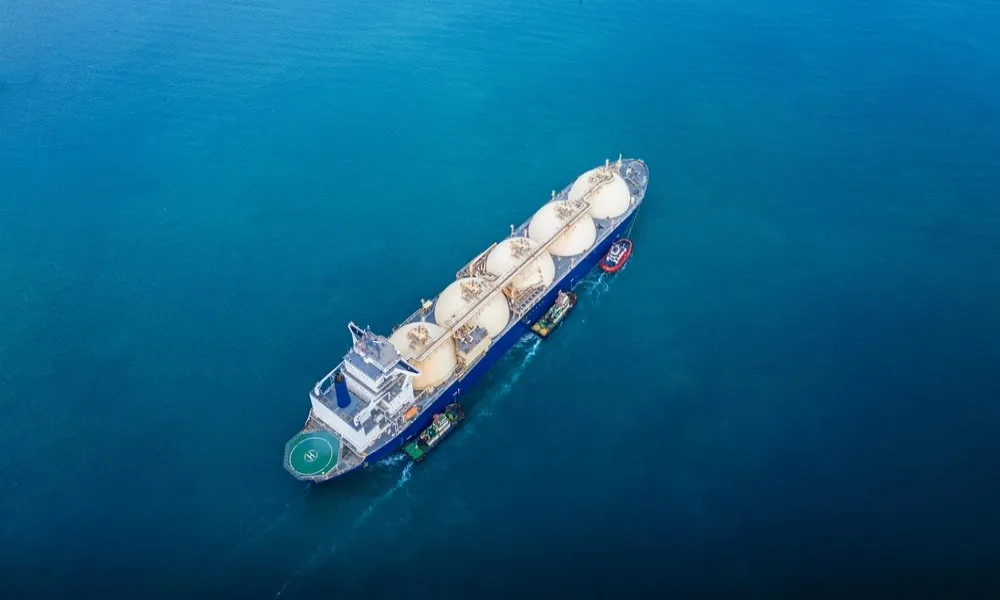
At the centre of this shift is Alexandroupolis, where the floating storage and regasification unit (FSRU) began commercial operations in October 2024. The facility is now a cornerstone of Greece’s ambition to become a major transit hub for liquefied natural gas (LNG) bound for central and eastern Europe.
Gas still seen as a bridge fuel
Despite the EU’s green transition goals, natural gas is expected to remain part of Europe’s energy mix for years, serving as a bridge fuel and stabiliser for electricity grids.
With Russian oil and gas imports set to reach zero by 2028, European markets face a supply gap. Estimates suggest central and eastern Europe could require an additional 35 billion cubic metres of gas annually by 2030.
Countries able to provide alternative supply routes stand to benefit economically and geopolitically.
The vertical corridor
Greece’s strategy centres on the so-called Vertical Corridor, linking the Alexandroupolis FSRU and the LNG terminal at Revithoussa to pipeline systems in Bulgaria and Romania, with potential onward flows to Ukraine, Hungary, Slovakia and Moldova.
The aim is to channel LNG, much of it from the United States, into markets that previously relied heavily on Russian supplies.
The Alexandroupolis FSRU has a maximum regasification capacity of 5.5 bcm per year, equivalent to roughly 50 to 55 LNG cargoes annually.
Greek authorities are now examining plans for a second floating LNG unit, to be located near the existing facility. The project is being advanced by Gastrade, which has secured environmental approval for the proposed FSRU Thrace.
Construction costs are estimated at around €600 million. Project backers argue that European or state financial support will be required to proceed.
Funding dispute in Brussels
The expansion plans coincide with a broader debate within the European Commission over whether gas infrastructure should continue receiving EU funding.
In recent years, Brussels has moved to phase out financing for new gas projects, citing climate neutrality targets. Industry players and several member states argue that gas remains necessary to ensure energy security during the transition period.
Negotiations are ongoing, with countries such as Romania also seeking flexibility as they develop new gas fields.
US interest
The United States has shown interest in supporting the Alexandroupolis expansion, viewing it as a route to strengthen LNG exports to Europe.
US financial institutions, including EXIM and the US International Development Finance Corporation, are exploring potential involvement in financing a second FSRU.
A meeting hosted by the US Department of Energy later this month in Washington will focus on strengthening the Vertical Corridor. The gathering is expected to include energy ministers from central and eastern Europe, as well as senior EU officials.
According to Gastrade vice president Kostis Sifneos, funding for replacement infrastructure in countries such as Ukraine, Hungary and Slovakia will be central to discussions.
A test case for EU energy policy
As Europe redefines its energy architecture, projects such as the Alexandroupolis FSRU are becoming test cases for how the bloc balances decarbonisation goals with security needs.
The coming year is expected to prove decisive, as Brussels determines under what conditions gas infrastructure can continue to play a role in the EU’s post-Russia energy strategy.
Source: Euronews