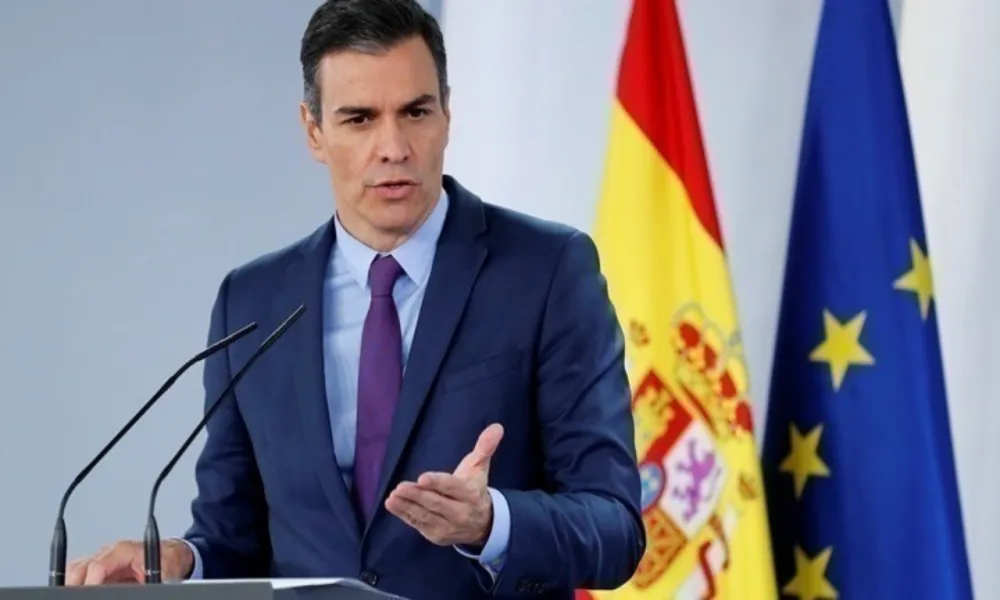

Spanish Prime Minister Pedro Sánchez has emerged as the most outspoken European Union leader criticising United States President Donald Trump over the war against Iran. His condemnation of the strikes as unjustified and illegal has prompted a sharp response from Washington, including threats of trade measures against Spain.
The dispute escalated after Madrid barred US military aircraft from using jointly operated bases on Spanish soil for operations related to the attack on Iran.
Public condemnation and diplomatic push
Pedro Sánchez described the attack on Iran as a “violation of international law” and an “unjustified and dangerous military intervention”. He also criticised the United States and Israel for acting “unilaterally, without consulting the international community”, stating that the offensive had caused “hundreds of innocent victims” and increased regional instability.
According to a diplomat briefed on Sunday’s emergency meeting of EU foreign ministers, Spain pushed for the bloc to explicitly state that the United States had violated international law and criticised what it described as double standards in the application of the United Nations Charter.
Following the meeting, Foreign Minister José Manuel Albares said the EU’s role in the crisis should be in favour of “de-escalation, a return to dialogue, détente, diplomacy and negotiation”.
Air base restrictions and US response
Madrid underscored its legal objections by blocking the use of jointly operated bases for attacks on Iran. Defence Minister Margarita Robles stated that US troops stationed at Morón de la Frontera and Rota must “operate within the framework of international law” and that the installations would not provide support unless required for humanitarian purposes.
Robles confirmed that the bases did not participate in Saturday’s attack and would not be used for maintenance and support operations related to it. Flight tracking data indicated that more than a dozen US aircraft departed the Morón and Rota bases over the weekend, with several redeployed to Ramstein Air Base in Germany. Robles said the US had “likely made those moves because they knew the aircraft could not operate” from Spain.
In response, Donald Trump described the Spanish government as “terrible” and “unfriendly” and threatened to cut trade with Spain. During a press conference with German Chancellor Friedrich Merz, he said: “We’re going to cut off all trade with Spain. We don’t want anything to do with Spain.”
Trump also stated that the US did not require Spain’s permission to use the bases, adding that he had the authority to halt business with Spain and impose embargoes if he chose to do so.
Domestic political context
Sánchez’s stance has been compared by observers to that of former French President Jacques Chirac in 2003, when he opposed the US-led invasion of Iraq on the basis of international law and multilateralism.
In Spain, public opinion appears critical of Trump. A recent poll by the state-run Centre for Sociological Research found that three-quarters of respondents held a “very bad” opinion of the US president, and eight out of ten considered him a threat to world peace.
The Spanish coalition government includes the left-wing Sumar party, which has also been critical of US policy. However, Economy Minister Carlos Cuerpo said Spain’s position was not based on political calculation. “Spain does that which it considers is correct and in line with humanitarian and international law,” he said.
Sánchez has stressed that opposing the attack on Iran does not equate to support for Tehran’s regime, which he described as “hateful”. He stated that one must oppose a war without authorisation from the UN Security Council and the US Congress.
Political scientist Pablo Simón of Carlos III University in Madrid said the confrontation could help Sánchez rebuild political capital ahead of national elections due by July next year, although its electoral impact remains uncertain.
Source: POLITICO