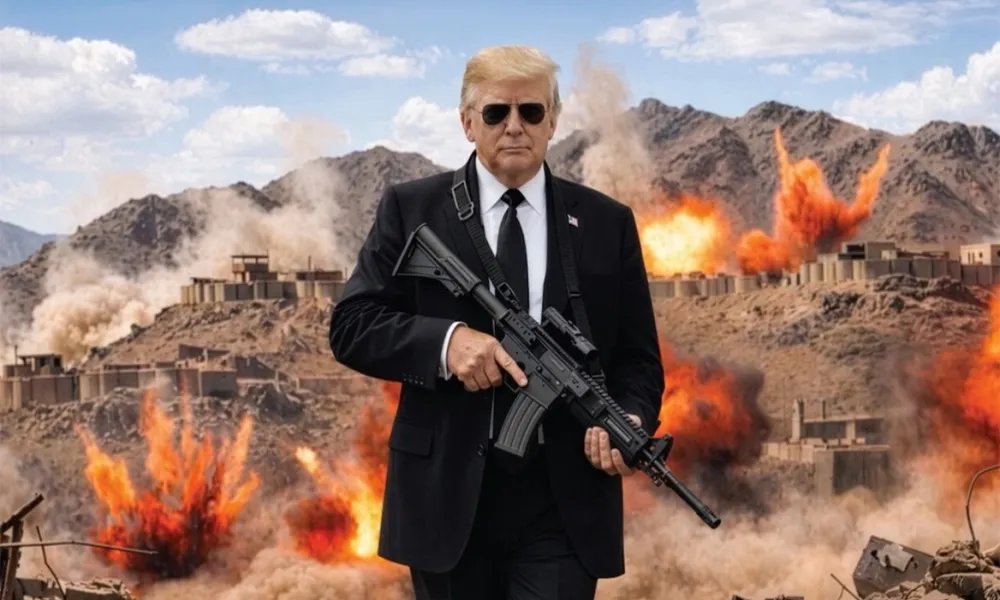

US President Donald Trump has issued a new warning to Iran, posting an AI-generated image of himself holding a rifle and declaring: “No more Mr Nice Guy.”
In a post on Truth Social, Trump accused Tehran of failing to reach a non-nuclear agreement and urged Iranian leaders to act quickly.
“Iran can’t get their act together. They don’t know how to sign a non-nuclear agreement. They would be wise to get smart soon!” he wrote.
The post comes as Washington continues to press Iran to place the nuclear issue at the centre of any negotiations. Tehran has instead proposed phased talks, seeking to delay discussion of its nuclear programme until after the war ends and disputes over navigation in the Persian Gulf are resolved.
The Guards’ growing role in Tehran
Two months into the war with the United States and Israel, Iran’s internal power structure appears to have shifted sharply towards the Islamic Revolutionary Guard Corps.
The killing of Supreme Leader Ali Khamenei on the first day of the conflict and the rise of his injured son, Mojtaba Khamenei, have changed the balance of power inside the Islamic Republic. Although Mojtaba formally sits at the top of the system, analysts say key decisions are now shaped by military and security institutions.
According to Reuters, real authority has become concentrated around the Supreme National Security Council, the office of the supreme leader and, above all, the Revolutionary Guards.
Iranian analyst Arash Azizi said major agreements would probably still pass through Mojtaba Khamenei, but added that it was difficult to imagine him overruling the bodies managing the war.
Diplomacy under pressure
Iran is represented diplomatically by Foreign Minister Abbas Araghchi, while parliament speaker Mohammad Bagher Ghalibaf, a former Guards commander, also plays an important role.
On the military side, the central figure is seen as Ahmad Vahidi, the commander of the Revolutionary Guards, who is reported to have played a key role on the night the ceasefire was announced.
The US insists that Iran’s nuclear programme must be addressed from the start. Tehran, however, wants to focus first on ending the war and resolving the maritime standoff in the Gulf.
Analyst Alan Eyre told Reuters that neither side appears ready to compromise, with both believing time is on their side. Iran is relying on its leverage around the Strait of Hormuz, while the US is betting on economic pressure.
A harder line in Tehran
The shift in Tehran points to a deeper move away from clerical authority and towards military power. With the country at war and Ali Khamenei gone, the Revolutionary Guards now appear to dominate both strategy and decision-making.
Former US negotiator Aaron David Miller described the change as a move “from divine authority to hard power”, saying Iran is now governed through the influence of the Guards.
Despite intense military and economic pressure from the United States and Israel, Iran’s ruling system still appears cohesive. Analysts say its strategy is to avoid a wider war, preserve bargaining power and emerge from the conflict with a stronger political and military position.
Source: protothema.gr