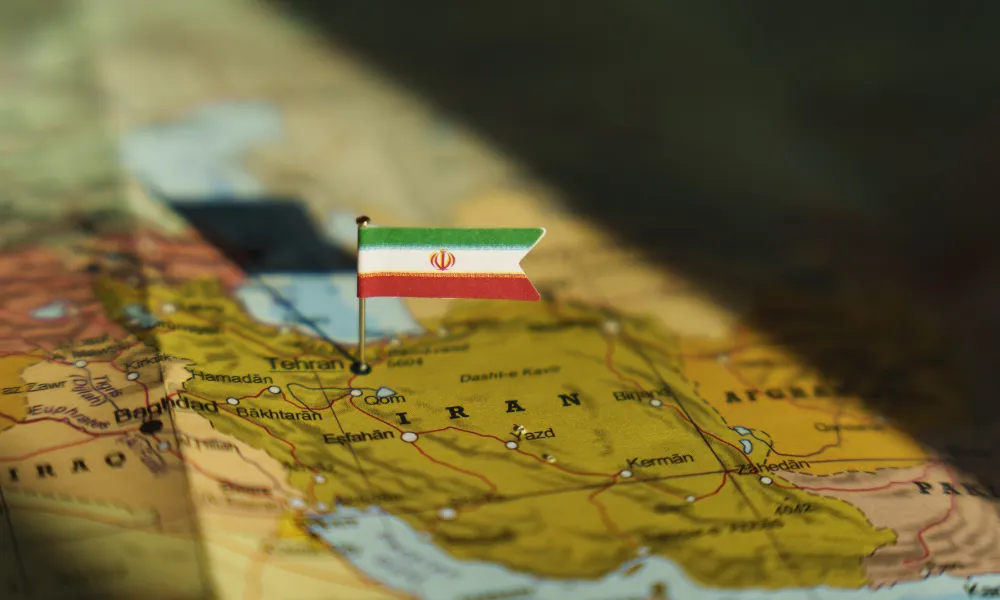

The Embassy of Iran in Nicosia has issued a lengthy statement accusing the United States and Israel of conducting “psychological warfare” and targeting civilian infrastructure as the war between the two sides enters its twelfth day.
The document, circulated to media outlets on Thursday, sets out Tehran’s narrative of the conflict, describing the ongoing military campaign as “joint aggression” and claiming that the strategic objectives of Washington and Israel have not been achieved. The statement comes amid continued escalation in the region and competing claims from both sides about military successes, casualties and the broader strategic outlook of the war.
Iran claims war goals are failing
In its communication, the Iranian embassy argued that early expectations in Washington and Tel Aviv of rapid political change in Iran have not materialised. Citing what it described as commentary in Israeli and Western media, the embassy said that hopes of destabilising the Iranian government or triggering internal unrest had proven unrealistic.
According to the statement, some analysts in the United States have acknowledged that the initial objectives attributed to the military campaign, including destroying Iran’s nuclear programme or forcing political change, would require a large-scale ground intervention. Such a scenario, the embassy said, is considered unlikely even by American officials.
Information war and competing narratives
The Iranian statement also accused the United States of conducting an information campaign to justify its military operations. It referenced remarks by Iranian Foreign Minister Abbas Araghchi rejecting claims from Washington that Tehran had been preparing an imminent attack on the United States before the conflict began.
The embassy further criticised international media coverage surrounding members of Iran’s women’s national football team who remained in Australia following a tournament, arguing that some reports portrayed the situation as a political defection despite most players returning home. The episode has attracted global attention and protests in Australia, where several players were granted humanitarian visas.
Trump rhetoric and military escalation
The embassy statement also criticised recent comments by US President Donald Trump, accusing him of escalating the rhetoric surrounding the war. Trump has repeatedly used social media to claim that Iranian military leadership and strategic assets have been severely weakened by American and Israeli strikes.
In one recent post on X, Trump suggested that a “second level of Iranian leadership” had been effectively neutralised, though the claim has not been independently verified. The Iranian embassy described such statements as dangerous escalation and accused Washington of normalising attacks on Iranian military and civilian infrastructure.
Civilian casualties and damage claims
Iran’s diplomatic mission also presented figures it says reflect the humanitarian impact of the conflict. According to data cited from Iran’s health ministry and the Iranian Red Crescent, more than 15,000 people have been injured since the start of the war, with thousands of residential buildings reportedly damaged in air strikes.
The statement also alleged that several hospitals, schools and emergency facilities had been hit during recent bombardments in cities including Tehran, Tabriz and Ahvaz. Independent verification of the figures remains difficult due to the limited access of international observers to the affected areas.
Military confrontation and regional risks
Tehran also outlined what it described as a “phased defensive response” involving missile and drone strikes against Israeli and US military facilities across the region. Iranian officials claim that several advanced air defence systems and reconnaissance drones have been destroyed during these exchanges.
At the same time, the embassy warned that continued attacks on energy infrastructure could trigger wider instability in the Strait of Hormuz, a crucial global shipping corridor through which roughly one fifth of the world’s oil supply passes. Energy markets have already reacted to the conflict, with oil prices rising sharply during the early days of the confrontation.
Diplomatic efforts continue
Despite the escalation, the embassy said diplomatic contacts were underway in several capitals including Beijing, Moscow, Cairo and Doha to explore ways to reduce tensions. Iran reiterated its position that it is acting in self-defence under Article 51 of the United Nations Charter.
Washington and Israel, for their part, maintain that their operations aim to degrade Iran’s military capabilities and prevent further regional threats. As the war progresses, the battle over military outcomes is increasingly mirrored by a struggle over narrative, with governments on all sides seeking to shape international perception of the conflict.