
In a written statement marking the anniversary of Cyprus’ EU accession, President Christodoulides noted that this year’s commemoration carries particular importance as the country currently holds the rotating Presidency of the Council of the European Union.
“The Republic of Cyprus today celebrates the anniversary of the most important political development in its modern history,” he said.
According to the President, Cyprus’ accession to the EU on 1 May 2004 constitutes “a milestone for the country and its people, serving as a reminder of the correct strategic choice to belong to the core of the European family.” He added that it represents “a choice for peace, democracy, cooperation, the rule of law, solidarity and respect for human rights, a guarantee of security, stability, prosperity and opportunity.”
He continued that the EU membership ushered Cyprus into a new era, making it “stronger and more secure” through its participation in the world’s largest political union of states.
Η Κυπριακή Δημοκρατία γιορτάζει σήμερα την επέτειο της πιο σημαντικής πολιτικής εξέλιξης στη σύγχρονη Ιστορία της: Την ένταξή της την 1η Μαΐου του 2004 στην Ευρωπαϊκή Ένωση.
— NikosChristodoulides (@Christodulides) May 1, 2026
Με την ένταξή της στην Ευρωπαϊκή Ένωση, η χώρα μας εισήλθε σε μια νέα εποχή που την κατέστησε πιο ισχυρή… pic.twitter.com/5hM2QiOTZF
Twenty-two years on, he said, the Republic of Cyprus is, “a mature, reliable and constructive member state, positioned at the heart of the Union and contributing meaningfully and effectively to the shaping and adoption of common European policies and decisions.”
At the same time, he noted that Cyprus, as the EU member state located at the south-easternmost edge of the Union and closest to the Middle East and the Gulf region, is demonstrating through the work and outcomes of its Presidency its capacity to further strengthen its role as a bridge between the EU and the wider region, which is once again facing significant challenges.
“Having assumed the helm of the EU from 1 January for a six-month term, Cyprus is working methodically and effectively under the vision of a ‘Strategically Autonomous Union, Open to the World’, aiming to enhance the EU’s autonomy across all sectors,” he said.
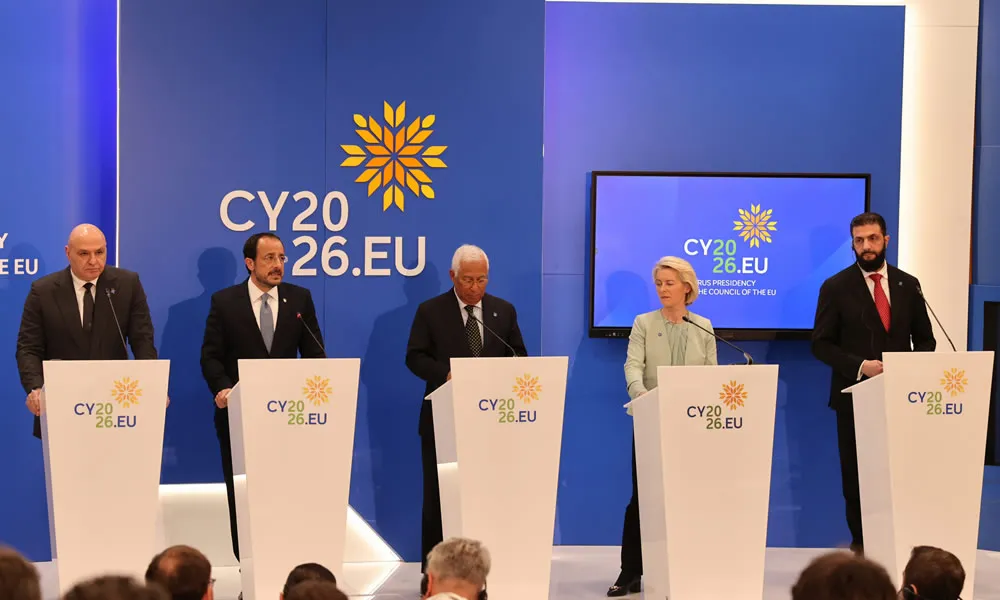
As a tangible example of this role, President Christodoulides said, was last week’s informal meeting of heads of state and government held in Cyprus for the first time since the country’s accession in 2004, with the participation of leaders of EU institutions.
On the margins of that meeting, and at the initiative of the Cypriot Presidency, a special EU summit was also held with the leaders of Egypt, Lebanon and Syria, the Crown Prince of Jordan, and the Secretary-General of the Gulf Cooperation Council, he noted, adding that discussions focused on cooperation aimed at de-escalation, as well as concrete ways to strengthen the EU’s strategic partnerships with countries in the region.
“During the informal European Council in Cyprus, the Presidency succeeded in placing key issues on the agenda and advancing them in line with our objective of strengthening the EU’s strategic autonomy,” he said.
Specifically, he noted that during the discussions held on 23 and 24 April, leaders focused on three “critical” areas for the Union’s level of autonomy: defence and security, competitiveness, and the next Multiannual Financial Framework, which is expected to serve as a vehicle for implementing the EU’s strategic priorities.
On defence and security, he said that, following his initiative, discussions were held on establishing an operational mechanism in the event of activation of Article 42.7 - the mutual defence clause - in order to reinforce efforts towards strategic and defence autonomy and enhance the security of member states.
Regarding economic autonomy, he noted that an agreement, the “One Market, One Europe” roadmap, was signed between Member States, the European Commission and the European Parliament, “with a significant contribution from Cyprus’ Presidency”, aimed at further integrating the European market, reducing bureaucracy for businesses and strengthening competitiveness.
At the same time, he said, the European Commission presented and discussed specific short-term measures to address the impact of the war in Iran on energy prices, while talks were also held on the Multiannual Financial Framework for 2028–2034, “one of the most important dossiers under negotiation during Cyprus’ Presidency”.
“The European Union is our common home. It is our political family, to which Cyprus has belonged since 2004,” the President said, highlighting shared values such as peace, democracy, justice, solidarity, progress and prosperity.
He added that, particularly for Cyprus, which continues to face the consequences of the Turkish invasion and the ongoing occupation of part of its territory, “the occupation of European soil”, the EU provides both security and the prospect of ending the occupation and achieving reunification. This, he said, must be based on the EU acquis, the Union’s principles and values, and relevant resolutions and decisions of the United Nations Security Council.
Cyprus has been divided since 1974, when Turkey invaded and occupied its northern third. Repeated rounds of UN-led peace talks have so far failed to yield results. The latest round of negotiations, in July 2017 at the Swiss resort of Crans-Montana ended inconclusively.