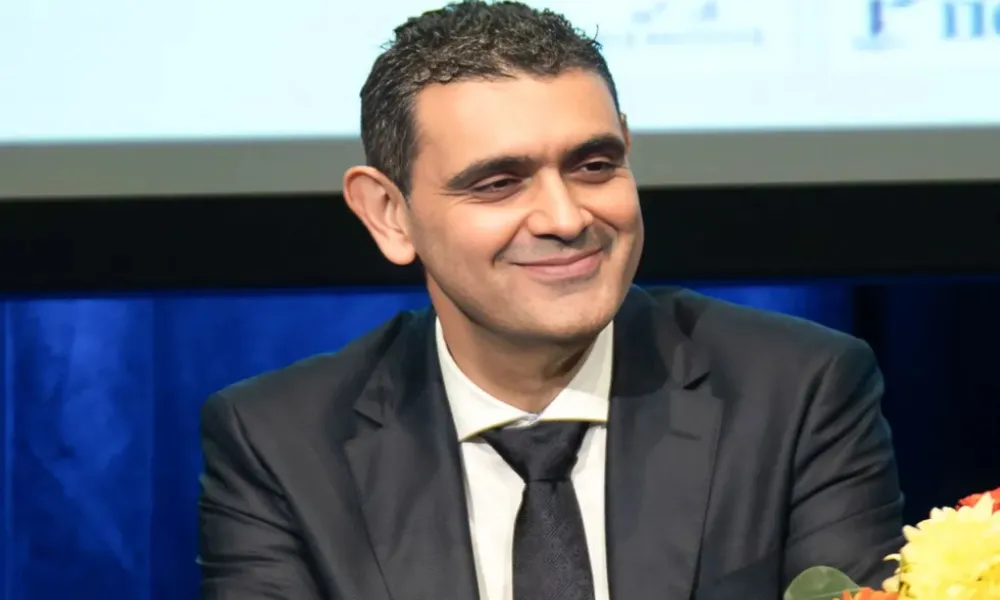

The Cyprus problem remains unsolved not only because of the disagreements over political equality, security or territory, but also because of society's inability to confront its difficult truths, argues constitutional law expert Costas Paraskeva. On the occasion of the 52 years since the Turkish invasion of Cyprus, Dr Paraskeva, associate professor of Public Law and head of the Law Department of the University of Cyprus, analyses the institutional consequences of the constitutional pendency since 1964, the role of the Doctrine of Necessity, the challenges of a federal solution, and warns that the current status quo does not constitute a safe or viable prospect. He also highlights under-discussed issues, such as the weakening of institutional checks and balances, the role of the Supreme Constitutional Court of 1960, how a functional state is designed, and what political equality means in practice.
Lack of trust
Why does the Cyprus problem remain unsolved after so many years?
First of all, allow me to say how important the Zurich-London Agreements ultimately were, given that after the collapse of the established constitutional order in 1964, the parties involved have been unable, for more than six decades since, to find a mutually acceptable solution. Despite the many rounds of negotiations, the Cyprus problem remains a complex political problem characterised by historical mistrust and conflicting interests. Thorns that remain impassable to this day are, for example, political equality and power-sharing, security and guarantees, the property issue, the territorial issue, even the very form of the solution itself. Beyond the technical and legal disagreements, however, deeper causes of the stagnation are also the almost total lack of trust between the two sides, the passage of time which consolidates situations and creates faits accomplis, and society's ignorance of the various complex aspects of the Cyprus problem.
Sleepwalking
Do you consider, then, that Cypriot society does not correctly perceive the various aspects of the Cyprus problem?
I will dare to say that a large part of our society is in a state of sleepwalking in relation to the Cyprus problem. The constant bombardment of society with ideological stereotypes and artificial narratives, and the reproduction of historical myths that can easily influence public opinion, prevent society from understanding what is really at stake in the Cyprus problem. Society is unable to grasp, for example, that the idea of the long struggle, the collection of resolutions and the fruitless passage of time lead towards the entrenchment, not the overturning, of the existing situation. Moreover, discussion of the contentious issues that will inevitably be on the negotiating table is absent from public discourse. Public opinion is kept in the dark and fed slogans empty of content, and overlooks the fact that our state has been in a situation of constitutional pendency since 1964. We have not realised as a society that the Cyprus problem is an existential issue, and we are obliged to undertake an exercise in historical self-knowledge which will, by its nature, be painful.
Checks and balances
Can a democracy be designed to withstand even 'bad' rulers, or is that theoretically impossible?
"Bad rulers" will always exist, and a democracy cannot rely on or depend upon the quality or morality of whoever governs at any given time. That is why, in Western-style liberal democracies, the existence of so-called institutional checks and balances, which function as barriers against those in power, is of the utmost importance. Equally important is the protection of fundamental rights and freedoms, which also acts as a counterweight against the governing.
Do these not exist in the Cypriot Constitution of 1960?
The Constitution of 1960, despite the negatives attributed to it from time to time, incorporates in Part II, in an almost verbatim manner, the fundamental rights enshrined in the European Convention on Human Rights. However, we must make a painful observation concerning the general organisational part of the Constitution. That part regulates and distributes the powers and aims at the realisation of Part II of the Constitution, which enshrines fundamental rights, and which in a liberal democracy constitutes the very essence of the Constitution. In our country, since 1964 and the withdrawal of the Turkish Cypriots from the organs of the Republic of Cyprus, the general organisational part of the Constitution has not functioned, the institutional checks and balances (which were inextricably interwoven with bicommunalism) have been shattered, and this has a great impact on the rule of law, on the way our polity operates and, ultimately, on the protection of our fundamental rights.
A case study
If a foreign constitutional scholar studied the Republic of Cyprus as a case study, which element would they consider unique in international constitutional theory?
Indeed, there are various elements in the Cypriot Constitution that are not often encountered. Beyond being one of the most detailed and lengthy Constitutions in the world, it should be pointed out that the Constitution of 1960 emerged from an international arrangement and not from a national process. It was a Constitution born out of anguish and fear, to put an end to bloodshed, and it was the product of a political compromise rather than the embodiment of sound democratic principles. Its classic characteristic was bicommunalism, that is, the sharing of power between the two communities of Cyprus. I can also say that the text is characterised by its drafters' anguished effort to find a state model that would have federal elements without, however, geographical separation, which is one of the basic characteristics of a federation. Finally, we should not forget that the birth of the Republic of Cyprus and its Constitution attempted to bring together, to coexist, two communities that were in a relationship of rivalry and/or hostility towards each other.
Was the 1960 Constitution ultimately non-functional and doomed to fail?
Some of the Greek Cypriot leaders refer from time to time to a return to the 1960 Constitution. Let us not forget that in July 1974, Archbishop Makarios himself had proposed the restoration of the 1960 Constitution. In practice, this Constitution became a target of disparagement from the outset. It suffered merciless criticism and was characterised as imposed, unbalanced and non-functional, and it was not given, I believe, sufficient time to be applied in practice so that the question of its functionality could truly be judged. In any case, the fact remains that Greek Cypriot lawyers, beyond participating actively, managed to significantly influence the drafting of the Cypriot Constitution.
A consciousness of (dis)obedience
How would you judge the implementation of the Constitution by the two communities in practice?
What was truly missing during the first years of the Republic's operation (1960-1963) was the cultivation of a consciousness of obedience to the Constitution among both leaders and citizens. Absent, in other words, were the cultivation of constitutional consciousness and the creation of a culture of constitutional patriotism. Instead, the two communities had engaged in an effort to impose themselves on one another, gnawing away at and eroding the institutions, with the result that the constitutional text was sidelined. The two communities had not grasped the significance of the Zurich Constitution. With it, the weapons had fallen silent and the logic of compromise prevailed. The importance of the agreements had not been adequately conveyed to the people. It had not been explained that it was an absolute imperative that this fragile balance achieved in Zurich should be preserved at all costs. On the contrary, the logic prevailed that there were other options besides Zurich, something which the then recent experience before independence, as well as the tragic events of 1964 and 1974 that followed, proved did not exist.
The Supreme Constitutional Court
Which institution of the 1960 constitutional order would you describe as the principal point of failure? That is, if it had operated differently, could history have changed?
The Constitution provided for the existence of a Supreme Constitutional Court which, among other things, was tasked with resolving disputes that would arise between the two communities. Through a web of constitutional provisions, it was responsible for upholding the constitutional order. And this is very significant, because if the decisions of that court were respected and the constitutional order upheld, then there was no scope for activating the protection mechanism established by the Treaty of Guarantee. It should be clear that only in the event that the guarantees of the Cypriot Constitution were not applied could the protection mechanism of the Treaty of Guarantee come into operation. After all, one of the basic purposes of the 1960 Agreements was the protection of the smaller Turkish Cypriot community and the creation of conditions for the preservation of peace on the island. The Agreements provided a carefully designed structure of guarantees aimed at achieving this purpose. The internal guarantees contained in the Constitution, for the safeguarding of which the Supreme Constitutional Court was responsible, constituted the first line of defence against intercommunal conflicts. But if those guarantees were not applied or did not function, then the protection mechanism established by the Treaty of Guarantee could come into operation. As is well known, the Supreme Constitutional Court operated for only three years and in 1964 was merged with the Supreme Court.
Legal uncertainty
Can the Doctrine of Necessity carry the Republic of Cyprus for many more years? Does it hold? How legal is it?
The Doctrine of Necessity gave the Republic of Cyprus the ability to survive, in the face of the spectre of collapse, and to function in essence outside the constitutional text, which, owing to the absence of the Turkish Cypriots, cannot be applied. The withdrawal of the Turkish Cypriots from the constituted organs of the Republic after the events of 1963 brought about the radical overturning of the architecture of the 1960 Constitution and had a serious impact on the mechanism of institutional checks and balances that was inextricably interwoven with bicommunalism. The application of this doctrine, which by its nature has a temporary character, and the deviation from the strict letter of the Constitution lead inevitably, over the course of time, to uncertainty and legal insecurity (see, for example, the question of the constitutionality of the deputy ministries that have been created).
Outside the constitutional framework
How much damage is the Doctrine of Necessity doing to us? Who checks whom? For example, the President of the Republic.
Since 1964, in the absence of the Turkish Cypriot community, the mechanism of institutional checks and balances has been shattered, leaving a significant void in the field of control mechanisms over the governing and the institutions. This fact means that the Cypriot citizen has, since 1964, tolerated the operation of the state outside the constitutional framework, and at times without institutional counterweights for those who govern, in the name of the need for the state to function (a need that was initially temporary and now tends to become permanent) until the solution of the Cyprus problem. This is an enormous sacrifice to which the Cypriot citizen submits daily without, in my view, realising the significance of the matter. In the exercise of power by each President of the Republic, in the absence of the institutional counterweight of the Turkish Cypriot Vice-President, it is not difficult for a President to exceed his institutional role. Without adequate institutional checks on his power, the President of the Republic can easily exceed his institutional role without this being perceived by citizens as a serious danger to the democratic character of the Cypriot polity.
'Federation is not a racist system'
Asked whether "federation is a racist system", Dr Paraskeva answered that "federation in itself is not a racist polity, as it constitutes a widely established form of democratic governance in the world, in which power is shared between a central federal government and individual constituent states". The distribution of power in a federal system, he continued, aims at more effective administration and the representation of different entities within the framework of a common state. "This institutional design is founded on democratic principles and not on racial or ethnic distinctions. The federal Constitution is the supreme law of the state and clearly defines which competences belong to the central (federal) government and which to the constituent states, which participate in the decision-making of the central state. It is common in every federation for there to be a Constitutional Court with the power to resolve the disputes that arise over who has competence on a matter and to interpret the Constitution," the professor added.
On the substance
Should we fear a decentralised federation?
In my view, we should free ourselves from whatever ideological baggage the various words and definitions carry, and focus on the substance. What matters above all is that the state model which emerges is genuinely a federation. It must without fail be ensured that there is one international personality, one sovereignty, one citizenship of the federal state, which will be the evolution of the Republic of Cyprus. Beyond that, the idea of a decentralised federation should not frighten us.
Is a decentralised federation a reunification of the country? Would a decentralised federation be better than today's status quo?
The idea of a decentralised federation, I can tell you, is positive if it is driven by the intention to soften as far as possible the consequences of any dysfunctionality of the federal state. In other words, the federal state must not be overloaded with a mass of powers, any weakness in the exercise of which would affect the daily life of citizens. In short, the federal state must have the necessary powers that are essential for the unity of the state.
They are not puppets
Is the key to the Cyprus problem in Turkey and Turkey alone?
Certainly the key to the Cyprus problem is not only in Turkey. Turkey has always been a decisive factor in the history of the Cyprus question and will have a say in its solution, but it does not exclusively hold the key to the solution on its own. I do not think it is right to overlook or downgrade, for example, the role of the Turkish Cypriot community in solving the Cyprus problem, a community which at various moments has shown its will for a solution. It is important to be able to weigh correctly which views prevail in the Turkish Cypriot community at any given time, without wholesale christening its leaders as mere puppets of Ankara.
Greece and Cyprus
How does Athens see us? What are we to Greece?
The Cyprus problem is an issue that naturally concerns Athens as the national centre. It would not be an exaggeration, however, to observe that the Zurich-London Agreements marked the way Greek governments handle the Cyprus problem. It is true that Archbishop Makarios received a hero's welcome on returning to Cyprus after the signing of the Zurich-London Agreements, while responsibility reaching even the level of national treason was attributed to Prime Minister Karamanlis. This fact haunts, I would say, even today the way Athens sees us in the negotiations on the Cyprus problem.
Status quo
For how much longer can the current situation of state and pseudo-state side by side remain a functional and viable status quo?
There is no doubt whatsoever that the current status quo is not viable. We live in a situation of continuing pendency, and today's deadlock cannot lead to the illusion of a "safe non-solution". The existing situation with the unsolved Cyprus problem constitutes a permanent strategic danger with unforeseeable consequences for our future, as demonstrated by the recent events unfolding in our bloodstained neighbourhood.