
The jury of the European Parliament's Daphne Caruana Galizia Prize for Journalism has selected ten investigations as finalists for the sixth annual award. The shortlist was drawn from 344 entries submitted by hundreds of journalists from across the 27 EU member states, and includes a joint investigation led by the Greek outlet Solomon.
The winner will be announced at a ceremony at the European Parliament in Strasbourg on Wednesday 21 October 2026.
The ten finalists
The Dutch outlet De Correspondent is shortlisted for "Handcuffed, caged, sidelined: this is Europe's 'innovative solution' for unwanted migrants".
"Making war 'sustainable': how green investment funds finance the arms industry with EU support" was coordinated by Voxeurop (France), with the participation of El País (Spain), IrpiMedia (Italy) and Mediapart (France).
The podcast "Protagonista" by investigace.cz (Czech Republic) is also among the finalists.
"Russian secrets: how Putin protects his nuclear weapons" was produced by Norddeutscher Rundfunk (NDR), Westdeutscher Rundfunk (WDR) and Süddeutsche Zeitung (Germany), in cooperation with Le Monde (France), L'Espresso (Italy), ICIJ (US), Kyodo (Japan), NRK (Norway), Pointer (Netherlands), SVT (Sweden), The Times (UK) and the Washington Post (US).
Indegazette.be (Belgium) is shortlisted for a groundbreaking analysis showing that Zeebrugge remains Europe's most important port for receiving Russian natural gas from the Arctic.
"How tech giants inserted secrecy clauses into EU law to hide the environmental impact of data centres" was published by Investigate Europe in cooperation with Altreconomia (Italy), Die Zeit (Germany), El País (Spain), EUobserver (Belgium), the Guardian (UK), the Journal (Ireland), Le Monde (France), Público (Portugal) and Tech Policy Press (US).
Maldita.es (Spain) is shortlisted for "TikTok predators, part two: a haven for more than 1,300 paedophiles".
The Spanish news agency EFE is among the finalists with "Fake news, real victims".
"Sponsored hate: how politicians across Central Europe use paid social media ads to attack journalists and civil society, spreading disinformation and hate" was produced by the Ján Kuciak Investigative Centre (Slovakia), Frontstory.pl (Poland), Investigace.cz (Czech Republic) and VSquare.org (Poland).
"'They protect the law by breaking it': inside Europol's shadow information system" was produced by Solomon (Greece), CORRECTIV (Germany) and Computer Weekly (UK).
Submissions and the award ceremony
Entries were submitted between 4 May and 31 July 2026, with 10 of the 344 investigations selected for the final stage.
Representatives of the finalists will attend both the award ceremony, to be held on the evening of 21 October in the Daphne Caruana Galizia press room, and a seminar on press freedom earlier the same day.
About the prize
Since it was established in 2020, the prize has been open to professional journalists and teams of professional journalists of any nationality who have published or broadcast investigations or reports in media based in any of the 27 EU member states.
The final decision is taken by an independent jury made up of representatives of the press and civil society from the 27 member states, as well as representatives of Europe's largest journalists' associations.
The prize, which carries a cash award of €20,000, reflects the European Parliament's support for investigative journalism and press freedom. This year's entries are a record.
Previous winners
The 2025 prize went to an investigation coordinated by Follow the Money into the hidden financial networks that allow Russia to circumvent sanctions on the oil trade.
In 2024, the award went to Lost in Europe for its investigation into missing unaccompanied migrant children.
The 2023 winner was a collaborative investigation into the Pylos shipwreck by Solomon, in cooperation with Forensis, the StrgF programme of Germany's public broadcaster ARD and the Guardian.
In 2022, the prize was awarded to the documentary "Central African Republic under Russian influence" by Clément Di Roma and Carol Valade (ARTE/France24/Le Monde).
The first award, in 2021, went to "The Pegasus Project", coordinated by Forbidden Stories.
Who was Daphne Caruana Galizia
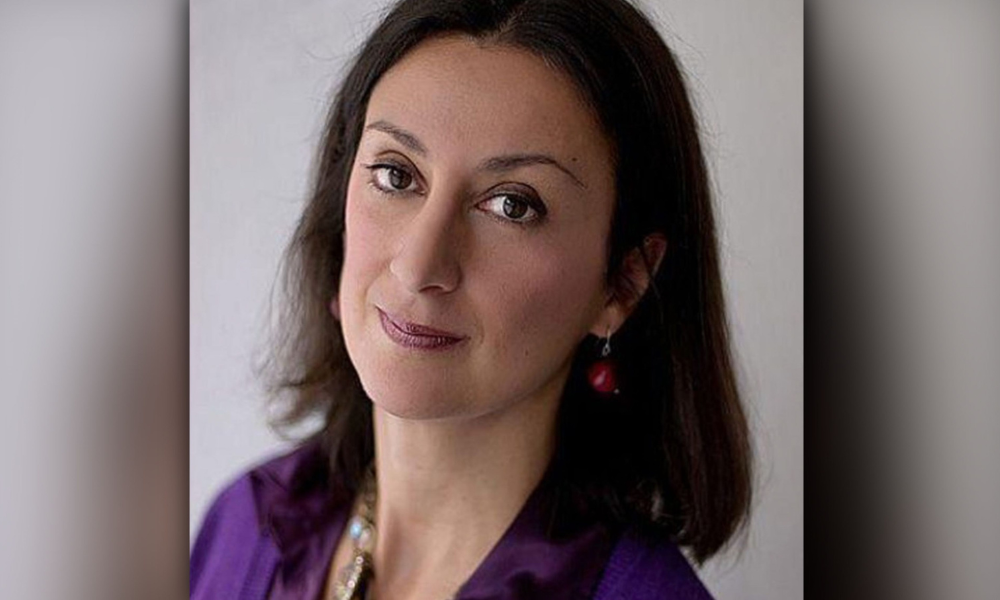
Daphne Caruana Galizia was a Maltese journalist, blogger and anti-corruption activist. She reported extensively on corruption, money laundering, organised crime, the sale of "golden passports" to third-country nationals and the involvement of the Maltese government in the Panama Papers scandal. She was repeatedly subjected to harassment and threats.
She was killed on 16 October 2017 when a bomb placed in her car exploded.
Public outcry over the Maltese authorities' handling of the murder investigation ultimately led to the resignation of Malta's Prime Minister, Joseph Muscat. Expressing their disapproval of failings in the investigations, MEPs called on the European Commission to take action in December 2019. They have returned to the issue repeatedly since, including in 2023, when they adopted a resolution condemning the lack of significant progress in bringing those responsible to justice.
To date, five people have been jailed for the murder, while no one has yet been convicted of masterminding it.