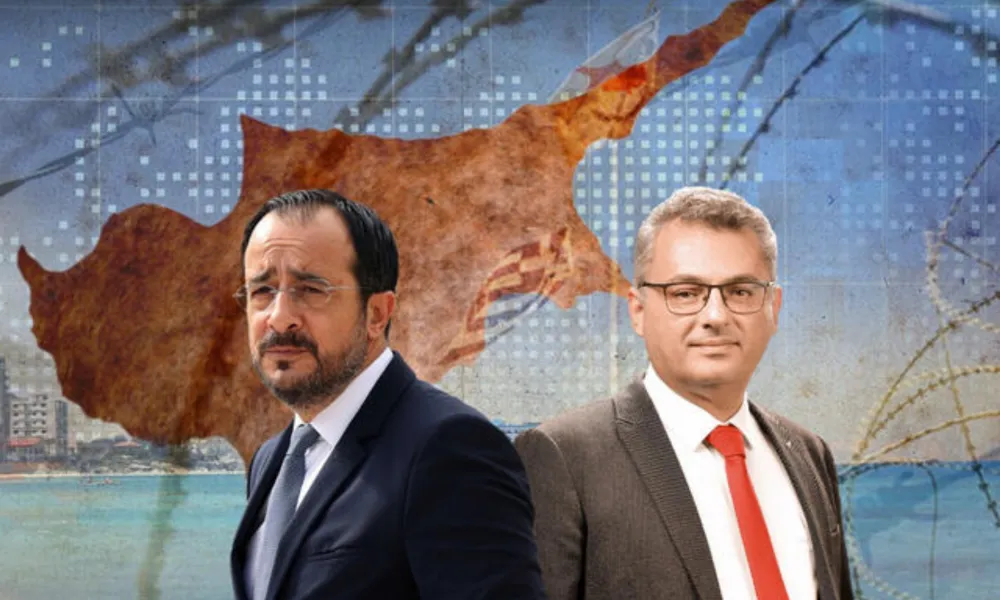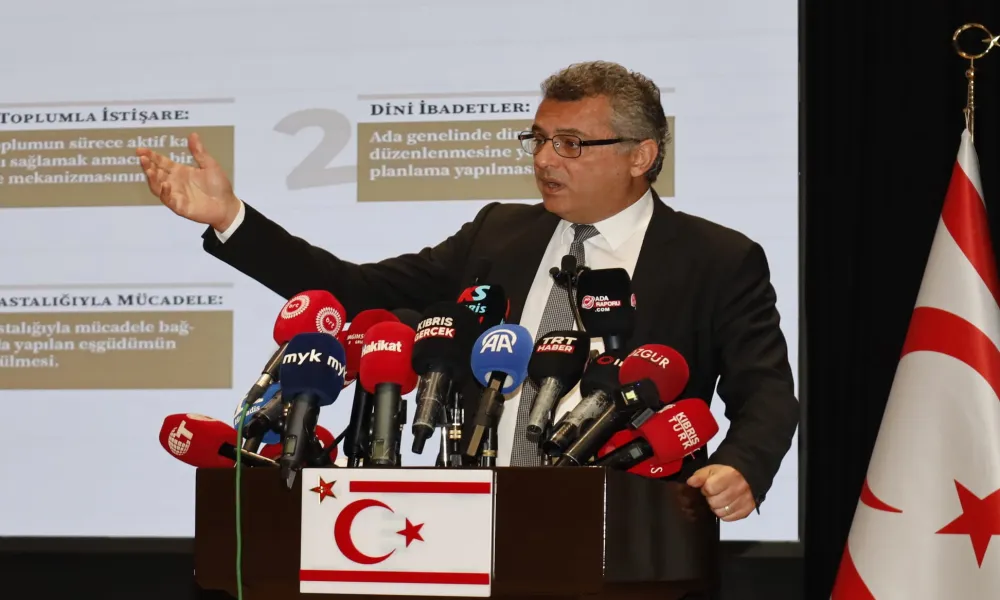

Turkish Cypriot leader Tufan Erhürman has said he will not attend a “formal” five-plus-one meeting on the Cyprus issue unless it is geared towards producing substantive results, stressing that content, not formulas or terminology, will determine whether a solution is possible.
Speaking after a one-hour meeting of the “council of political parties” under his chairmanship, Erhürman outlined a step-by-step process for moving forward, based on confidence-building measures, a defined methodology, a set timeframe for negotiations and ultimately a settlement.
According to reports from the north, the meeting focused on recent developments in the Cyprus issue and included an exchange of views on the Immovable Property Commission. It was attended by the leaders of parliamentary parties CTP, UBP, DP, YDP, including Unal Ustel, Sila Usar Inceirli, Fikri Ataoglu and Erhan Arikli, as well as leaders of extra-parliamentary parties TDP’s Zeki Celer, and HP’s Kudret Ozersay.
Cyprus issue
Erhürman reiterated that the Turkish Cypriot side supports the new initiative of the UN Secretary-General, Antonio Guterres, implemented through his personal envoy Maria Angela Holguin, adding that he has conveyed his readiness to contribute “in line with our own principles and in good faith”.
He stressed that he is not interested in negotiations for their own sake but in talks aimed at achieving a solution, again referring to Guterres’ statement that “this time must be different”.
He also reiterated his proposed four-point methodology, saying it “must be incorporated into the ongoing work”.
“Sometimes the discussion revolves more around concepts that are not clearly defined,” he said. “Our position is clear, as you know. You can define positions through concepts, but what will determine whether there is a solution is the content. Therefore, we do not focus on concepts or positioning, but on seeking a solution. We prefer to discuss the content, and that is what is being discussed at this moment.”
5+1 meeting
On the prospect of a five-plus-one meeting, Erhürman said his position remains unchanged.
“It makes no sense for issues that two leaders can resolve in Nicosia to be transferred to a meeting under the UN Secretary-General in the presence of the three guarantor powers,” he said. “As I have said before, how can two leaders who cannot sit down in Nicosia and resolve even one or two crossing points solve the Cyprus problem?”
He added that the Turkish Cypriot side does not consider it appropriate to hold a 5+1 meeting merely to discuss whether confidence-building measures are possible.
“We are ready to discuss these measures at any time in Nicosia and will make every effort in that direction,” he said.
However, he clarified that he is not opposed in principle to such a meeting, provided it produces concrete results.
“We want a 5+1 that will deliver outcomes. Our efforts are aimed in that direction, but we have always said that preparatory work must be done very well,” he said, adding that certain outcomes should effectively be secured in advance.
Immovable Property Commission
On the Immovable Property Commission, Erhürman repeated his assessment that a recent decision by the Committee of Ministers in Strasbourg does not concern the effectiveness of the body, but this does not make the decision insignificant.
He said there is a shared understanding among political leaders on the steps needed to strengthen the commission.
Referring to the Strasbourg decision as a first step, he said it was not favourable to the Turkish Cypriot side, adding that efforts will continue to ensure the commission’s effectiveness is not questioned, now or in the future.
Fidan – Holguin meeting
Asked to comment on reports that Turkish Foreign Minister Hakan Fidan told UN envoy Holguin that a two-state solution is the most realistic outcome for Cyprus, Erhürman again avoided engaging in discussion of “formulas”.
“Talking about formulas and concepts reflects each side’s positions, but what will show whether there can be a solution is the content,” he said.
He stressed that before addressing substance, a four-point methodology must guide the process, rejecting claims that this constitutes a Turkish imposition.
“We start from where Mr Guterres said, ‘this time must be different’. If it is to be different, this framework sets the rules of the game. As we all know, you must know the rules of the game before it begins. Otherwise, the game starts and by the 60th minute you are still debating the rules,” he said.
‘Step by step’
Erhürman said he is committed to reaching a solution and that no one should doubt this.
“Let us proceed step by step, with steady progress,” he said, noting that the four-point methodology already has traction at international and UN level.
The “step-by-step” process, he explained, consists of confidence-building measures, agreement on methodology, a defined negotiation period and finally a solution.
He added that he would not accept a superficial attempt to launch a new process and said consistency in his positions before and after the “presidential election” works to his advantage.
Source: CNA