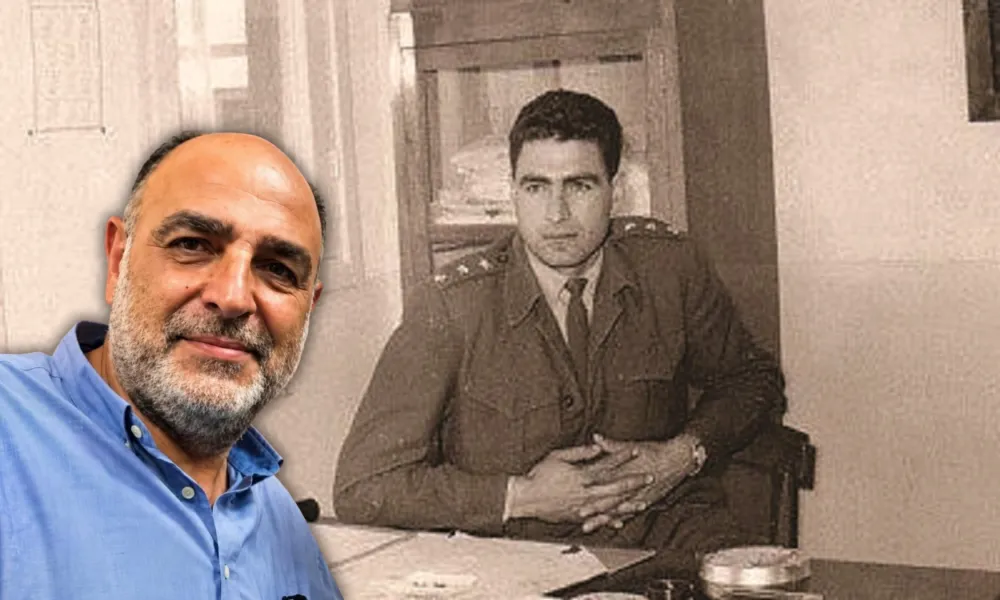

For most Cypriots, Tassos Markou is remembered as a hero of the 1974 Turkish invasion and the defence of Mia Milia.
For his son Paris Markou, he was first and foremost a father.
“For me, he was not the hero the world knows. He was my father.”
Speaking to the Cyprus News Agency (CNA), Paris recalls a parent he knew only until the age of six, yet whose presence, memories and absence shaped the rest of his life.
Remembering the man behind the hero
Markou says his memories are few but vivid.
“I remember him in uniform at home. He was calm, serious and had a presence that made us feel completely safe.”
He remembers family outings to the sea and mountains, as well as the discipline that defined family life, with set times for play, study, meals and sleep.
As he grew older, Paris pieced together an image of his father through stories from relatives, friends and his mother.
He came to know a modest man who rarely spoke about his role in EOKA or his achievements.
According to family accounts, when a superior once asked Tassos Markou to record his actions during the EOKA struggle, he replied:
“What I did was my duty to my homeland, and therefore I have nothing to say about myself.”
“That's probably the sentence that describes my father best,” Paris says.
Understanding the burden of the uniform
As a child, he saw only strength in his father's military uniform.
Later, after pursuing a military career himself, he came to understand the responsibility it symbolised.
“As a child I saw only strength. As an adult I understood the burden.”
His own service in the armed forces helped him better understand his father's dedication to the soldiers under his command.
“A commander is not only someone who gives orders. He is the one who steps forward first and accepts responsibility.”
“His children were now his soldiers”
Paris says he does not clearly remember the final moment he saw his father.
However, he knows from his mother what happened during those critical days in July and August 1974.
Tassos Markou contacted his wife and instructed her to take the children to Limassol, where they would be safe with her parents.
He also told her that from that moment on she would need to look after the children because:
“His children were now his soldiers.”
The remark troubled Paris as a child.
“I wondered how he could say his children were his soldiers when he already had us.”
Only later did he understand what his father meant.
“He was not setting us aside. He had already ensured we were safe, and at that moment he felt responsible for his men and for his duty to the homeland.”
A family waiting for answers
The war years became decades of uncertainty.
The family followed every report and every possible sighting of prisoners, hoping Tassos Markou might still be alive.
“Every report about prisoners and every testimony made us hope again.”
Those hopes were repeatedly followed by disappointment.
“Our home waited. There was no grave, no ending, no place to visit. Life continued, but part of us remained in August 1974.”
Paris' mother never stopped searching for answers and died in 2004 without learning her husband's fate.
Today, Paris remains firm in his position:
“Until we have a documented answer, my father remains missing.”
Pride and loss
Growing up as the son of one of Cyprus' most celebrated wartime figures brought both pride and responsibility.
“For the public he was Tassos Markou, the hero of Mia Milia. For us he was our father who never came home.”
He says pride can never replace a missing parent.
“Pride does not fill the empty seat at the table. It does not replace a father during celebrations, difficult moments or important decisions.”
His own military career brought him into contact with people who had known his father.
While proud of that legacy, he says he always felt the need to prove himself on his own merits.
The letter
Among the family's treasured possessions is a letter Tassos Markou sent to his son while training at the Hellenic Army Academy in Chalkida.
The letter contains no grand statements.
Instead, it is the simple message of a father advising his child to behave well, listen to his mother and avoid causing her trouble.
“When I read it, I do not see the officer or the hero. I hear my father speaking to me.”
The family also preserves his uniform, sword and cap.
But the letter means something different.
“It is his, and it was written for me.”
“What is missing is the truth”
Paris acknowledges that his father has been honoured by the Republic of Cyprus, Greece, the National Guard and wider society.
Yet he believes one thing remains absent.
“What is missing is the most important thing. The truth about his fate.”
He argues that no memorial or recognition can close the wound while Tassos Markou remains missing.
“The state must continue searching for answers, not only for Tassos Markou but for every missing person and every family still waiting.”
A message to younger generations
Paris also believes younger generations should learn not only the name of Tassos Markou, but the person behind it.
He urges young people to study history without turning it into a tool of hatred.
“History should not become an instrument of hatred. It should help us understand our mistakes and avoid repeating them.”
He notes that the consequences of 1974 remain part of everyday life through the issues of occupation, refugees, enclaved people and the missing.
“Look forward, but know what came before. Never take freedom and democracy for granted.”
“Father, I missed you all my life”
Asked what he would say to his father if given one chance, Paris does not hesitate.
“Father, I missed you all my life. I hope I proved worthy of your name. I am sorry you never met my children.”
For most people, Tassos Markou is a hero and a symbol of sacrifice.
For his son, he remains something more personal and more profound:
The father who never came home.
Who Was Tassos Markou?
Tassos Markou (1936-1974) is regarded as one of the most prominent figures in modern Cypriot history.
Born in Paralimni, he joined the EOKA anti-colonial struggle and later graduated from the Hellenic Army Academy in Athens before joining the newly established Cyprus National Guard.
During the 1974 Turkish invasion, he commanded forces in the Mia Milia-Kythrea sector and became associated with fierce resistance against advancing Turkish troops.
His last known radio contact with military headquarters took place on 15 August 1974, when he reportedly said he would remain at his position and continue fighting.
He has been listed as missing in action ever since and was later posthumously promoted to the rank of Lieutenant General.
Source: CNA