


In New York these days, there is more talk of who will succeed Antonio Guterres than of what he himself might still achieve before his term ends. That alone says a great deal. His second five year term expires on 31 December 2026, and the succession battle has already shifted to the UN's real centre of power, the Security Council. Eight candidates are now competing for the post, and informal straw polls are already under way.
The clash between the United States and Russia on one side and the President of the General Assembly, Annalena Baerbock, on the other is itself revealing of where the balance of power lies. Washington and Moscow have accused her of trying to expand the General Assembly's role in the selection process. Their objection rests on a simple point. Article 97 of the UN Charter provides that the Secretary General is appointed by the General Assembly on the recommendation of the Security Council. In practice, that means there is no Secretary General without the consent of the five permanent members.
This is also where the great contradiction surrounding Guterres' departure lies. It may be excessive to call him, objectively, the weakest Secretary General in history, yet he leaves office having experienced, perhaps more acutely than many of his predecessors, the shrinking of the post's political weight. In Ukraine, in Gaza, in Iran and in the era's other major crises, decisions have not been made by the Secretary General. They have been made by the major powers, often outside the UN altogether, or through mutual blocking inside the Security Council itself. Guterres could warn, mediate and denounce, but he could rarely force events in a given direction.
A narrow window
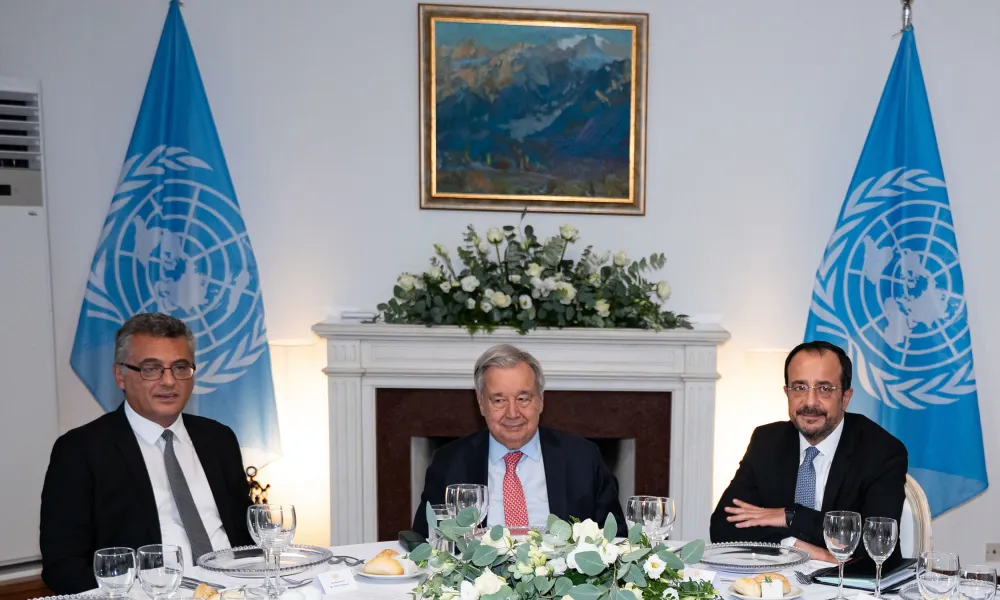
It is against this backdrop that the latest push on the Cyprus problem should be viewed. The outgoing Secretary General has a limited window in which to hand his successor at least a process that is moving, rather than another frozen file. That does not mean a dramatic new initiative is being planned. On the contrary, Holguín appears notably cautious. She has made clear that the UN does not want another expanded conference that ends in failure, and regards confidence-building measures as a necessary precondition for the next 5+1 format.
That is why the most important work at this stage is happening away from the cameras. Canadian constitutional expert John McGarry, brought in by the UN along with other specialists, is trying to consolidate into a single document the convergences reached up to and including Crans-Montana. Holguín has explained that these convergences must not be reopened one by one, since that could drag the process into years of fresh negotiation over ground already considered settled. Once complete, the document will be handed to both sides and to the three Guarantor Powers, and will effectively serve as the test of whether common ground exists on which a negotiation could genuinely resume.
This is where the difficulty begins. The Christodoulides-Erhürman meeting on 26 August could produce a small agreement, chiefly on crossing points. If it does, the UN will be able to present it as proof that the two sides are capable of reaching agreements, and move toward another expanded conference. Even now, though, the crossing points issue itself remains blocked. And although there is now agreement in principle on more frequent meetings between the two leaders, they will meet only a month after the UN Secretary General's own visit to Cyprus.
Little real change
The core problem is that, behind the visible activity, no shift in the underlying strategic positions is yet apparent. Turkey continues to publicly back the two state position. Erhürman himself, though clearly more conciliatory and negotiation minded than his predecessor, openly acknowledges that neither a 5+1 meeting nor any eventual agreement can proceed without Turkey's consent. This may be the most important fact of all, that a change in tone in the north does not necessarily amount to a change in Ankara's underlying strategy.
At the same time, so called confidence-building keeps running into the daily politics of confrontation. Erhürman's claim that the Cypriot foreign ministry had called embassies to discourage diplomats from attending a briefing organised by the Turkish Cypriot side was confirmed by diplomatic sources. Nicosia also moved to have the Serbian festival EXIT withdrawn from a music event at Kyrenia Castle, and succeeded. From the Republic of Cyprus's perspective, this is simply a self-evident policy of preventing steps that could upgrade the occupation regime. From Erhürman's perspective, however, it is the ideal argument to support his claim that the Greek Cypriot side talks about trust at the table while pursuing a policy of isolation outside it.
Movement, or just motion?
This is roughly where the real question arises: is today's activity substantive, or artificial? The likeliest answer is that the process itself is real, but it does not yet have political momentum behind it. Guterres wants to leave having tried. Holguín wants to build something more solid than yet another photograph of five sides around a table. Erhürman wants a negotiation, but operates within the limits set by the Turkish Cypriots' dependent relationship with Ankara. Turkey has far bigger geopolitical fronts to manage and has not so far shown the political shift a federal solution would require. Athens supports the process but does not present itself as the player trying to drive it forward decisively, wary of being burned once again.
Then there is Nikos Christodoulides. For the president, this activity undoubtedly carries political value too. A president seen to bring the Cyprus problem back onto the international stage, to bring the Secretary General himself to Cyprus, and to keep dialogue open, can put that image to political use ahead of 2028, even without a solution. That does not prove his effort is merely for show. It does, however, create an interesting political paradox, that the process can be useful even without a result.
That is precisely the greatest risk. That the Cyprus problem begins once again to produce meetings, statements, documents, visits and five sided gatherings, without producing real results. In other words, enough activity for everyone to claim they are trying, but not enough for anyone to be forced into the hard decisions. This is a script Cyprus has seen many times before.
Will there be a crack?
26 August will show whether even the first small crack exists in this pattern. Crossing points will not solve the Cyprus problem. But they can show whether the two sides are currently capable of agreeing even on the easy issues. Because if they cannot agree even on these, the great document of convergences may ultimately record not how close the two communities once came, but how far apart they still remain today. If Antonio Guterres achieved anything during his visit to Cyprus at the end of July 2026, it was to place responsibility for whatever does, or does not, happen on the Cyprus problem squarely on the shoulders of the two leaders. He did not ask Christodoulides and Erhürman to solve the Cyprus problem. He asked them to open two or three crossing points. If that cannot be achieved on 26 August, why should anyone genuinely engage with the Cyprus problem again?