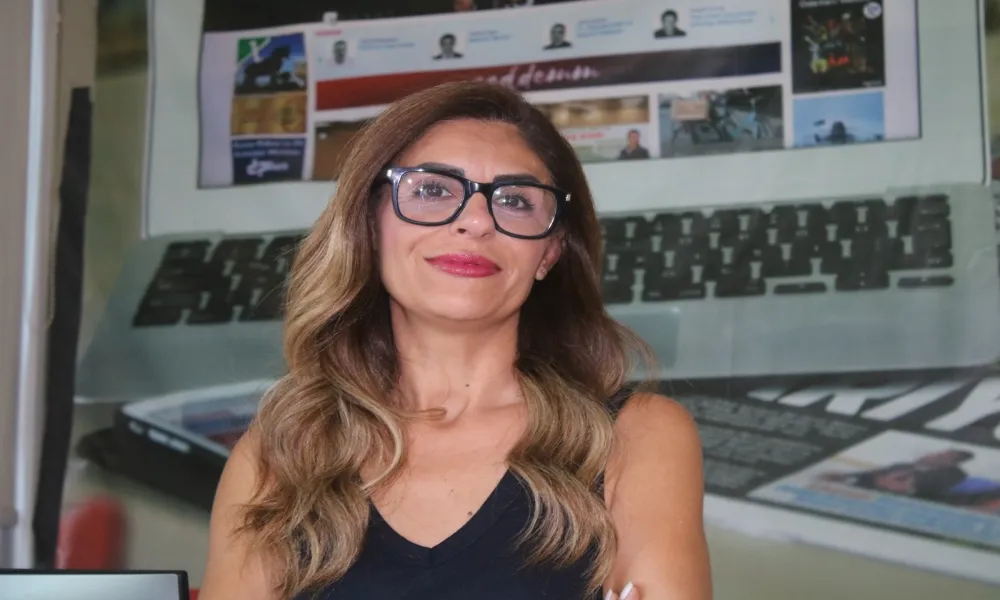
Turkish Cypriot journalist Tümay Tuğyan of Yenidüzen has taken the initiative to document a series of stories about “humanity amid war”. She is seeking to record experiences that are usually lost within the dominant, ethnocentric and nationalist narratives of the conflict in Cyprus, as noted by Turkologist and assistant professor at the University of Cyprus Nikos Moudouros, who brought attention to the initiative in a Facebook post.
“Such initiatives can save oral history that is at risk of being lost. The people who experienced the conflicts of the 1950s, 1960s and 1970s are becoming fewer. Stories of mutual assistance, protection and even the saving of lives often remain family memories.
“The systematic recording of these stories turns them from ‘private memory’ into historical evidence,” the academic notes, while stressing that the title of the series, “Humanity Amid War” (Savaşın içinde yaşayan insanlık), does not mean or suggest that humanity cancelled out the war or that there were no perpetrators and victims.
Tümay Tuğyan, whose roots lie in a village in the Troodos mountains and in Famagusta, and the Turkish Cypriot newspaper Yenidüzen Gazetesi are also inviting Greek Cypriots to take part in the process.
Personal experience
What prompted you to start this series of stories about “Humanity Amid War”? Was there a particular story, testimony or personal experience that inspired you?
My great-grandmother and great-grandfather had exactly such an experience. In 1964, they escaped mass killings in Varosha — something that would later become connected with the history of the missing persons issue in Cyprus — thanks to a Greek Cypriot who warned them literally at the last moment.
That inspired me to start the series. In fact, the first interview in the series tells the story of that incident.
Why did you feel these stories needed to be recorded now? Some might think that you are preventing the wounds from healing…
In my view, the greatest obstacle to healing old wounds is nationalism, which deliberately and continually scratches those wounds in ways that fuel hostility.
I believe, on the contrary, that the stories I am looking for can serve as an antidote to nationalism.
“To be human”
The title of the series is “Humanity Amid War”. What does “humanity” mean to you in conditions of war and ethnic violence? Are we talking about acts of heroism, everyday acts of solidarity, or something more complex?
For me, humanity has a very simple definition. Whether you are at war or in any other circumstance, humanity means fulfilling the most fundamental obligations of being human — such as being ethical, having a conscience, showing compassion and empathy.
It is as simple as that.
Have you received a response? Have people sent you texts or contacted you about this? From both Turkish Cypriots and Greek Cypriots?
Yes. As soon as the interviews began to be published, I started receiving messages from both Turkish Cypriots and Greek Cypriots who contacted me to share their own memories and stories of things they had experienced themselves, or that members of their families or people they knew had experienced.
People who helped members of the “other” community.
Sometimes these are small acts of kindness. At other times, however, they are acts of assistance that literally saved lives.
And many of these stories concern incidents that people have shared within their close circles, but about which they have never spoken publicly.
Is there any testimony that stands out?
For example, in one story concerning Turkish Cypriots who helped Greek Cypriot soldiers cross towards the south, I wondered whether publicly sharing such a story could create difficulties for the people involved.
Because, as you know, in a wartime context, helping civilians and helping soldiers can be perceived in very different ways.
Enemies and friends
How do people react when you ask them to revisit events that happened 50, 60 or even 70 years ago?
Some people feel completely comfortable sharing their memories with us, while others approach the process with some concern and hesitate to speak publicly about their experiences.
I think this may be because saying something positive about the other side — which is often portrayed in the dominant narrative as the “enemy” — can sometimes be perceived as a kind of betrayal of one’s own community.
Why have such stories not occupied a greater place in the official history of Cyprus until now?
Perhaps because official histories tend to focus on political events, violence and the actions of political figures, while personal acts of kindness and solidarity are more difficult to incorporate into dominant national narratives.
Which ties appear to have proved stronger than ethnic identity? Neighbourhood, friendship, professional relationships, family ties, economic relations, something else?
From the stories I have heard, it is difficult to identify one single type of bond.
Neighbourhood ties, friendships, professional relationships or simply the fact that people knew one another as human beings often seem to have created connections that were stronger than ethnic identity, at least at an individual level.
What is particularly striking is that some of these acts did not necessarily arise from deep or long-standing relationships, but simply from a sense of humanity and a willingness to help someone who was in a difficult situation.
Humanity does not mean equating the two sides
Is there a risk of creating an idealised picture of the past? How can one speak about humanity without equating perpetrators and victims or silencing responsibility for the violence?
Our aim is not to romanticise the past.
We deliberately focus on individual acts of humanity because they can coexist with violence, injustice and responsibility.
Recognising that an individual helped, protected or showed kindness to someone from the other community does not erase the violence that took place, nor does it diminish the experiences of victims.
Recognising humanity does not mean equating perpetrators with victims.
It means creating space for stories that are often lost within the broader political narrative, while remaining clear about the realities and responsibilities surrounding the conflict.
The purpose of the series, therefore, is not to rewrite the past but to add another layer to our understanding of it: to remember that even during periods of conflict, people were capable of choosing compassion and helping one another.
Why is a Turkish Cypriot newspaper asking Greek Cypriots to share personal memories relating to the conflict?
I can give you many reasons.
First of all, the series is about remembering not only what divided us, but also the humanity, solidarity and kindness that existed between us.
Through personal stories of solidarity, we want to show the human side of the conflict and highlight the good that people did for one another, on both sides of the dividing line.
We want to present Greek Cypriots not simply as the political “other”, but as fellow Cypriots who, like us, experienced fear, loss, displacement and mourning.
Rather than asking “Who was right?” or “Who started it?”, our aim is to focus on ordinary people and the acts that connected the two communities, while recognising that there is no single, universally shared Cypriot memory of the conflict.
We also believe that bringing these stories to light can create empathy and contribute to reconciliation and coexistence.
At the same time, we want to preserve these personal memories before they are lost and help fill gaps in the historical record.
The role of the media
What has been the role of the press, over time, in relation to the Cyprus problem?
Over all these years, both the Turkish Cypriot and Greek Cypriot press have played an important role in shaping the way each community perceives the Cyprus problem.
Like the political narratives of the time, the media often reflected and reinforced the division between the two communities, particularly by presenting the other side through a national or, at times, hostile lens.
However, although not to the extent I mentioned above, some publications have also provided space for alternative voices and stories that challenge these dominant narratives.
Our series of interviews is an attempt to do the latter.
Social memory
How would you like this initiative to develop?
I would like the series to continue, reaching more people from both communities and bringing to light more stories that have largely remained untold.
I hope these stories can become part of a broader public memory of Cyprus — a memory that does not ignore the conflict or its painful history, but also remembers the solidarity that existed alongside it.
To Greek Cypriots
Is there a message you would like to send to the Greek Cypriots who will read this interview?
I would simply say that we are listening.
These stories matter to us and we want to hear them — not to challenge or judge anyone’s experience, but to understand it and remember it.
I hope Greek Cypriots will feel that they can share these memories with us.
Sometimes publicly telling these stories can be difficult, particularly when they do not fit the dominant narrative.
But I believe they are an important part of our shared history.
Ultimately, I hope this series will remind us that, alongside everything that divided us, there were also people who helped, protected and cared for one another.