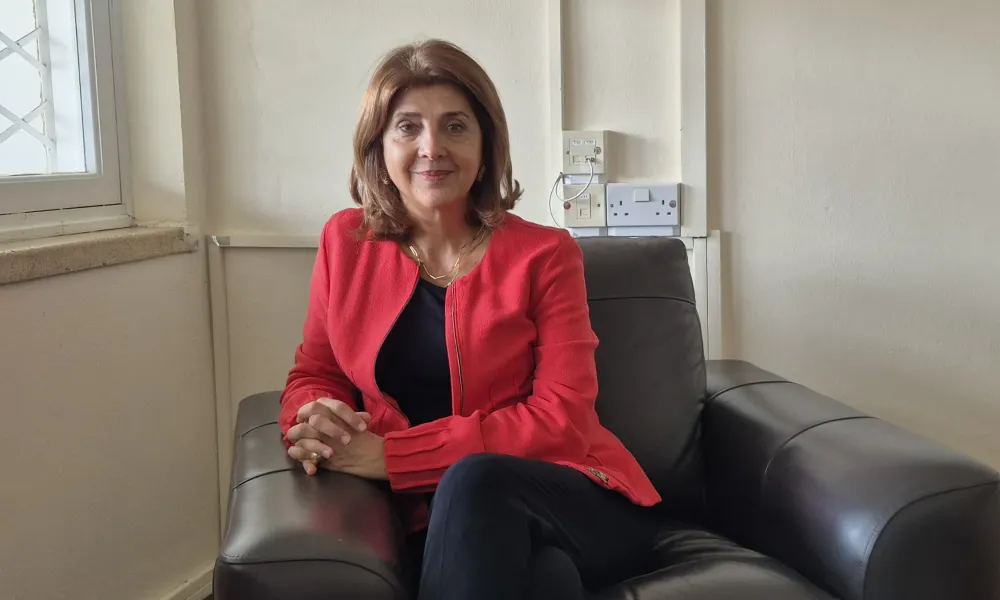

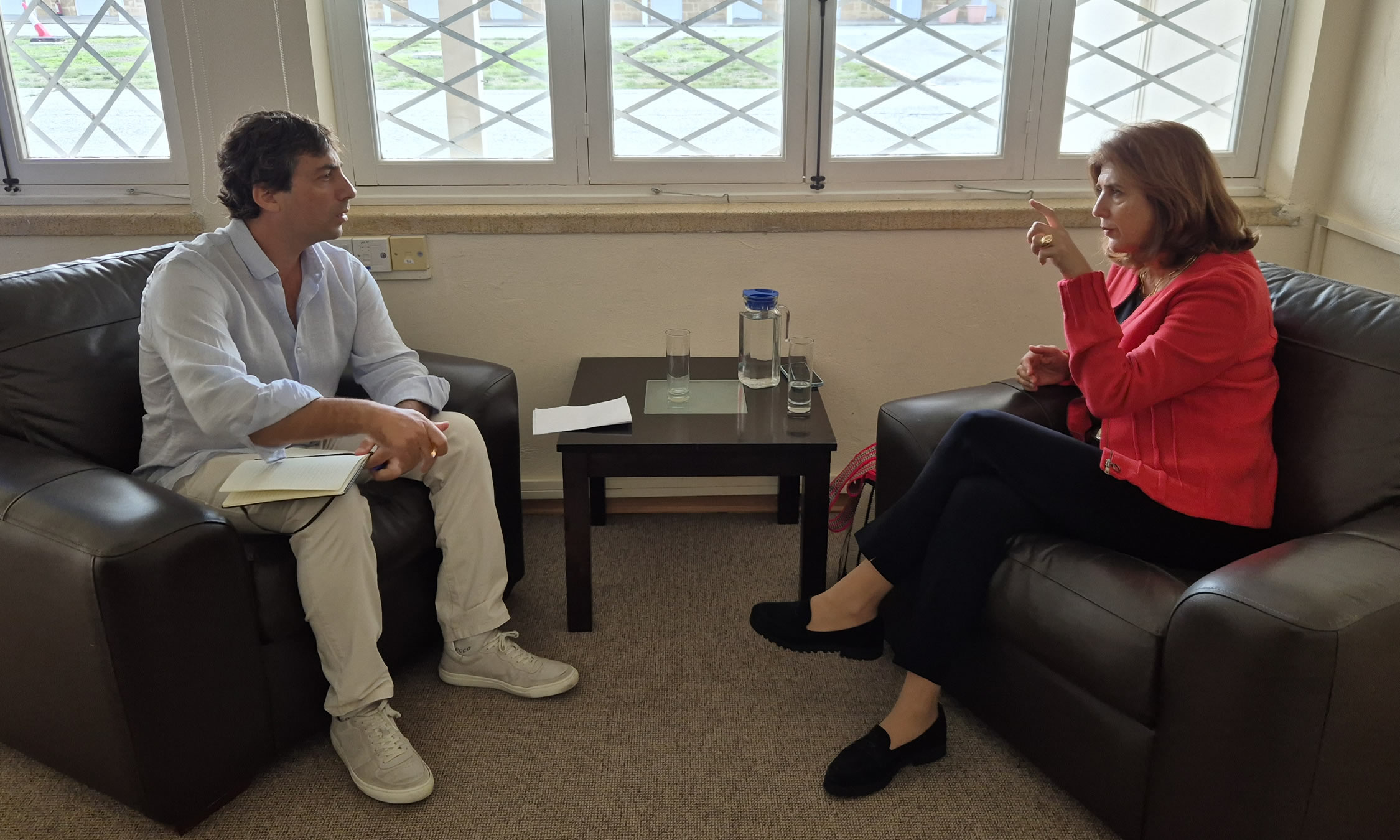
The first question UN Personal Envoy María Ángela Holguín was asked in an interview with Politis on Friday was whether we should expect announcements at the weekend, as President Nikos Christodoulides had suggested.
“If there are going to be announcements, they will be on Monday. There is nothing before Monday,” she said.
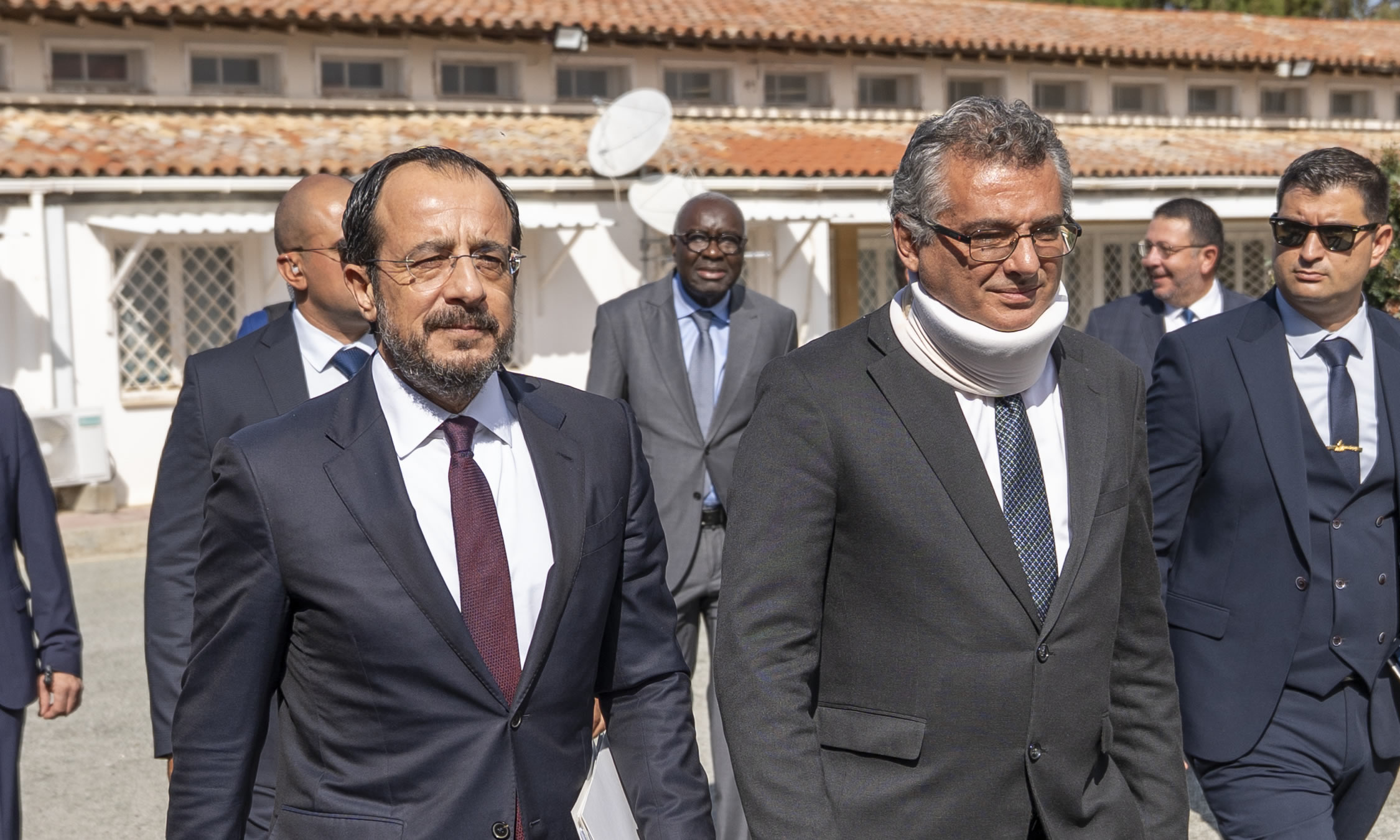
Should things go well, the two leaders will have a “small” package of confidence-building measures (CBMs) to announce tomorrow when they meet Holguín at the old Nicosia airport.
The envoy clarified the package will concern CBMs alone, not methodology or substance.
The aim is to agree on four crossings and demining though as of Friday, both matters had yet to be resolved. If finalised, the package will also include measures on the environment, such as microplastics, on cultural heritage, and on disaster response, with the creation of a bicommunal, fast-track team that can react rapidly in the event of a crisis or natural disaster.
Kokkina never on the table
On the four crossings, Holguín confirmed these related to Athienou-Pyroi-Aglandjia, Mia Milia, Louroudjina-Lymbia and Kampos-Karavostasi.
“But we do not have the ‘yes’ yet,” she said.
Asked about Kokkina, the envoy was clear: “Kokkina has never been on the table.”
The Turkish Cypriots were clear this was never an option, she added.
Christodoulides, meanwhile, only tabled an alternative to Kokkina a few weeks ago.
On demining, ANKA News Agency reported on 70,000 square metres of minefields that could be cleared as part of the CBM package. Holguín confirmed an agreement on demining was possible but not locked in yet.
On Thursday, Deputy Government Spokesperson Yiannis Antoniou told Politis Radio that some aspects of discussions required the green light from Ankara. It wasn’t clear if he was referring to demining or crossing points or both.
When 7+19 = confusion
Turkish Cypriot leader Tufan Erhürman argues that during his visit to Cyprus, UN Secretary-General António Guterres asked the sides to focus on seven specific proposals: crossing points, demining, a consultative body, a disaster response mechanism, migration management, sports, and citizenship for children of mixed marriages.
Asked to comment, the envoy pointed to the list of CBMs agreed in principle at the 5+1 meetings held in 2025.
Regarding Erhürman’s list, she noted the citizenship issue was not a CBM. “This is a unilateral decision of the Greek Cypriots, so we cannot call this a CBM.”
On sports, the Greek Cypriot side does not accept developing this measure, though the European Union has organised some bicommunal games, she said.
Regarding President Christodoulides’ own 19 proposals raised orally in September, Holguín said a number of them have already been implemented, such as the leaders’ joint attendance at the Pyla festival and three bicommunal committee meetings.
However, the envoy said: “We don’t have the 19 points.” She noted that both she and Erhürman asked for the list in writing but did not get a response.
Turkey decides on Varosha
On the proposal to hand the fenced area of Varosha to the UN in exchange for putting Famagusta port under EU supervision, Holguín said: “There are some issues that whether we want it or not, it is a Turkish decision. Security, guarantees, and Varosha. Because the troops are there.”
At the same time, Erhürman slammed the proposal, noting that giving Varosha to the UN is an irreversible measure, while opening trade with the EU is not and can be rescinded on demand.
The Turkish Cypriot leader has told Christodoulides that such a big measure has to be irreversible for both sides.
Asked if significant CBMs could change the climate, given the public’s seeming fatigue over the Cyprus issue, Holguín agreed.
“Yes of course. But this is why I am optimistic that on Monday we can announce four crossings. It's something that gives some energy to the people.”
Fidan’s surprise visit
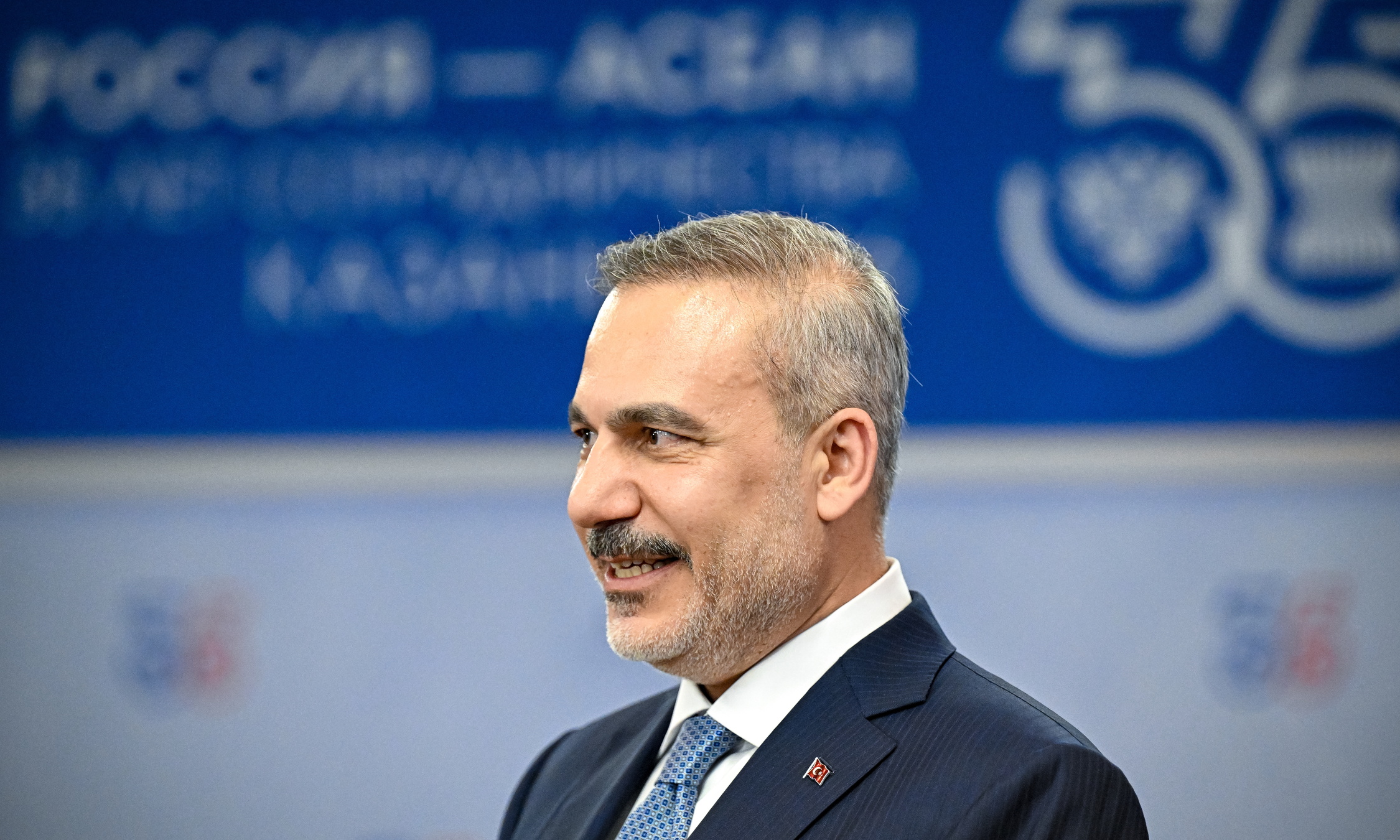
A significant unknown variable in the whole effort to move towards agreement on CBMs this Monday, and further down the line on methodology and substance, is the impromptu, flash visit of Turkish Foreign Minister Hakan Fidan to the north on Friday.
The Turkish FM came to the island just three days before a critical trilateral that could decide whether Guterres’ initiative fizzles out or produces something that potentially leads to a 5+1 and, more importantly, the resumption of talks.
Fidan met with Erhürman and his representative Mehmet Dânâ for 80 minutes, after which no statements were made.
Prior to his arrival, Turkish Cypriot media reported that he would discuss latest developments on the Cyprus issue while reiterating Ankara’s position on a two-state solution, sovereign equality and the equal international status of Turkish Cypriots.
Asked if the UN was aware of the purpose of his visit, Holguín said she was not, and that she hadn’t talked to Fidan since the summer.
Asked if their last meeting gave her a sense Ankara would be flexible if things moved forward, she replied: “If things moved forward, maybe yes. But they asked for movement.”
Specifically, movement by the leaders in Nicosia.
Regarding the EU-Turkey track, Fidan met with EU foreign policy chief Kaja Kallas last month in Brussels. However, there have been no recent meetings with the EU Special Representative for Cyprus Raffaele Fitto, despite Christodoulides repeatedly suggesting such a development was imminent. It remains to be seen whether anything can come of this effort, particularly after the European Commission’s highly critical 2026 report on Turkey.
Conducive conditions and cancellations
Another issue that keeps coming up and impacting the climate between the two leaders is Greek Cypriot efforts to cancel cultural, sporting or diplomatic engagements by Turkish Cypriots.
While Christodoulides shrugged it off last summer as the natural response of a legitimate state when dealing with a breakaway entity, Erhürman was furious and made his exasperation publicly known.
He complained to the Commission and the UN Secretary-General and received sympathetic responses from both. In his reply to Erhürman on 16 October 2026, Guterres described developments as “disheartening” and “contrary to my repeated calls for initiatives that strengthen mutual trust and confidence”.
The SG noted that while UN policy remains unchanged and UN Security Council decisions on the matter are strictly upheld, “I reiterate that concerns about recognition should not in themselves constitute an obstacle to increased cooperation.”
Leaving no doubt about his position on the matter, he concluded: “actions which hinder the building of trust, including the cancellation of events based on fears related to recognition, are contrary to all our collective efforts”.
What about methodology and substance
The UN envoy sent a letter to both leaders over a month ago requesting they move forward on methodology. They did not, nor on substance.
On methodology, the Turkish Cypriot leader’s four-point proposal looks very much like a list of preconditions. While agreeing on past convergences and setting a timeline are not obstacles, the other two points – getting a rotating presidency secured before negotiations start and seeking safeguards against a return to the status quo – are more problematic.
Asked to comment, Holguín said she will propose to the leaders tomorrow to take a different approach in an effort to make progress. She will ask them to work on ‘procedural steps’ that set a framework for formal negotiations. They will need to work out things like a timeframe, an agenda, deadlock-breaking mechanisms.
Convergences for later
Asked about the UN document that has been prepared, including convergences achieved between 2015-2017 but not conditional convergences at Crans-Montana, the UN envoy was adamant this will not be given to the sides before negotiations start.
Holguín pointed to a similar exercise by Alexander Downer who shared the convergences with the two sides and the guarantor powers.
“And what happened? A huge mess.”
She argued the UN does not want a repeat of what happened under Downer, which created discord and increased the gap between the sides.
“You know that they have (their own convergence) papers, both sides. They know exactly where they are.”
Substance = agenda
The former Colombian foreign minister said once negotiations start, the agenda of the negotiations should be the six points set out by Guterres at Crans-Montana, otherwise known as the Guterres Framework, covering the fundamental pending issues across chapters.
“The perfect agenda is the six points. You can call it whatever,” she said.
She argued that negotiations should start from there, and then the sides can come back to the convergences when needed, and tackle pending issues as they go through the agenda.
Dealing with a heavy past
Holguín argued that the “heavy weight of the past” is a big issue in Cyprus. What if the leaders were to start negotiations without focusing on that weight, that is, the body of convergences, but “tried to look ahead to the future” by working on these six fundamental points set out by Guterres, she asked.
The convergences are there if they need them. But rather than starting with these 200-odd pages that include elements that may or may not be considered useful today, why don’t the leaders start with a discussion on what they want and where they want to go, the envoy added.
“What are the views of the two sides?” Do they both want to go back to a strong federation as in Crans-Montana?
“Which is your port of destiny? If you know your port of destiny, it’s much easier to go in.”
This conversation needs to be had by the two leaders, said Holguín.
Next steps and the new SG
Assuming a spanner is not thrown in the works over the weekend, and the two sides wrap up pending issues, the leaders could announce a package of CBMs at tomorrow’s trilateral.
On next steps, Holguín said this depends on the Secretary-General, what he decides to do next and his agenda.
Her own preference is for the leaders to meet with Guterres in a 2+1 to finalise the ‘procedural steps’ that will serve as the framework for future negotiations, defining how they will start and what the agenda will be.
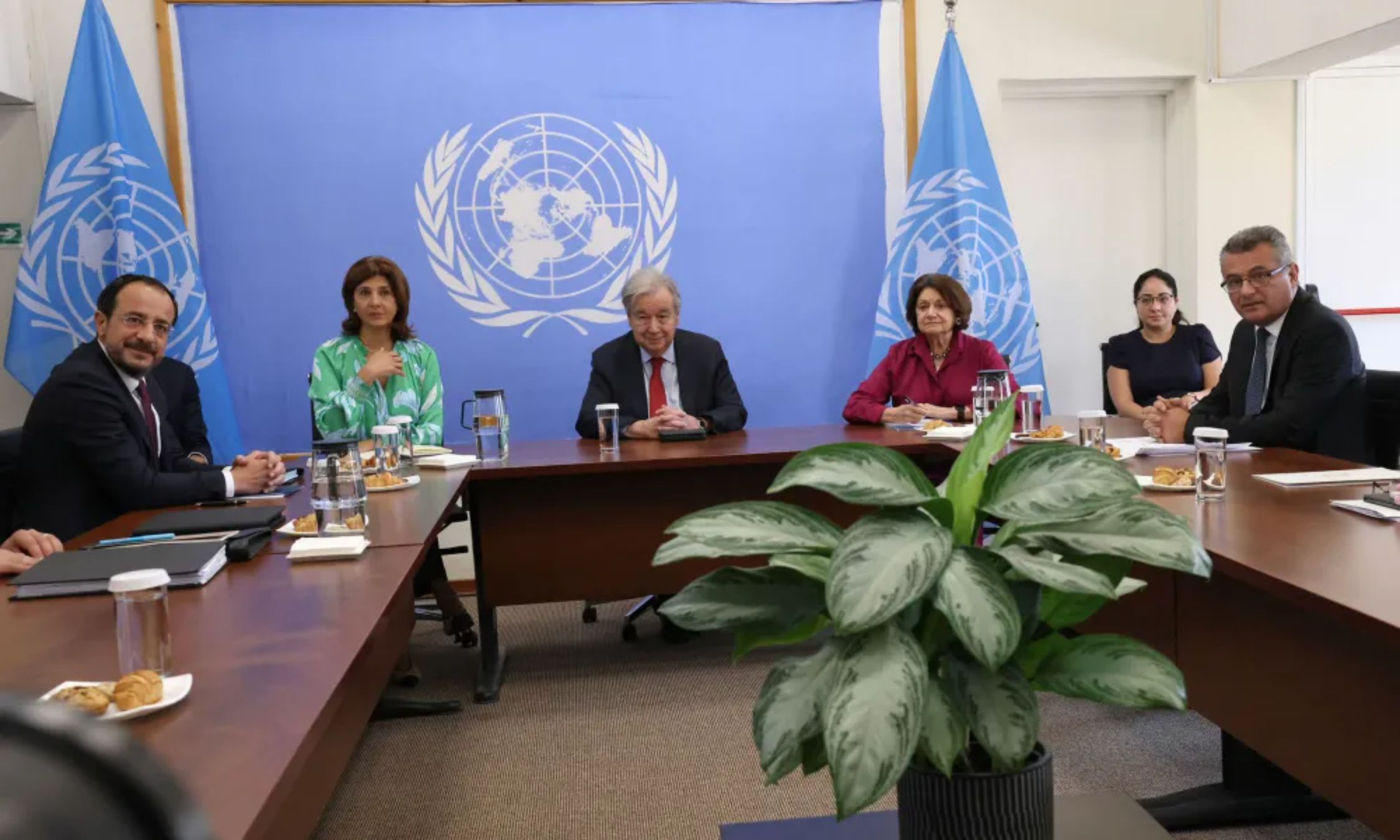
Then, a 5+1 with the guarantor powers could be convened with the goal of launching the start of negotiations. “That could be with Guterres or the next SG.”
The envoy noted that Guterres is on travels all November, leaving only December for potential Cyprus-related meetings when he will also be focused on arranging the transition phase with his successor.
Asked if, given the history of failed peace talks, the new SG would even consider starting their term with the Cyprus issue, Holguín was blunt in her reply.
“You know, they spent a year to decide on crossings.”
And to get to a 5+1, Guterres asked for progress on CBMs, methodology and substance, she noted.
Asked if she will stick around after Guterres leaves, Holguín said if she could see there would be progress in a short time of three-four months, and if the new SG asked her then ‘yes’. But if the pace continues as it has done this past year, then it’s a ‘no’.
On whether she had any advice for her potential successor, Holguín said she does not expect Ankara to agree on another envoy until after the presidential elections in Cyprus in 2028.
Internal politics
Asked what the biggest obstacle to progress has been so far, Holguín replied: “I think, internal politics […] There is always an election.”
She noted that with political willingness on both sides, “I am sure you can get something.”
Does this mean political will is lacking? “Yes.”
Asked if this stood for all sides, she replied it did.
As for the Greek Cypriots, if they wanted to get something from this process soon, they could perhaps consider delaying the presidential election a little, the UN envoy argued.
Regional complications
The former foreign minister once again raised her concern about regional developments complicating matters further for a Cyprus solution. “There are more actors involved” with their own interests. Some may prefer the status quo, she added.
From Colombia to Cyprus
Holguín has worked on Cyprus on and off since January 2024. Asked what she has learnt about Cyprus since her journey began, the envoy pointed to her own conflict in Colombia.
“I come from a country with a huge conflict, where the past is one of the most complicated things. But in the end, we try to look to the future and to the new generation. This is what I think, here, it's really very difficult (to do).”
She noted the huge challenges faced by the public in Colombia to consider a path of reconciliation with the guerrillas after half a century of killings and kidnappings all over the country. Even on a personal level, her family questioned why she sat in an official capacity at the negotiating table during peace talks.
“I don't want to sound naive, I know how difficult the past is. But sometimes, even with the past, you have to think that life has to be different. I wanted a different country for my son, and even for me.”