There is a saying that an invisible thread connects all those who lose their homeland overnight. It is the same thread that has woven Cyprus' story for the past 52 years.
These are people who have now spent more years living in the free areas, in Limassol, Nicosia and Larnaca, than they ever spent in the villages and towns where they were born. People who put down roots again, grew to love their new surroundings, yet kept their hearts firmly locked in the past.
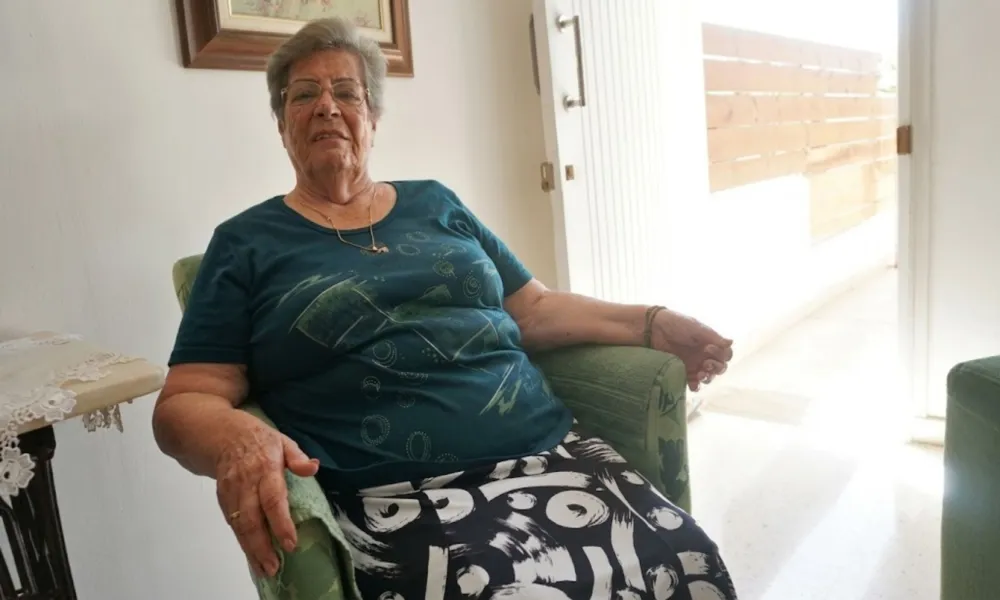
The story of Yiannoula Zenonos-Evangelou is not just another personal account. It reflects the experience of an entire generation. A generation that raised babies in tents, counted absences, lost loved ones both in war and in peace, and now, 52 years later, looks at the keys of occupied homes with dignity and deep sorrow.
From her beloved Tymbou to Varosha, and then through the flames of 1974 to the Ayios Spyridonas refugee settlement in Limassol, hers is a deeply personal testimony about loss, motherhood during wartime and the heavy burden of a promise of return that is slowly fading.
Her conversation with Politis serves as a reminder that amid all the dramatic changes Cyprus has undergone over the past half-century, there remains a generation living with open wounds, one that experienced injustice and watched entire careers and fortunes built upon its suffering.
Where were you when the events of that summer unfolded, and how did your journey from Tymbou to Varosha begin?
I was born, raised and married in Tymbou. Both my husband, Andreas, and I came from there.
When the invasion took place, we had two small children. We had been living in Varosha for four years because of my husband's work. He was a machinist.
Andreas met someone from Varosha while serving in the army. The man owned a machine workshop and, because Andreas was highly skilled, he was invited to work for Chrysostomos in Famagusta.
That is how our family ended up there. The journey from Tymbou to Famagusta was long, requiring travel across the whole of the Mesaoria plain. I remember the workshop being located outside Varosha's harbour and we lived in Ayia Zoni.
What were conditions like before you decided to settle there permanently?
For three years before moving permanently to Varosha, Andreas crossed the Mesaoria every day.
It was a long journey, so we eventually decided to rent a house there.
We moved to Varosha in 1970.
Later, Andreas and two partners opened their own machine workshop and our life became permanently centred there.
What do you remember from the day of the coup?
We were in Varosha when the coup took place on a Monday.
Andreas was at work and I remember him returning home. I had a seamstress working at the house that day.
The children were small. My eldest was in second grade, my middle daughter was in kindergarten and little Athinoula was only eight months old.
Andreas told me:
"Tell the girl let's take her home, there's been a coup."
Back then seamstresses came to people's homes.
I asked him:
"What is that supposed to mean?"
We didn't know what a coup was.
He replied:
"They want to overthrow the government and there will be trouble. We'll take the girl back to her family."
And that's exactly what we did.
How did that week unfold until the first invasion on Saturday?
There was nervousness throughout the week.
People continued going to work, but there was anxiety and they kept coming home to check on what was happening.
When mobilisation was announced, Andreas immediately reported for duty. He was born in 1940.
On Saturday, 20 July, we were at home when they called them up.
They left early in the morning.
Andreas and others were sent to Prastio. The company assembled there before being sent elsewhere.
I stayed home with the children until we were taken to Tymbou.
When the ceasefire came, we returned briefly to Varosha.
But 14 August changed everything. How did you leave Varosha?
Like something from a film.
The second invasion began on 14 August.
I remember a police officer from Kapedes living upstairs from us. He came home from work and put us all in his car. His own family, his wife and two children, and me with my three children.
He told his wife:
"Go and tell Mrs Yiannoula to get the children. I'll take you to the village and then come back. I'm on alert duty."
He put us all in the car and then returned.
I never went back.
People thought Tymbou would be safer but because of the airport it too was eventually captured.
We stayed there briefly and then had to leave again.
Were you able to take anything with you?
I took nothing from our home in Varosha and it still breaks my heart.
Not even my jewellery.
Athinoula was eight months old and in the bag I packed I had to make room for milk and nappies.
I remember trying to put our jewellery into the suitcase. I had it all in a box.
But the suitcase would not close.
So I took the jewellery back out because I needed space for the baby's things.
Where did you go afterwards and how did you hear news about your husband?
On the afternoon of 14 August, the church bells in Tymbou were ringing because the Feast of the Virgin Mary was approaching.
We gathered what little we had and ended up in Athienou with my sister-in-law.
It took days before we were reunited.
My husband remained in the army throughout the fighting.
I only learned news about him by chance through radio messages.
He was in Ayios Pavlos, where battles took place.
Later, when things calmed down, we moved temporarily to Pallouriotissa.
It was there that I saw my husband again after many days.
A relative found him and told him where we were staying.
He came, saw us, and left again.
He remained in uniform from the beginning of the war until demobilisation.
My brother served for three years.
How did you manage until your family was reunited?
After Athienou we went to Ponantza and then to Xylofagou.
My mother-in-law knew a family there because she had worked in their potato fields.
The landlady hosted us without charging a penny.
Those people stood by us until Andreas returned.
There were people who felt sympathy for us and helped us without asking for anything in return.
How did you decide to move to Limassol?
By September the children needed to attend school and we had to decide what to do.
We eventually settled in Kalavasos.
The only place where work was available was Vasiliko, so it was the nearest option, especially since we did not own a car.
Andreas found work there earning nine pounds a week.
Later he secured a job at the shipyards and we moved to Limassol.
When did you move into the refugee settlement and what was the reception like?
We moved to the settlement in Limassol shortly before 1990.
My husband died in a car accident in 1986, leaving me alone with the children.
At the time we were already living in Polemidia and I applied for a house in the settlement.
The people of Limassol welcomed us warmly.
The Ayios Spyridonas settlement was the last one built.
When we arrived there were not even proper roads.
I remember us sitting outside and talking about everything that had happened.
Everyone shared their pain.
We had neighbours from Kyrenia, Kythrea, Syngrasi and Pentagia.
Fifty-two years later, what happened to the keys of your house in Varosha?
The keys to our house in Varosha are still in a drawer.
We have gone to Tymbou and stood outside the gate.
We have gone to Varosha too.
But we cannot visit our house.
I do not know whether we will ever go back.
I only know that hope dies last.
Although, to be honest, I think even the hope of return has now died.