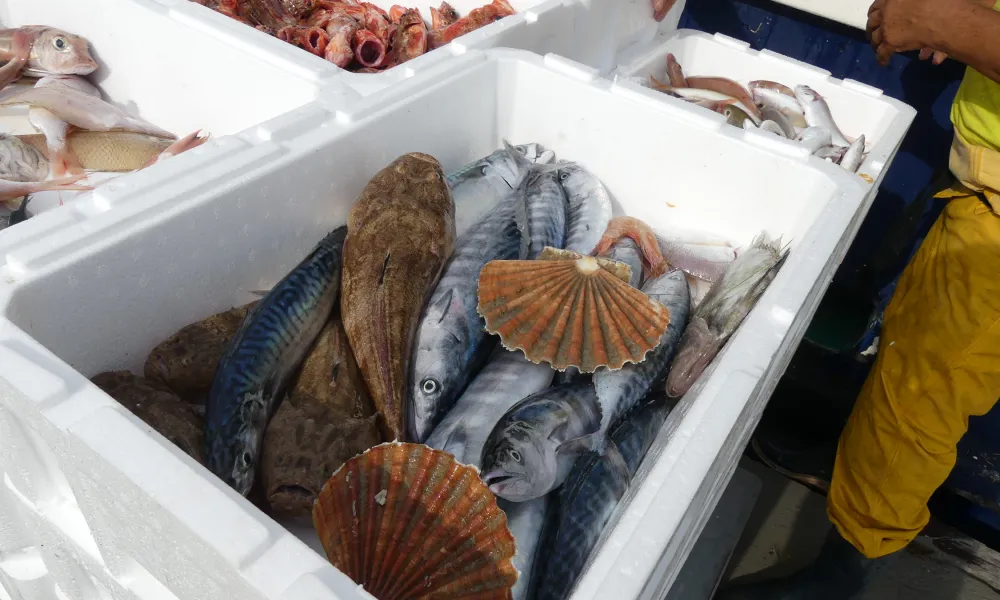

Despite EU rules that have been in force since 2019, large quantities of unwanted catches continue to be discarded at sea, often without being recorded, according to a new study jointly prepared by Oceana and the Environmental Justice Foundation (EJF), two leading international non-governmental organisations working to protect marine ecosystems, combat overfishing and promote sustainable ocean policies.
This has implications for the sustainability of fish stocks, the reliability of scientific data and fishermen who comply with the rules, Javier López, Sustainable Fisheries Campaign Director at Oceana Europe, says in an interview with Politis. Similar problems also affect bottom trawl fisheries in the Mediterranean, including in Cyprus, mainly due to the catching of juvenile fish.
The study sets out a number of specific solutions, including supporting fishermen in avoiding unwanted catches, using new technologies to monitor fishing activity, and strengthening transparency and enforcement.
“Cyprus should build on the experience gained through the Department of Fisheries and Marine Research’s pilot Remote Electronic Monitoring (REM) programme and develop a transparent national plan based on risk assessment,” Javier López notes.
The publication of the study comes at a critical moment for the future of the EU’s Common Fisheries Policy (CFP), following the European Commission’s announcement last month of its “Vision 2040 for Fisheries and Aquaculture.”
1. Landing obligation has been fully in force since 2019. More than five years on, what are the main findings of your research? Why does its implementation remain problematic?
Our main finding is that the Landing Obligation remains necessary but has not delivered the expected results. There has been no clear large-scale reduction in discarding, and the uptake of more selective fishing techniques remains limited.
The biggest problem is the lack of reliable, verifiable information about what vessels catch, retain, release and land. The rule has too often been treated as an obligation governing what happens after fish are caught, rather than as a policy that should help fishers avoid unwanted catches in the first place.
2. What are the consequences of this failure to comply with the rules?
When catches that should be retained and reported are illegally discarded or underreported, part of the real fishing mortality disappears from the official data. This makes scientific assessments less reliable and makes it harder to set appropriate measures to manage stocks sustainably.
Discarding is also a profound waste of marine resources. Fish may be returned to the sea dead or unlikely to survive, without contributing to food security or the economy. This is difficult to justify, both ethically and in a context where EU production covers only around 38% of the seafood consumed in Europe.
3. How widespread do you believe non-compliance is across the EU today, and which fishing areas face the greatest challenges?
It is impossible to give a reliable EU-wide percentage, and that information gap is part of the problem. While Commission audits identify illegal and undocumented discarding as a serious risk across the EU, the low number of detected infringements should not be mistaken for widespread compliance, as routine inspections rarely witness discarding at sea.
The greatest challenges arise in mixed demersal fisheries, where several species are caught together. Particularly concerning discard estimates have been reported for Irish Sea haddock and eastern English Channel plaice. Mediterranean bottom-trawl fisheries also face significant problems, especially concerning juvenile fish.
4. You argue that the legislation does not need to be revised but rather enforced more effectively. Where do you see the biggest shortcomings? In monitoring and inspections, penalties or political will?
All three are connected, but the most immediate weakness is monitoring. At-sea inspections provide only a brief snapshot, while landing inspections cannot reveal what happened during the trip. Without hard evidence, infringements are difficult to investigate and sanction.
Penalties on paper achieve little when the risk of detection is minimal. Ultimately, political will is needed to invest in monitoring, allocate sufficient enforcement resources and act consistently when evidence of non-compliance is found.
5. How can we strike a balance between protecting fish stocks and ensuring the economic viability of professional fishers?
In the long term, these objectives are inseparable: healthy fish populations are the foundation of viable fishing businesses. To address the short-term costs associated with the transition, the priority should be to help fishers avoid unwanted catches through selective gears, appropriate mesh sizes, real-time information and temporary closures. Fishers should receive technical assistance and targeted public funding to adopt proven solutions.
6. Cyprus is a small Mediterranean country with a predominantly coastal fishing sector. Are there particular challenges for countries of this size when it comes to implementing the landing obligation?
Yes. Around 95% of Cypriot vessels are under 12 metres. Small boats have limited space for sorting and storing unwanted catches, while monitoring costs can be proportionally greater.
Cyprus also has a diverse, multispecies Mediterranean fishery. Correct species identification, reporting undersized catches and monitoring numerous small vessels is challenging. However, the country’s size can also be an advantage: authorities, scientists and fishing communities can work together and test locally adapted solutions. Requirements should therefore be proportionate to vessel size, gear and risk.
7. What steps would you recommend the Cypriot authorities take to improve data collection and ensure greater compliance?
Cyprus should build on the Remote Electronic Monitoring pilot already undertaken by its Department of Fisheries and Marine Research and develop a transparent, risk-based national plan. This should identify the fisheries, gears, species and areas where unwanted catches, sensitive-species bycatch or incomplete reporting present the greatest risks.
Priorities should include better digital catch reporting, representative landing-site sampling, collaborative data collection with fishers and cross-checking catch, location and landing information. Authorities should also provide practical training on species identification and reporting requirements, publish annual enforcement results and use available EU funding to support selectivity, data collection and proportionate monitoring.
8. Your study recommends the use of new monitoring technologies. Which specific technologies are you referring to?
For much of the EU fleet, particularly vessels presenting a high risk of non-compliance, the main tool is remote electronic monitoring. REM combines onboard cameras with vessel-position and gear-sensor data, creating a verifiable record of fishing operations and catch handling. From January 2028, it will be mandatory for EU vessels of 18 metres or more that are assessed as high risk.
Cyprus requires a more tailored approach. As most of its fleet consists of small coastal vessels, installing extensive camera and sensor systems on every boat would be difficult, costly and often impractical. Instead, digital catch-reporting applications, coastal surveillance, targeted inspections and drones may be more proportionate for much of the fleet. Drones cannot see everything happening onboard, but they can help identify suspected discarding and direct inspections in coastal areas.
9. What message does your study send in the context of the ongoing debate over a possible revision of the Common Fisheries Policy?
Failure to implement a rule is not evidence that the rule should be weakened. The objectives of the Landing Obligation, reducing waste, encouraging selective fishing and documenting fishing mortality, remain essential.
The CFP already provides the main tools needed. The priority is to apply them properly by supporting selectivity, improving catch documentation, implementing REM and ensuring credible enforcement. Reopening the Basic Regulation could consume years of political attention without addressing these practical failures. The immediate challenge is implementation and accountability, not lowering environmental ambition.
10. If the situation does not improve in the coming years, what will be the consequences for European fish stocks?
Undocumented discarding means that fish caught and thrown back into the sea disappear from official records, leaving a blind spot in our understanding of how many fish are being removed from the sea.
Over time, this increases the risk of overfishing, delays stock recovery and put vulnerable populations at further risk. The consequences would ultimately include smaller and less predictable catches, lower incomes for fishing communities, greater dependence on seafood imports and reduced confidence in EU fisheries management.