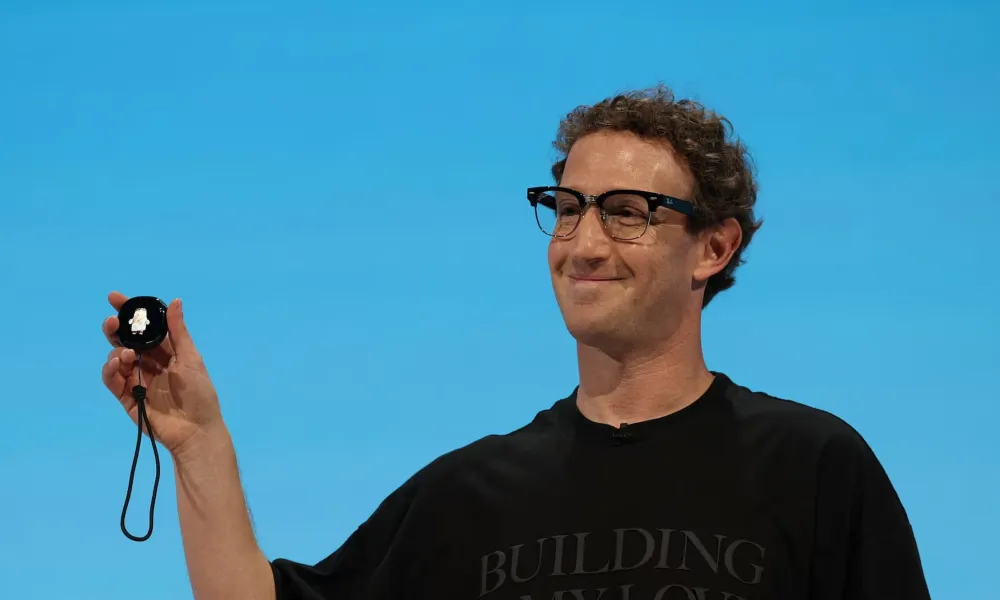

Meta has unveiled a small device, roughly the size of a pocket watch, that gives users one-touch access to its AI assistant Muse without opening an app on their phone. The launch marks a new step in the company's long-running effort to reduce its dependence on the ecosystems controlled by Apple and Google.
Launch at Meta Connect
The device, called Muse Charm, was presented by Meta founder and CEO Mark Zuckerberg at the company's annual Meta Connect conference on Wednesday.
Mr Zuckerberg used the event to take several swipes at Apple, but the biggest surprise came with the reveal of the device itself, in a presentation that recalled Steve Jobs' landmark product launches.
How Muse Charm works
Muse Charm has a screen of around two inches (five centimetres), which users navigate with their thumb. A customisable Muse character appears at the centre of the display.
The device includes a built-in 5G modem, allowing access to Muse without a Wi-Fi connection. It does not support phone calls.
Meta's bid for its own platform
The launch forms part of Meta's long-term goal of building its own technology platform, reducing its reliance on the operating systems run by Apple and Google.
From the metaverse to "personal superintelligence"
A few years ago, Mr Zuckerberg invested heavily in the metaverse as the next major computing platform. After that costly bet failed to deliver as expected, he now sees "personal superintelligence" as the next big technological shift.
Speaking at Meta Connect, he said it was now clear that personal superintelligence would not only arrive sooner but also matter far more.
He said Meta had refocused its efforts on developing the best possible devices for this new era, adding that Muse would soon be integrated across the company's entire range of smart glasses.
A strong start for Muse
The announcements come as Muse is gaining considerable momentum. The assistant has recorded millions of downloads within a few days, with some analysts estimating it may be the biggest app launch in the US since ChatGPT in November 2022, which sparked the current AI boom.
Markets have also reacted strongly. Investors see potential in Muse's ability to automate everyday tasks, such as booking flights or even filing tax returns.
That optimism has lifted shares of partner companies such as Shopify, while companies seen as potentially threatened by the spread of such applications have come under pressure, including Booking and Intuit, the company behind TurboTax software.
Targeting Gen Z
Analysts believe Muse Charm could find particular appeal among younger consumers, at a time when older devices such as digital cameras, flip phones and MP3 players are returning to fashion on a wave of nostalgia.
Gen Z, consumers aged roughly 14 to 29, appears to use AI tools differently from older age groups. Rather than treating them only as search engines, they often use them as conversation partners, collaborators or tools for generating ideas.
Younger users are also more familiar with voice messages, short videos and AI chatbots, while older age groups tend to remain more comfortable with personal computers and traditional smartphone apps.
Linda Sui, founder of market research firm Smart Analytics Global, said Muse Charm could attract Gen Z and younger audiences generally, particularly because of its combination of AI, fashion and personalisation. She added that price and ease of use would play a decisive role.
Comparisons with the Tamagotchi
Jitesh Ubrani, a director at IDC, said Meta appears to be targeting consumers who do not want to use smart glasses or are uncomfortable with that category of device.
He compared the philosophy behind Muse Charm with the Tamagotchi, the small virtual pets that became a global cultural phenomenon in the late 1990s.
According to Mr Ubrani, a device of this size could also potentially run a small language model locally, enabling AI functions without always relying fully on the cloud.
Lessons from the Rabbit R1
Despite the initial enthusiasm, it remains to be seen whether Muse can sustain its momentum and whether Muse Charm will add to public interest. Experience with similar devices shows that success is not guaranteed.
One example is the Rabbit R1, a handheld generative AI device with a screen and a single button, made by startup Rabbit Inc. It launched to considerable publicity in early 2024, but its performance was disappointing, as it was seen to have promised more than it could deliver and suffered from reliability problems.
Questions over mass-market appeal
Ms Sui is cautious about whether Muse Charm can reach a mass audience. She said that to move beyond being an interesting gadget for early adopters, it would need to offer functions that cannot easily be replaced by smartphones, smartwatches, headphones or smart glasses.
Otherwise, she said, it is more likely to remain a complementary device for a limited audience than to become a mass-market product.