Late on Sunday evening, 24 May, political parties will know the final results of the legislative elections and their actual percentages, clarifying which forces enter the House of Representatives and which do not. By Monday morning at the latest, a definitive picture of seat distribution will emerge. From that exact moment, serious calculations will begin regarding the necessary political alliances required to elect the next president of parliament. Consultations among the newly formed parliamentary parties must be completed within the ten days leading up to the inaugural plenary session on 4 June, which will elect the head of the legislative body. Traditionally, alliances for the house presidency are viewed as a precursor to the subsequent presidential elections.
The current landscape
Despite efforts by party leadership to keep their cards close to their chests, the current political landscape and ideological proximity between key forces offer certain clues. For instance, the right-wing Democratic Rally (DISY), the centrist Democratic Party (DIKO), and the centrist Democratic Alignment (DEPA) find common ground on numerous issues. Conversely, the left-wing Progressive Party of Working People (AKEL) has maintained a visible presence at public demonstrations alongside officials from the progressive Volt and the Green Movement. This mutual understanding and alignment on critical issues frequently shapes the framework for broader political cooperation.
Predicting the behavior and intentions of Fidias Panayiotou’s Direct Democracy remains exceptionally difficult. The MEP does not operate through conventional political methods, meaning all scenarios remain on the table. However, the trajectory of the newly formed ALMA movement presents less of a riddle. Although its leader, former Auditor General Odysseas Michaelides, responded sharply to accusations made by AKEL leader Stefanos Stefanou during the televised leaders' debate on Omega—creating a significant rift between the two sides—an alliance between Michaelides' party and DIKO or DISY is considered highly improbable.
Meanwhile, the far-right ELAM remains in political isolation. Nevertheless, it appears poised to secure third place and a significant number of parliamentary seats, a development that could create the conditions for a partial lifting of its political exclusion and pave the way for tactical partnerships regarding the house presidency.
Declared intentions of party leaders
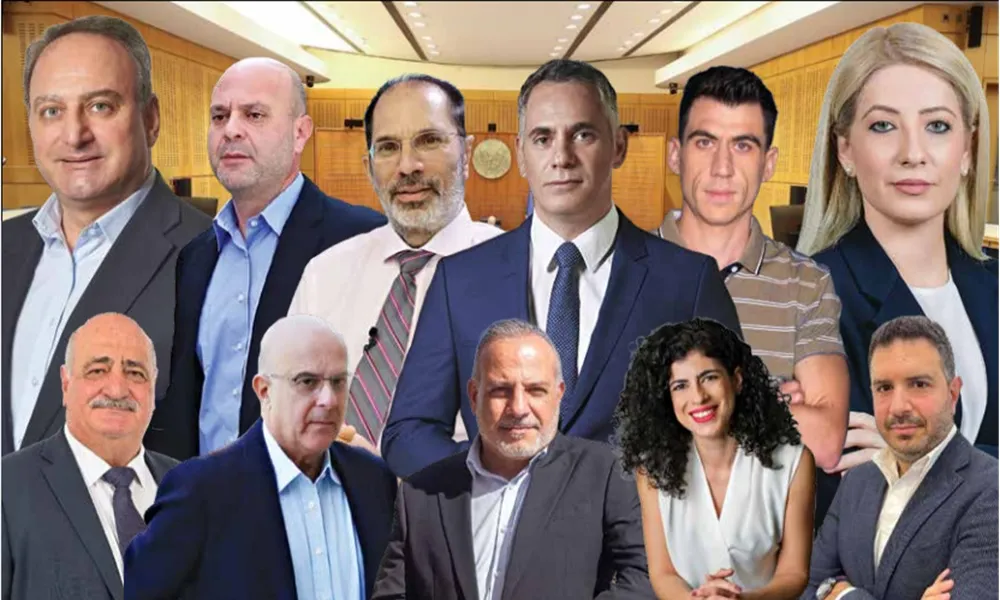
Beyond ideological proximity, the explicit intentions of certain party leaders are already steering the debate. Annita Demetriou, the current house president and leader of DISY, recently stated that she has never hidden her interest in seeking re-election to the post. On Thursday, AKEL General Secretary Stefanos Stefanou noted that the left-wing party does not rule out launching a bid for the house presidency, though he did not clarify who the candidate would be under such a scenario.
DIKO President Nicolas Papadopoulos has avoided expressing explicit interest in the office, yet his name is being heavily discussed as part of a potential coalition among center-right forces. On the other hand, the leader of ALMA has no desire to contest the post. A senior party official stated that Odysseas Michaelides intends to focus exclusively on building ALMA's organizational structure the day after the vote. Michaelides has previously stated that AKEL MP Irene Charalambides represents an excellent choice for the position.
Political fragmentation and tactical vetoes
The party system is heading toward severe fragmentation. The potential entry of nine or ten parties into parliament creates conditions of political chaos, compounded by numerous smaller factions remaining outside the legislature. This unprecedented environment does not favor the establishment of stable, long-term alliances. Consequently, cooperation for the house presidency is unlikely to serve as the traditional chessboard for the 2028 presidential elections. Instead, the process is expected to be dictated by logic of exclusion rather than cooperation, with short-term tactical strategies prevailing over long-term presidential planning. Nonetheless, these maneuvers will serve as a testing ground for potential political fronts and the intentions of new political actors.
Our current knowledge reveals far more about what combinations parties rule out rather than their actual blueprints:
-
DISY explicitly excludes any cooperation with AKEL or ELAM, while a partnership with ALMA remains highly far-fetched.
-
AKEL rules out working with ELAM or DISY but remains open to dialogue with all other political forces.
-
DIKO is the sole party rejecting the logic of automatic exclusions regarding the house presidency. However, the fierce campaign clash with Odysseas Michaelides casts doubt on any eventual cooperation between DIKO and ALMA. Michaelides has explicitly ruled out ALMA supporting Nicolas Papadopoulos, Annita Demetriou, or ELAM leader Christos Christou, while remaining open to backing a potential candidacy of Stefanos Stefanou.
-
Volt will refer the matter to its Political Council immediately after the vote, though any cooperation with ELAM is completely off the table. Partnerships with other forces remain possible under specific conditions, though conservative candidates face reduced prospects of securing Volt’s backing. In this volatile environment, the potential re-election of Alexandra Attalides might serve as a bridge to facilitate cooperation between AKEL and ALMA following their recent falling out.
-
EDEK excludes cooperation with ELAM and faces serious friction regarding a potential endorsement of Nicolas Papadopoulos due to the high-profile party defection of MP Andreas Apostolou.
-
DEPA is also unlikely to back the DIKO leader following the defection of MP Michalis Giakoumi, while completely ruling out ELAM. Reports indicate that the day after the election, EDEK President Nikos Anastasiouwill seek a joint meeting with the leaders of DEPA and the Green Movement to propose forming a unified parliamentary group to maximize their collective legislative leverage. The Greens exclude ELAM and remain open to other forces, focusing heavily on the individual personality of candidates rather than party labels.
ELAM’s critical role
The role of ELAM in the election of the house president is shaping up to be critical, if not decisive. A potential alliance between DIKO and DISY backing Nicolas Papadopoulos would present ELAM with an opportunity to break its political isolation by supporting the centrist leader. A senior ELAM official stated that there is zero chance the party would back an AKEL candidate, raising the possibility that ELAM might field its own candidate for the presidency.
While emphasizing that no final decision has been made, the official stressed that ELAM demands a house president who treats all parties equitably. The official clarified that ELAM excludes supporting Annita Demetriou specifically, rather than DISY as a whole, warning that if other forces ignore their strength, ELAM will reciprocate. Furthermore, the party intends to assertively claim the chairmanships of regular parliamentary committees proportional to its elected strength, pointing out that it held no mainstream committee chairs in the outgoing legislature.
Institutional significance
The election of the house president is linked to the presidency of the republic in another profound way. Beyond party bargaining, the occupant of the post frequently emerges as a central figure in future presidential calculations.
The president of the parliament is the second-ranking state official in the Republic of Cyprus, succeeding the president in the institutional hierarchy. Elected during the first plenary session of a new legislative term, the house president serves as the acting president of the republic during the head of state's absence, illness, or in the event of a vacancy. The holder of the office directs parliamentary proceedings, ensures the smooth functioning of the legislature, and represents the body in high-level international diplomacy. It is a position of immense institutional prestige that has historically served as a stepping stone to the highest office in the land, as demonstrated by the political trajectories of Spyros Kyprianou and Demetris Christofias, both of whom served as house presidents before being elected president of the republic.