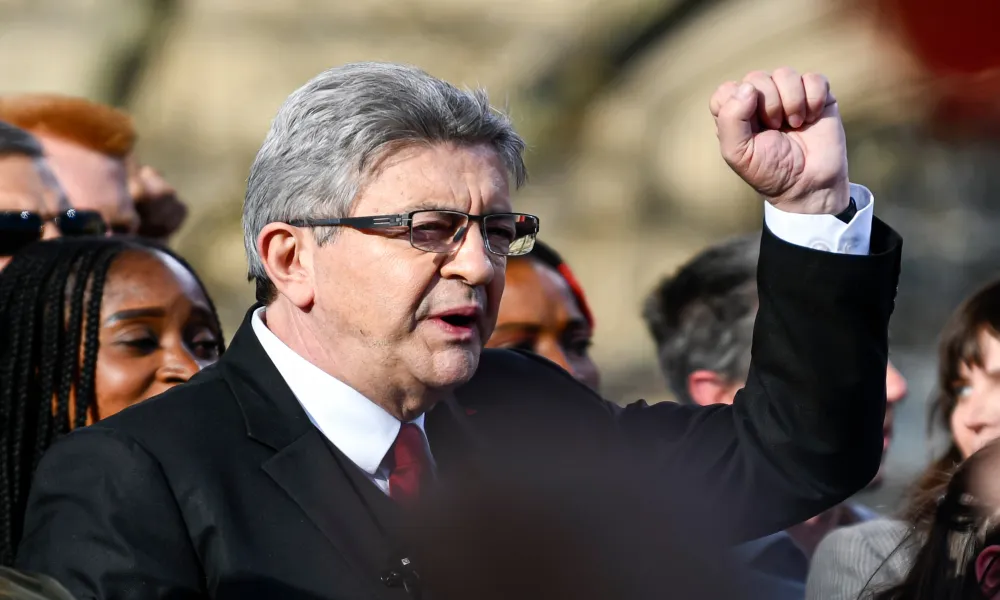

Jean-Luc Mélenchon’s La France Insoumise (France Unbowed) has published a presidential programme proposing that France leave NATO and that major defence companies be nationalised. The 222-page document, released on Friday ahead of the 2027 presidential election, sets out two stages. France would first withdraw immediately from NATO’s military command structure and then gradually leave the alliance itself.
🔴️️️️️️ Notre programme, l’Avenir en commun, est disponible ! Faites comme Manuel Bompard : prenez une photo avec et partagez-la sur les réseaux avec le #ProgrammeLFI ! Et retrouvez-le dès maintenant en librairie ou commandez-le en ligne : https://t.co/zcUpEDS8mH https://t.co/ipdb6Lx78C
— La France insoumise (@FranceInsoumise) November 6, 2026
A two-stage withdrawal from NATO
The programme makes the immediate exit from NATO’s integrated military command its first step. A gradual withdrawal from the alliance would follow.
If carried out, the move would reverse a long-standing element of French policy. France left NATO’s integrated military command in 1966 under President Charles de Gaulle and returned to it in 2009 under President Nicolas Sarkozy. Mr Mélenchon has repeatedly criticised that reintegration.
Rejection of the 5% defence spending target
The party rejects the United States’ demand to raise defence spending to 5% of GDP, describing it as “tribute”.
🇫🇷 Liberté, Égalité, Solidarité. Découvrez notre nouvelle affiche de campagne ! Ce n’est pas une nouvelle devise, c’est notre slogan, et il dit tout de notre programme qui sort aujourd’hui en librairie. La solidarité est au cœur de notre campagne. Ensemble, construisons une société de l’entraide plutôt que celle de la compétition généralisée et du chacun pour soi ! (Pour les curieux, c'est Gergovie en fond)
— Jean-Luc Mélenchon (@JLMelenchon) November 6, 2026
NATO allies agreed the 5% commitment at the alliance’s summit in The Hague in June 2025, split between core defence spending and wider defence-related investment.
Continued assistance to EU member states
The programme states that a government led by Mr Mélenchon would continue to provide assistance to European Union member states on the basis of the European treaties. The position is consistent with statements the French politician has previously made to Politico.
The EU treaties include a mutual assistance clause, Article 42(7) of the Treaty on European Union, which obliges member states to aid and assist a member state that is the victim of armed aggression on its territory. The clause is particularly relevant for EU members that are not part of NATO, such as Cyprus.
Ukraine and the wider race
Recent polls place Mr Mélenchon second ahead of next year’s election, which will choose a successor to President Emmanuel Macron. Mr Macron cannot run for a third consecutive term. The 2027 race will be Mr Mélenchon’s fourth presidential bid. He took 11.1% of the vote in 2012, 19.58% in 2017 and 21.95% in 2022, when he finished third.
Under the French electoral system, the two candidates with the most votes in the first round go through to a second round. One possible scenario is a contest between Mr Mélenchon and Marine Le Pen, leader of the French far right, who also supports France’s withdrawal from NATO’s integrated military command.
Unlike Ms Le Pen’s party, La France Insoumise does not explicitly propose ending military aid to Ukraine. Instead, it stresses the need for a diplomatic solution. It says any peace agreement should rest on collective security guarantees, both between the warring parties and with the involvement of the rest of Europe.
Arms regulation and space
The NATO proposal comes with plans for stricter regulation of the arms sector, including lethal autonomous weapons systems and nuclear weapons.
The party also opposes an arms race in space and proposes closing NATO’s space centre in Toulouse. At the same time, it argues that France must strengthen its own capabilities to safeguard its sovereignty, going as far as proposing that the country acquire a space shuttle.
The programme also backs the French aerospace industry and refers to Dassault Aviation’s Vortex reusable spaceplaneprogramme.
Nationalisation and defence technology
The document places particular emphasis on developing critical military capabilities such as communications, intelligence and logistics. Europe still depends heavily on the United States for these through NATO. “Their production must be a priority,” the programme states.
Macron t’es foutu, le peuple est dans la rue. https://t.co/G6TzEqHGeh
— Jean-Luc Mélenchon (@JLMelenchon) November 5, 2026
La France Insoumise also seeks to nationalise some of the country’s most important defence companies, including ArianeGroup.
According to a member of parliament from the party speaking to Politico, a more detailed programme focused specifically on defence policy is expected to be published in the coming period.
With information from Politico