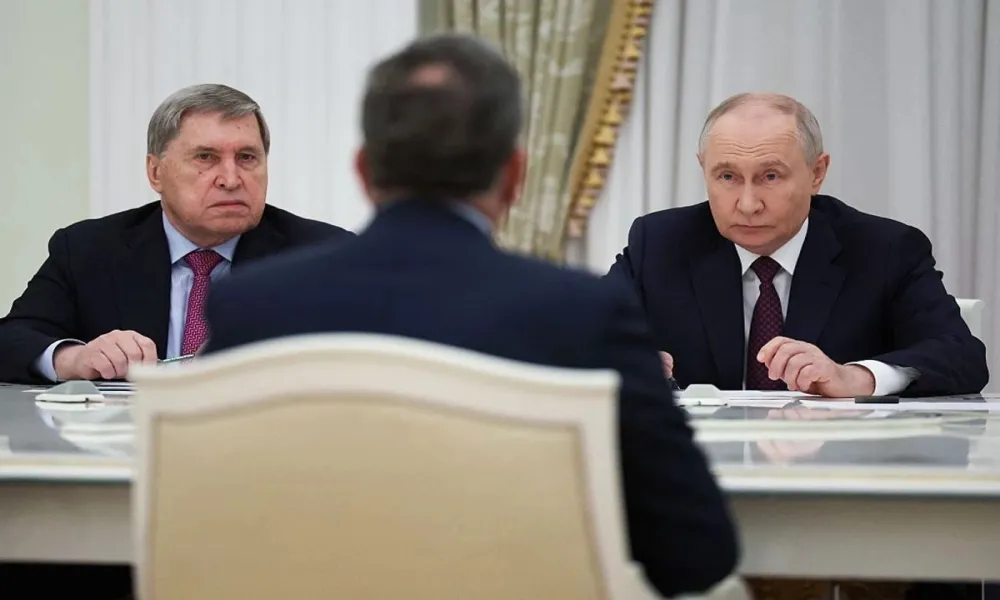

Russian President Vladimir Putin has agreed to allow European representatives to take part in the next round of peace talks on Ukraine, according to US envoy Steve Witkoff, who spoke after their meeting at the Kremlin on Thursday, 12 November. However, Moscow has not confirmed the agreement, and on Friday it set conditions for Europe’s participation in the negotiations.
Witkoff: Europeans will take part
“The Europeans will participate in the next meeting. We consider this a very important development, because they are our partners and we want them to take part,” Mr Witkoff told Russian state television.
Mr Witkoff and Jared Kushner, also an envoy of US President Donald Trump, had met Mr Putin in Moscow earlier.
Kremlin: no final decision yet
On Friday, 13 November, Kremlin spokesman Dmitry Peskov made clear that no final decision has yet been taken on European participation.
“When we understand their real intentions and their willingness to contribute to the peace process, then we will be able to decide on holding talks with broader participation,” he said.
Mr Peskov added that Moscow is open to preliminary contacts with European officials, but that no specific discussions have taken place yet. This position contrasts with the statements of the US envoys, who presented European participation as agreed.
Putin’s warnings to Europe
During the Kremlin meeting, Mr Kushner told Mr Putin that Washington sees a significant change in the stance of European governments and believes their participation will not hinder progress in the negotiations.
The Russian president said Moscow had never ruled out dialogue with Europe. “It was not us who broke off dialogue with the European Union. They broke off dialogue with the Russian Federation,” he said.
He also warned that sending Western troops to Ukraine, even after a peace agreement is reached, could trigger a new conflict, as Russia would consider it a threat to its security.
.@SEPeaceMissions, @jaredkushner, and I met in Ireland following all the negotiations held this week. First, a humanitarian outcome – prisoners will be released, and we are counting on the largest prisoner exchange since the start of this war. The second outcome – we are involving European representatives even more actively in diplomacy so that they can have an equal seat at the negotiating table. Ukraine always defends the interests of all of Europe. Third, we are also preparing further multilateral meetings. Diplomacy will remain active. Thank you to everyone who supports Ukraine. Thank you, Steve and Jared, for the intensive communication. Thank you to Ireland for the excellent organization of the European Political Community Summit and for hosting our negotiations today. Glory to Ukraine!
— Volodymyr Zelenskyy / Володимир Зеленський (@ZelenskyyUa) November 12, 2026
“We would very much like you and the American administration as a whole to work with your European allies so that they finally decide what they want: peace or war in Ukraine,” Mr Putin said.
His adviser, Yuri Ushakov, described the current stance of European governments as “a recipe for endless war”.
EU response
EU foreign policy chief Kaja Kallas said on Friday that it is not for Russia to decide who will represent the European Union in the peace talks.
Focussing on Russia's demands on Europe’s security architecture risks shifting attention away from a ceasefire and walking into Moscow’s trap. While Russia keeps to its maximum demands, we should stick to our own. We have prepared these with EU Foreign Ministers. Europeans have to be present at talks, not just to attend, but to influence the outcome. My remarks at the informal European Council in Dublin ↓
— Kaja Kallas (@kajakallas) November 13, 2026
Zelensky calls for ceasefire talks
After their meeting with Mr Putin, Mr Witkoff and Mr Kushner travelled to Ireland, where they met Ukrainian President Volodymyr Zelensky, who was in Dublin for a European summit.
Mr Zelensky welcomed the prospect of European participation in the negotiations. He expressed hope that the next meeting would consider specific measures to reduce tensions and achieve a ceasefire.
“We decided to work on an agenda that will include de-escalation measures and some form of ceasefire. I hope we will have such an agenda,” he said.
Abu Dhabi talks and the territorial question
The new diplomatic contacts follow two days of talks between Russia, Ukraine and the United States in Abu Dhabi, the first direct negotiations with US mediation in nine months. Both sides acknowledged that some progress had been made, but no agreement was reached on the most important issues.
The main obstacle remains territory. Russia controls around one fifth of Ukraine and is demanding that Kyiv also give up the areas of the Donbas that remain under Ukrainian control. The Ukrainian government rejects this, while Mr Putin has shown no intention of scaling back his territorial demands.
Problems with Ukraine’s satellite communications
At the same time, Mr Zelensky said new restrictions on the use of the US Starshield satellite communications system are causing serious problems for Ukrainian forces. Starshield is the military version of SpaceX’s Starlink and is used by Ukraine for battlefield communications.
According to the Ukrainian president, the restrictions affect the entire front line, as well as areas under Russian control. He expressed concern that US decisions might treat Ukrainian territory as if it did not belong to Ukraine. SpaceX declined to comment.
Putin’s proposal for a humanitarian mission
In the talks with the US envoys, Mr Putin also proposed a joint Russian-Ukrainian humanitarian mission to Kostiantynivka, in eastern Ukraine.
The Russian president claimed that the city is under Moscow’s control. Kyiv disputes this and says it maintains a military presence in the area. According to Mr Putin, 400 to 500 residents remain in the city, and Russia would need five days to clear mines from the area so that humanitarian aid could be delivered.
Mr Ushakov said the US envoys responded positively to the proposal. Ukraine, however, has previously expressed fears that Russia may use temporary ceasefires for humanitarian missions to regroup its military forces.
With information from Reuters