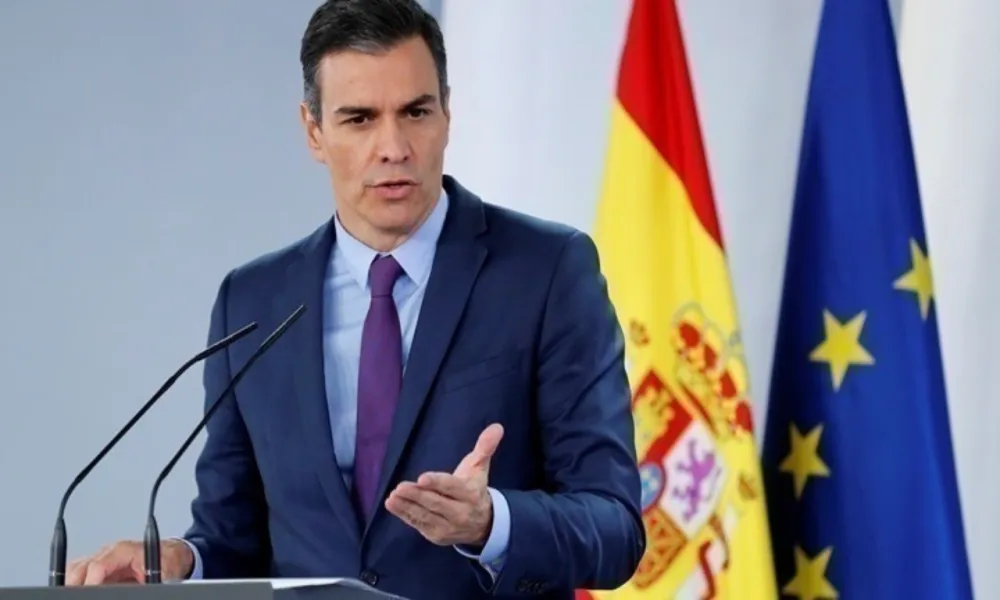

Spaniards vote on Sunday in snap parliamentary elections that could bring a far-right party into government for the first time since the country returned to democracy after the death of dictator Francisco Franco in 1975.
Poll after poll predicts that the conservative People's Party (PP) will finish first but without an outright majority, leaving it dependent on a deal with the far-right Vox. Together, the two parties are expected to secure a comfortable majority, well above the 176 seats needed in the 350-seat Spanish parliament.
Why early elections were called
The next election was scheduled for summer next year. Socialist Prime Minister Pedro Sánchez called early elections in October, after three right-wing and far-right parties voted down his government's emergency legislation to tackle the housing crisis.
Public anger over rents boiled over in September, following the eviction of María del Carmen Abascal, an 87-year-old woman forced out of her home in Madrid. She could not pay a 230% rent increase demanded by the investment fund that had bought her flat.
Facing nationwide protests, Mr Sánchez's minority coalition government drew up a package of measures to improve access to housing. It ranged from a ban on evictions until 2030 to rules on short-term lets and room rentals.
The proposals were blocked by the PP, Vox and the right-wing Catalan pro-independence party Junts. Mr Sánchez responded by calling an early election.
Sánchez confident of victory
The Prime Minister calculated that his opponents' decision to block the housing reforms could work in his favour at the ballot box. On Friday morning, he said he was certain of victory.
"I cannot imagine that we will lose," he told radio station Cadena SER, adding: "When progressive Spain gets going, it is unstoppable."
What the polls show
The Spanish Socialist Workers' Party (PSOE) has narrowed the gap with the PP, which leads in the polls, to less than three percentage points. Even so, the right appears likely to form the next government in coalition with the far right.
Even if the PSOE makes a last-minute surge and finishes first, the parliamentary arithmetic suggests it would find it difficult to form another coalition government with the support of its left-wing allies and regional nationalist parties.
Corruption allegations and the Ceuta crisis
According to The Guardian, making housing the main battleground allowed Mr Sánchez to try to move attention away from the corruption allegations facing his inner circle.
It also gave him a chance to move on from his government's heavily criticised handling of the crisis in Ceuta, the Spanish enclave in North Africa. The crisis began when around 80,000 people crossed into the territory from Morocco within 48 hours.
The impact of two deadly train crashes
Some of the momentum in the government's recovering campaign was lost in late October, when 69 people were killedin Spain's second deadly railway accident in just nine months.
The PP and Vox used the two accidents to accuse the government of failing in its basic duty to protect Spaniards. More broadly, both parties are treating the election as a referendum on what they dismissively call "Sanchismo". They argue that the style of government favoured by the Prime Minister and his allies is cynical, corrupt, opportunistic and self-serving.
Key statements from the television debate
"Spain deserves a decent prime minister, and [Sánchez] is not one," PP leader Alberto Núñez Feijóo told viewers during a televised debate between the two men last week.
Mr Sánchez insisted that, despite his mistakes, Spain is in a better position than when he took office in 2018. "My government has not been perfect; I have made mistakes," he admitted. "But I am also fully aware that we have always governed in the right direction."
Sánchez frames the vote as a choice of direction
Mr Sánchez has sought to present the snap election as a clear choice between progressive and regressive forces, as represented by a possible PP and Vox alliance.
"You must decide whether you want our country to go backwards or keep moving forward, and whether you prefer a government that works for the interests of the majority of society," he told Spaniards when he called the vote.
What the parties are promising
In recent days, the government has tried to highlight its commitment to social justice and equality, proposing a new tax on fortunes above €100 million. The money would fund childcare, housing and public services.
The PP is promising tax cuts, the construction of 1 million homes and to "restore the country's ambition and self-esteem".
Vox's programme focuses on deregulation, "remigration" and giving native-born Spaniards priority over those born abroad for housing and public services. It also includes plans to prosecute Mr Sánchez and his government "for treason and crimes against the security of the state" over Ceuta.
The PP's relationship with Vox
Former PP leader Pablo Casado openly rejected Vox and its ideology, accusing the party of practising politics based on "fear, anger and revenge". Even so, the PP has repeatedly formed regional coalition governments with Vox and now governs four of Spain's autonomous communities with it.
Claims about the integrity of the vote
In recent days, the PP and Vox have sought to question the integrity and transparency of the elections, making what The Guardian describes as unfounded claims that the government might attempt fraud in postal voting.
Vox leader Santiago Abascal also suggested, without providing evidence, that Mr Sánchez is working to undermine democracy and alter the country's demographic make-up.
With information from The Guardian